Pesticides Registration in Zimbabwe
Pesticides registration in Zimbabwe
Sondayi, L. (2019). Pesticides registration
Pesticides registration in Zimbabwe
Sondayi, L. (2019). Pesticides registration
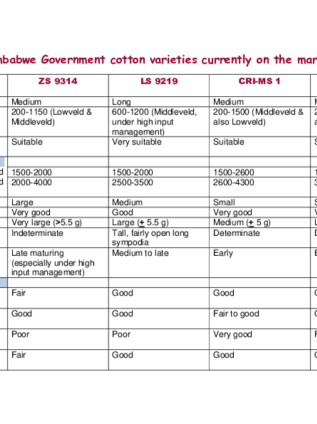
Cotton varieties in Zimbabwe.
Genetic Resources and Biotechnology
Sondayi. L.(2019). Genetic Resources and Biotechnology
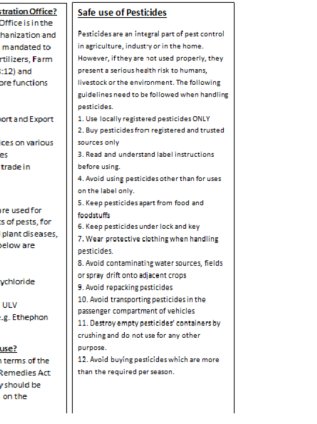
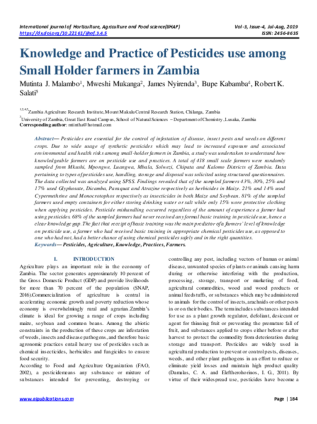
Pesticides are essential for the control of infestation of disease, insect pests and weeds on different crops. Due to wide usage of synthetic pesticides which may lead to increased exposure and associated environmental and health risks among small-holder farmers in Zambia, a study was undertaken to understand how knowledgeable farmers are on pesticide use and practices. A total of 418 small scale farmers were randomly sampled from Mkushi, Mpongwe, Luangwa, Mbala, Solwezi, Chipata and Kalomo Districts of Zambia. Data pertaining to types of pesticides use, handling, storage and disposal was solicited using structured questionnaires. The data collected was analyzed using SPSS. Findings revealed that of the sampled farmers 43%, 30%, 25% and 17% used Glyphosate, Dicamba, Paraquat and Atrazine respectively as herbicides in Maize. 21% and 14% used Cypermethrine and Monocrotophos respectively as insecticides in both Maize and Soybean. 81% of the sampled farmers used empty containers for either storing drinking water or salt while only 15% wore protective clothing when applying pesticides. Pesticide mishandling occurred regardless of the amount of experience a farmer had using pesticides. 68% of the sampled farmers had never received any formal basic training in pestic ide use, hence a clear knowledge gap. The fact that receipt of basic training was the main predictor of a farmers’ level of knowledge on pesticide use, a farmer who had received basic training in appropriate chemical pesticides use, as opposed to one who had not, had a better chance of using chemical pesticides safely and in the right quantities.
Malambo, M.J, Mukanga, M., Nyirenda, J., Kabamba, B., & Salati, K.R,. (2010). Knowledge and Practice of Pesticides use among Small Holder farmers in Zambia. International journal of Horticulture, Agriculture and Food science(IJHAF). pp184-190. Available at:https://dx.doi.org/10.22161/ijhaf.3.4.5 [05/09/2019]
Neste panfleto, poderá encontrar três novas variedades de amendoim, lançadas recentemente em Moçambique pelo IIAM (Instituto de Investigação Agrária de Moçambique) no contexto de um projecto financiado pelo APPSA, liderado pelo Dr. Amade Muitia. No geral, essas variedades são tolerantes a secas, manchas precoces / tardias e roseta e produzem cerca de 2,5 toneladas por hectare. Os nomes das variedades são Mapupulo-018, Amena-018 e AMM-018.
Muitia,A (2019)Principais características de 3 variedades de Amendoim libertadas em Moçambique. Maputo, Mozambique
In this flyer you will find 3 new groundnut varieties recently released in Mozambique by IIAM (Mozambique Agricultural Research Institute) under an APPSA funded project led by Dr. Amade Muitia. Overall, these varieties are tolerant to droughts, early/late leaf spots and rosette and yield around 2.5 tons per hectare. The names of the varieties are Mapupulo-018, Amena-018 and AMM-018.
Muitia.A(2019) Main traits of 3 new Groundnut varieties released in Mozambique, Maputo, Mozambique.
The Department of Agricultural Research (DAR) held a one-day workshop in Maseru, Lesotho
on the Integrated Pest Management Plan (IPMP) and the Environmental and Social Monitoring
Framework (ESMF) papers. These documents were submitted in compliance with the
Environmental Act of 2008 for application of environmental clearance for DAR’s research
project under APPSA. The objective of the workshop was to validate and review these two
documents.
Government of Lesotho. (2019). Lesotho Stakeholder Consultation Workshop on Environmental and Social Safeguards Under the Agricultural Productivity Programme for Southern Africa (APPSA). Maseru, Lesotho: Department of Agricultural Research.
¨Micronutrients are essential for plant growth and play an important role in balanced crop nutrition. They promote the strong ,steady growth of crops that produce higher yields and increase harvest quality- maximizing a plant’s genetic potential.
¨ Most micronutrients are immobile in soils and plants. There is therefore need to supply additional micronutrients to the soil.
Sondayi,l.(2019),Effects of micronutrients on maize grain yield and macronutrients uptake
.2019.[Onlone]Harare:20
¨Micronutrients are essential for plant growth and play an important role in balanced crop nutrition. They promote the strong ,steady growth of crops that produce higher yields and increase harvest quality- maximizing a plant’s genetic potential.
¨ Most micronutrients are immobile in soils and plants. There is therefore need to supply additional micronutrients to the soil.
Sondayi,l.(2019),Effects of micronutrients on maize grain yield and macronutrients uptake
.2019.[Onlone]Harare:20
In Zimbabwe, KRG is grown in rotation with tobacco and irish potato to control the root knot nematode (Meloidogyne javanica). It is a good seed producer and the seed exported to mostly Arab countries that can hardly produce their own seed due to unfavourable climatic conditions.
Zana, Monica M. (2018). CHARACTERISTICS OF WEEDS COMMONLY FOUND IN KATAMBORA RHODES GRASSES SEED PRODUCTION IN ZIMBABWE. DR&SS. Harare, Zimbabwe.