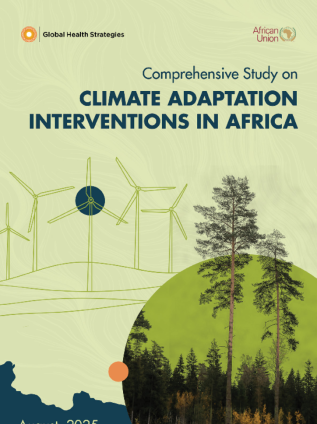
The Comprehensive Study on Climate Adaptation Interventions in Africa

Type
File
Date of Publication
Feb 25, 2026
Description/Abstract

Africa faces escalating climate risks that threaten livelihoods, ecosystems, and hard-won development gains. In response, the African Union (AU), Member States, and partners are advancing Locally Led Adaptation (LLA) as a cornerstone for building resilience and climate justice. Yet, adaptation efforts remain fragmented, unevenly financed, and dominated by external priorities. This study, commissioned by the Global Health
Strategies (GHS) in partnership with the AU Commission’s Sustainable Environment and Blue Economy Directorate, maps, analyzes, and synthesizes scalable and inclusive LLA models across Africa to inform member states’ positioning under the AU Climate Strategy (2022–2032), and Agenda 2063.

Author or Institution as Author
Africa Union
Language
Category
Citation

African Union (2025), The Comprehensive Study on Climate Adaptation Interventions in Africa,Pg51, Addis Ababa

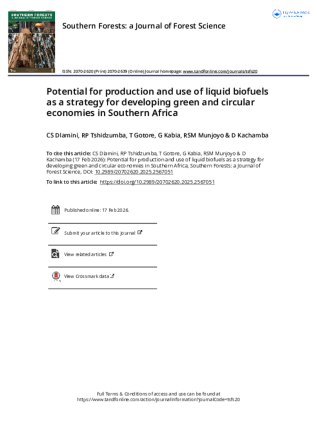
Potential for production and use of liquid biofuels as a strategy for developing green and circular economies in Southern Africa

Type
File
Date of Publication
Feb 20, 2026
Description/Abstract

The Southern African Development Community (SADC) responded to global calls to address environmental challenges such as high greenhouse gas (GHG) emissions through the use of liquid biofuels. This study assessed the potential of liquid biofuel production in the SADC region with data collected in Malawi, Mozambique, South Africa and Zimbabwe. The results showed that the liquid biofuel industry is struggling. Countries do not have enough resources to support the industry effectively and there is overreliance on international sponsors. In terms of policy and regulatory frameworks most countries are doing well. However, these policies are not implemented effectively. Most countries use sugar-cane to produce bioethanol. Over the years countries, such as Malawi, have attempted to incorporate crops such as cassava (Manihot esculenta) and castor bean (Ricinus communis). Although the industry is not performing well it has contributed massively to livelihood development in all the region

Author or Institution as Author
Prof Cliff Dlamini
Co-authors

RP Tshidzumba, T Gotore, G Kabia, RSM Munjoyo & D Kachamba

Language
Category
Resource Type
Citation

CS Dlamini, RP Tshidzumba, T Gotore, G Kabia, RSM Munjoyo & D Kachamba (17 Feb 2026): Potential for production and use of liquid biofuels as a strategy for developing green and circular economies in Southern Africa, Southern Forests: a Journal of Forest Science, DOI: 10.2989/20702620.2025.2567051

Contact Information

* Corresponding author: CDlamini@ccardesa.org.

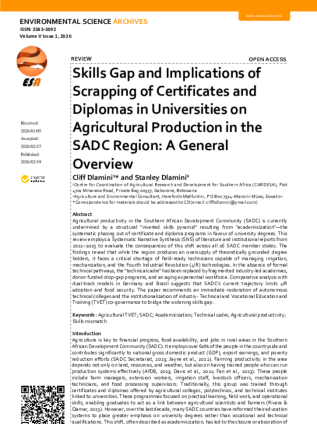
Skills Gap and Implications of Scrapping of Certificates and Diplomas in Universities on Agricultural Production in the SADC Region: A General Overview

Type
File
Date of Publication
Feb 20, 2026
Description/Abstract

Agricultural productivity in the Southern African Development Community (SADC) is currently undermined by a structural "inverted skills pyramid" resulting from "academicization"—the systematic phasing out of certificate and diploma programs in favour of university degrees. This review employs a Systematic Narrative Synthesis (SNS) of literature and institutional reports from 2021–2025 to evaluate the consequences of this shift across all 16 SADC member states. The findings reveal that while the region produces an oversupply of theoretically grounded degree holders, it faces a critical shortage of field-ready technicians capable of managing irrigation, mechanization, and the Fourth Industrial Revolution (4IR) technologies. In the absence of formal technical pathways, the "technical cadre" has been replaced by fragmented industry-led academies, donor-funded stop-gap programs, and an aging experiential workforce. Comparative analysis with dual-track models in Germany and Brazil suggests that SADC’s current trajectory limits 4IR adoption and food security. The paper recommends an immediate restoration of autonomous technical colleges and the institutionalization of industry- Technical and Vocational Education and Training (TVET) co-governance to bridge the widening skills gap.

Author or Institution as Author
Prof. Cliff Dlamini
Co-authors

Mr. Stanley Dlamini

Language
Topic
Category
Resource Type
Citation

 Dlamini C and Dlamini S (2026) Skills Gap and Implications of Scrapping of Certificates and Diplomas in Universities on Agricultural Production in the SADC Region: A General Overview. Environmental Science Archives 5(1): 166-17

Contact Information

Centre for Coordination of Agricultural Research and Development for Southern Africa (CARDESA), Plot 4701 Mmaraka Road, Private Bag 00357, Gaborone, Botswana 2Agriculture and Environmental Consultant, Herefords Matfuntini, PO Box 7514-Manzini-M200, Eswatini *Correspondence for materials should be addressed to CD (email: cliffsdlamini@ymail.com)

The Impact of Scrapping of Certificates and Diplomas in Universities on the Performance of Forestry Sector: Regional and International Perspective

Type
File
Date of Publication
Feb 20, 2026
Description/Abstract

The forestry sector in the Southern African Development Community (SADC) is seeing fewer fieldready technical workers, even as university forestry programs grow. This paper looks at how putting more focus on academic forestry training has changed the workforce, operations, and skill development in the area. By systematically reviewing 15 documents from 2021 to 2025, like skills audits, qualification standards, industry reports, and global comparisons, this study puts together information about the topic. The results show a reversed skills situation, where there are too many university graduates but not enough technicians with practical, on-the-job skills. This issue has raised training expenses for employers, reduced how much they can produce, and slowed down the use of new forestry technologies. Looking at Europe and Latin America, we see that systems that keep separate technical training tracks in two-track education models do a better job at running things efficiently and letting workers move around easily. The paper ends by saying that bringing back diploma-level technical training inside a standard SADC Qualifications Framework, along with ways to recognize past learning and joint public-private management, is key to bringing back lasting, competitive forestry production in Southern Africa.

Author or Institution as Author
Prof. Cliff Dlamini
Co-authors

Mr.  Stanley Dlamini

Language
Topic
Category
Resource Type
Citation

Dlamini C and Dlamini S (2026) The Impact of Scrapping of Certificates and Diplomas in Universities on the Performance of Forestry Sector: Regional and International Perspective. EnvironmentalScience Archives 5(1): 115-126

Contact Information

1Centre for Coordination of Agricultural Research and Development for Southern Africa (CARDESA), Plot 4701 Mmaraka Road, Private Bag 00357, Gaborone, Botswana 2Agriculture and Environmental Consultant, Herefords Matfuntini Near New School, P.O. Box 7514-Manzini-M200, Eswatini *Correspondence for materials should be addressed to CD (email: cliffsdlamini@ymail.com)

H4H Communication and Visibility Plan

Type
File
Description/Abstract

The Centre for Coordination of Agricultural Research and Development for Southern Africa (CCARDESA) Herding for Health Knowledge Management (H4H KM) Project is aimed at contributing towards the improvement of livestock and rangeland management across the Southern African Development Community (SADC) region through documentation and dissemination of critical H4H information to a number of priority stakeholders who are making decisions and who directly involved in implementing livestock and rangeland management.

Institution
CCARDESA
Language
Topic
Category
Resource Type

Neglected and Underutilised Species (NUS): Potential for Food and Nutrition Security – a Knowledge Review

Type
File
Description/Abstract

Of the thousands of edible plant species estimated to exist worldwide, global food systems are currently domi-nated by only three crop species: rice, wheat and maize. These provide more than 50% of the world’s daily requirements of calories and protein and cover around 40% of global arable land [1]. Nearly 80%–90% of hu-man total dietary intake comes from just 12–20 species [2]. While the focus on high yielding crops has driven remarkable productivity gains, it has not always translated into improved food security or nutrition outcomes. Instead, it has increased the vulnerability to a variety of shocks, including climate change effects and extreme weather events. It also contributed to the erosion of agro-biodiversity and exacerbated the risks of crop fail-ures, ultimately reducing the resilience of food systems.

Language
Category
Resource Type

Regional Stakeholders (NARES) Sensitization of the Relevance of Foresight for Food Systems Training & Establishment of a Regional Hub in Zambia

Type
File
Description/Abstract

Food Systems provide a direct pathway to Sustainable Development Goals (SDG) achievement in particular in regard to food insecurity and poverty. Therefore, transforming Food Systems – making them more productive, competitive and resilient is key. At the same time, Food Systems resilience is threatened by conflicts, climate change, inflation (rising food, fertilizer, fuel prices) and also pandemics e.g. Covid 19. More crucially we are now in a “VUCA” world characterized by Volatility as reflected in the speed and turbulence of change, Uncertainty which means that outcomes, even from familiar actions are less predictable, Complexity due to the growing vastness of interdependencies in globally connected economies and societies and Ambiguity as conveyed in the multitude of options and potential outcomes from the many forces buffeting the world.

Language
Category
Resource Type

WOMEN & YOUTH IN AGRICULTURE KNOWLEDGE SHARING & EXCHANGE SYMPOSIUM

Type
File
Description/Abstract

The Centre for Coordination of Agricultural Research and Development for Southern Africa (CCARDESA) is a SADC subsidiary dedicated to coordinating regional cooperation in agricultural research and development. As part of its mandate, CCARDESA is implementing the CAADP-XP4 Programme on Gender, funded by the International Fund for Agricultural Development (IFAD) from 2019 to 2023. This program emphasizes the critical role of women and youth in achieving a science-led, climate-resilient agricultural transformation in Africa. It aims to empower women and youth-led organizations to actively participate in global climate issues, fostering stronger partnerships and enhancing the capacities of implementing countries to achieve gender equality and the program's intended outcomes.

Language
Category
Resource Type

National Knowledge Management, Data Capture, CCARDESA Themes and Monitoring/Reporting Malabo Commitments Training Workshop - Zimbabwe

Type
Description/Abstract

The meeting brought together a diverse group including government officials, researchers, media, agriculture specialists including farmer representatives and the private sector, development partners and academia to discuss and learn more about the African Union Comprehensive Africa Agriculture Development Programme (CAADP), the Malabo Declaration commitments and the Biennial Review Reporting, SADC regional frameworks on agriculture and knowledge management.

Language

National Knowledge Management, Data Capture, CCARDESA Themes and Monitoring/Reporting Malabo Commitments Training Workshop - Zambia

Type
File
Description/Abstract

The Workshop Moderator, Mr. Louis Chikopela from the Ministry of Agriculture asked for a volunteer to open the day’s proceedings with a word of prayer. Following the opening prayer, the Moderator then took the participants through the workshop programme and then requested participants to introduce themselves. Annex 3 provides the full list of workshop participants. Also present at this workshop was Dr. Frank Kayula, a representative of the National Association of Smallholder Farmers and a Board Member of the CCARDESA Board of Directors. The Moderator welcomed everyone to the workshop and called upon Mr. Mwanza for the welcoming remarks

Language
Category
Resource Type
Subscribe to Document

Funding Partners