Maize Regional Centre of Leadership Video on Provitamin "A" Maize Research
A video on Maize production in Malawi.
This Video provides step-by-step information on Bean Production to Malawian Farmers interested in Bean Production. Ms. Virginia Chisale, a bean breeder working at Chitedze Agricultural Research Station give details on bean varieties that are approved for production in Malawi. She also provide key agronomic recommendations to be followed by farmers to successfully grow their bean crop.
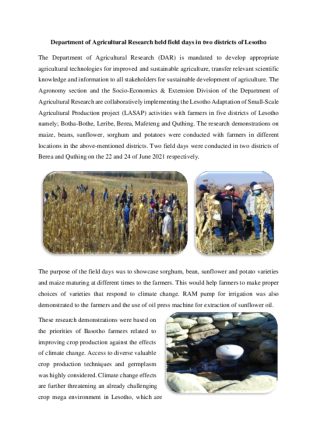
The Agronomy section and the Socio-Economics & Extension Division of the Department of Agricultural Research are collaboratively implementing the Lesotho Adaptation of Small-Scale Agricultural Production project (LASAP) activities with farmers in five districts of Lesotho.
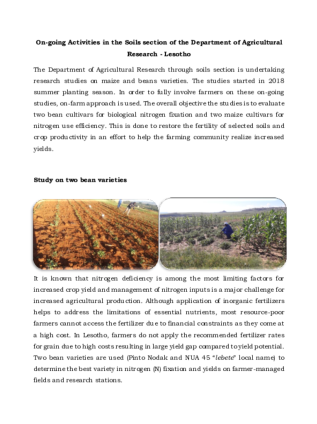
The Department of Agricultural Research through soils section is undertaking research studies on maize and beans varieties. The studies started in 2018 summer planting season. In order to fully involve farmers on these on-going studies, on-farm approach is used. The overall objective the studies is to evaluate two bean cultivars for biological nitrogen fixation and two maize cultivars for nitrogen use efficiency. This is done to restore the fertility of selected soils and crop productivity in an effort to help the farming community realize increased yields.
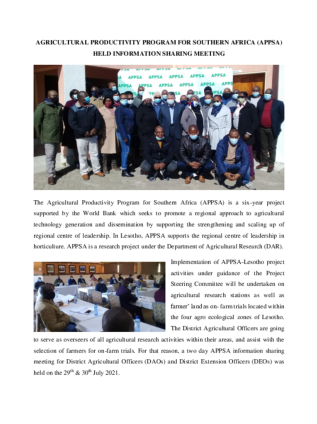
The Agricultural Productivity Programme for Southern Africa (APPSA)- is a project supported by the World Bank which seeks to promote a regional approach to agricultural technology generation and dissemination by supporting, strengthening and scaling up of regional centers of Regional Leadership on commodities of regional importance. APPSA is structured around four components of which one of them is technology generation and dissemination hence the reason for sub-projects that address this component.
Terms of reference
Budget allocation form
WAMPP is national in scope covering all of 10 Lesotho’s administrative districts, with a focus on the rangelands that cover more than two thirds of the country’s surface. The project pays special attention to poor rural women and young people with more emphasis on the foothills because there are more incidences of food insecurity.
Conservation Agriculture (CA) is currently widely recognized as a viable approach for sustainable agriculture due to its potentially comprehensive benefits of economic, environmental, and social sustainability. In response to the aforesaid, Tanzania Agriculture Research Institute (TARI) at Uyole Centre initiated intensive research on CA technology practices since 1999. The research started on-station and widened the geographical coverage of CA trials and promotions on-farm from two to 18 villages (Mkomwa et al., 2007) in Southern highlands of Tanzania. An onstation study was undertaken to evaluate influence of CA planting methods on labour, weed and maize yields. The study results show that use of tractor ripper, ox-direct seeder and ox-ripper had high yields of 8.5, 8.5 and 7.6 t/ha respectively compared to hand hoe (4.7 t/ha).
Mwakimbwala R1, Ngailo J1, Mlengera N1, Nyenza E2, Kabungo C 1, Mwalukasa E 2, Urio P 1, Kulwa B1 and Mwabenga (2018). Effect of Conservation Agriculture Planting Methods on Increasing Yield of
Maize: The Case of Southern Highlands Tanzania. 2ACCA Book of Condensed Papers - Final Draft 04.10.2018. https://africacacongress.org/generaldownloads/2acca-book-of-condensed-p…;
Agronomy research
Sondayi, L. (2019). Agromy Research