Agricultural Zoning and Recommendation of Pigeon Pea Cultivars in Mozambique

Type
File
Date of Publication
Nov 01, 2022
Description/Abstract

Pigeon pea is one of the important legumes for export and domestic consumption in Mozambique. The objective was to evaluate the performance of the genotypes and to stratify environments for agricultural zoning and subsequent recommendation. The experiments were conducted in the northern region of Mozambique, to evaluate grain yield, in randomized blocks, with three replications and 20 long-maturing genotypes, in the 2016/2017 season in four environments. The results were obtained through the joint analysis and the complementarity of information from the biometric methodologies of Eberhart and Russell, Centroid and GGE-biplot aiming at better use of the significant GXE interaction. A mega-environment (Nampula and Namapa) was observed, of which Namapa district was the most discriminating and representative. The genotypes suggested for a recommendation as cultivars showed average performance. The ICEAP01490 genotype was of specific adaptability to favorable environments (Nametil and Namapa district) and high stability, is recommended for medium to high technology environments and the ICEAP01498 genotype was of specific adaptability to unfavorable environments (Nampula and Montepuez district), is recommended for low technology environments. The ICEAP01409 genotype can be indicated for a general recommendation. The ideal genotype with high mean, general adaptability and high stability was not observed, suggesting evaluations in more environments.

Author or Institution as Author
Pedro, C.
Co-authors

Donça, M.C.B., Somueque, S. I., Barbosa, I. P., de Souza, J. E., Dique, J. E. L., Gimo, S. T., and Cruz, C.D

Language
Category

The Government of Mozambique Launches the Nutrition Education Program

Type
File
Date of Publication
Oct 01, 2022
Description/Abstract

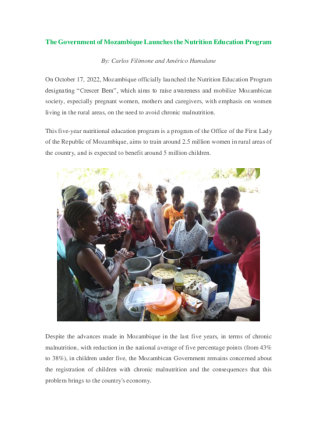
On October 17, 2022, Mozambique officially launched the Nutrition Education Program designating “Crescer Bem”, which aims to raise awareness and mobilize Mozambican society, especially pregnant women, mothers and caregivers, with emphasis on women living in the rural areas, on the need to avoid chronic malnutrition.

Author or Institution as Author
Carlos Filimone
Co-authors

Americo Humulane

Institution
INSTITUTO DE INVESTIGAÇÃO AGRÁRIA DE MOÇAMBIQUE (IIAM)
Category

Characterization of molecular features underlying drought tolerance in Mozambique´s drought tolerant maize (Zea mays L.) varieties

Type
Date of Publication
Oct 01, 2022
Description/Abstract

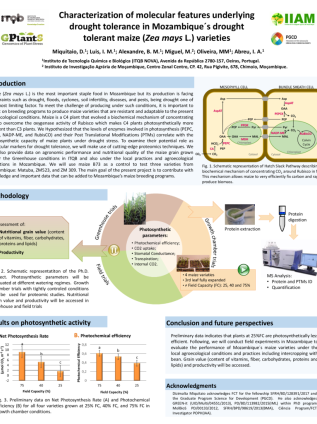
Maize (Zea mays L.) is the most important staple food in Mozambique but its production is facing constraints such as drought, floods, cyclones, soil infertility, diseases, and pests, being drought one of the most limiting factor. To meet the challenge of producing under such conditions, it is important to invest on breeding programs to produce maize varieties that are resistant and adaptable to the present agroecological conditions. Maize is a C4 plant that evolved a biochemical mechanism of concentrating CO2 to overcome the oxygenase activity of Rubisco, which makes C4 plants photosynthetically more efficient than C3 plants. We Hypothesized that the levels of enzymes involved in photosynthesis (PEPC, PPDK, NADP-ME, and RubisCO) and their Post Translational Modifications (PTMs) correlate with the photosynthetic capacity of maize plants under drought stress. To examine their potential role as molecular markers for drought tolerance, we will make use of cutting-edge proteomics techniques. We will also provide data on agronomic performance and nutritional quality of the maize grain grown under the Greenhouse conditions in ITQB and under the local practices and agroecological conditions in Mozambique. We will use maize B73 as a control to test three varieties from Mozambique: Matuba, ZM523, and ZM 309. The main goal of the present project is to contribute with knowledge and important data that can be added to Mozambique’s maize breeding programs.

Author or Institution as Author
Miquitaio, D
Co-authors

Luís, I. M.; Alexandre, B. M.; Miguel, M. ; Oliveira, MM ; Abreu, I. A.

Institution
INSTITUTO DE INVESTIGAÇÃO AGRÁRIA DE MOÇAMBIQUE (IIAM)
Language
Category
Citation

Miquitaio, D.; Luís, I. M.; Alexandre, B. M.; Miguel, M. ; Oliveira, MM ; Abreu, I. A. (n.d). Characterization of molecular features underlying drought tolerance in Mozambique´s drought tolerant maize (Zea mays L.) varieties

Influence of weaning management at 30, 75 and 180 days of age on non‐esterified fatty acids and reproductive performance in beef cows

Type
File
Date of Publication
Oct 01, 2022
Description/Abstract

This study aimed to investigate the effect of age at weaning of calves on non‐ esterified fatty acids (NEFA) and reproductive parameters of beef cows. Animals (n = 65) were randomly assigned to three treatments after calving: hyper‐early weaning (W30) at 32 ± 0.89 days, early weaning (W75) at 77 ± 0.95 days, and conventional weaning (W180) at 183 ± 0.82 days. Body weight (BW) and body condition score (BCS) were evaluated at parturition (AP) and at 30, 45, 64, 81, 100 and 115 days postpartum (dPP). Blood samples were collected to analyze NEFA levels and progesterone (P4) at 30, 45, 64 and 81 dPP. Higher BW and BCS were observed from 64 to 115 dPP in W30 cows than W180 ones (p < 0.05). Cows subjected to W30 condition had higher levels of NEFA at 30 dPP compared to 64 and 81 dPP (p < 0.05). We also observed that cows from W180 group showed decreased levels of NEFA at 30 dPP compared to 45 (p < 0.01) and 64 dPP (p < 0.05). The highest P4 level was observed at 64 dPP in W30 cows compared to W75 and W180 (p < 0.05). We also observed higher CR of W30 (86%) compared to W180 (47%) at 45 dPP (p < 0.05). The overall pregnancy rate (PR) was higher for W30 (95.5%) than W180 (73.9%). In addition, higher BW at calving and P4 levels at 30 dPP were positively correlated with the possibility of pregnancy (p < 0.05). Improvement in BW and BCS were observed in cows subjected to hyper‐early weaning management. However, levels of NEFA decreased as the postpartum period progressed. We concluded that cows who weaned calves hyper‐early have greater chances of increasing cyclicity and PRs.

Author or Institution as Author
Alforma, A. M. P
Co-authors

Pereira, G. R.; da Rocha, M. K. ;Teixeira, O.S.; Oliveira, M. C. M.; Lima, J.A.; Cumbe, T.A.; Barcellos, J.O.J

Language
Category
Citation

Alforma, A. M. P., Pereira, G. R., da Rocha, M. K., Teixeira, O. d. S., de Oliveira, M. C. M., Lima, J. A., Cumbe, T. A., & Barcellos, J. O. J. (2022). Influence of weaning management at 30, 75 and 180 days of age on non‐esterified fatty acids and reproductive performance in beef cows. Journal of Animal Physiology and Animal Nutrition, 1–11. https://doi.org/10.1111/jpn.13736

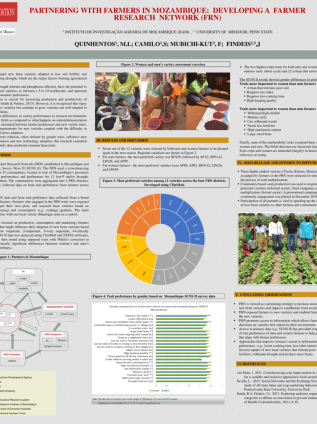
PARTNERING WITH FARMERS IN MOZAMBIQUE: DEVELOPING A FARMER RESEARCH NETWORK (FRN)

Type
File
Date of Publication
Oct 01, 2022
Description/Abstract

Agricultural scientists developed new bean varieties adapted to low soil fertility and extreme weather event including drought, which are the major factors limiting agricultural productivity in Mozambique. The new bean varieties are drought tolerant and phosphorus-efficient, have the potential to yield almost double that of local varieties, ie, between 1.5 to 3.0 ton/hectare, and represent different market classes and consumer preferences. Adoption of the new varieties is crucial for increasing production and productivity of common bean (Sevilla, 2013; Smith & Findeis, 2013). However, it is recognized that many farmers may not adopt the new varieties but continue to grow varieties not well adapted to current soil and climatic conditions. Low adoption may result from differences in variety performance in stressed environments that farmers face in their own fields as compared to what happens on station/demonstration plots. Similarly, the potential mismatch between farmer preferences and new variety traits, higher labor or other input requirements for new varieties coupled with the difficulty in accessing newly-released seed slows adoption. Recognizing that dynamic power relations, often defined by gender roles, influence men and women’s access to information and new technology adoption, this research examined how farmers evaluate and identify their preferred common bean traits.

Author or Institution as Author
Quinhentos, M.L
Co-authors

Camilo,S; Mubichi -Kut, F.; Findeis, J. 

Institution
INSTITUTO DE INVESTIGAÇÃO AGRÁRIA DE MOÇAMBIQUE (IIAM)
Language
Category
Citation

Quinhentos, M.L; Camilo, S; Mubichi-Kut, F; Findeis, J. Partnering with farmers in Mozambique: developing a farmer research network (FRN), (online). Mozambique

Lesotho Agricultural College (LAC) student internship at the Department of Agricultural Research

Type
File
Date of Publication
Aug 01, 2022
Description/Abstract

Lesotho Agricultural College [LAC] is committed to providing professional education and training, promoting research and community outreach, providing guidance on commercialized agriculture, through combining quality theory, practicals and research methodologies. The College strives to remain relevant, forward-thinking, industry-related in developing graduates who are thinkers and practitioners. The College programmes involve practicals and theoretical knowledge facilitated by highly skilled academic professionals by ensuring that students are well equipped to enter the world-of-work confidently upon graduation.

With this intent, through the Department of Crops [CPD], LAC is engaged in collaborative partnerships with other Government ministries and Departments, NGOs, and commercial farmers to create a platform for internship. Through this initiative, the CPD placed the first group of students of Diploma in Agriculture (General) and Diploma in Agriculture (Crop production) for an internship at the Department of Agricultural Research [DAR] and to thirty-two (32) farmers who are actively engaged in horticulture enterprises in Lesotho. These enterprises and farms were selected based on their accessibility to the students. The internship ran from the 27th June 2022 to 22nd July 2022.

Author or Institution as Author
Department of Agricultural Research
Co-authors

Lesotho Agricultural College

Language
Category

Challenges and Opportunities in Common Bean Production and Marketing in Botswana: Prospects and Farmer’s Perspectives

Type
File
Date of Publication
Aug 01, 2022
Description/Abstract

Common bean (Phaseolus vulgaris) is the most consumed legume crop in the world, and one of the most consumed legume crops in Botswana. This study aims to identify constraints and opportunities in common beans production in order to enhance common bean production in the country

Author or Institution as Author
National Agricultural Research and Development Institute,
Co-authors

Mangole G, Ithuteng M , Radikgomo M and OO Molosiwa

Institution
National Agricultural Research and Development Institute
Language
Category
Citation

Mangole.G et al (2022) Challenges and Opportunities in Common Bean Production and Marketing in Botswana: Prospects and Farmer’s Perspectives,pg 19, Gaborone, Botswana 

Sustainability Planning with Community and Local Stakeholders : Guidance Notes

Type
File
Date of Publication
Jun 01, 2022
Description/Abstract

Sustainability planning with the community and local stakeholders is important to ensure that promoted land restoration practices continue being implemented after the Regreening Africa Programme transitions at the end of 2022. Sustainability planning should be part of the programme’s exit planning.

Author or Institution as Author
Regreening Africa. World Agroforestry (ICRAF),
Co-authors

Fuchs, L.E., Bourne, M., Achieng, W., Neely, C.

Institution
ICRAF
Language
Category
Citation

Fuchs, L.E., Bourne, M., Achieng, W., Neely, C. 2021. Sustainability planning with community and local stakeholders: Guidance Note, Regreening Africa. World Agroforestry (ICRAF), Nairobi: Kenya, 26 pp

Calendário de tarefas e responsabilidades para produção de Batata

Type
Date of Publication
May 01, 2022
Description/Abstract

Este calendário ilustra os passos a seguir cronológicamente na produção de batata no ano agrícola 2020-2021 no âmbito da implementação do projecto MOSAP II em Angola.

Author or Institution as Author
Instituto de Desenvolvimento Agrário: Projecto de Desenvolvimento da Agricultura Familiar (MOSAP II)
Language
Subscribe to Partner Collections Content

Funding Partners