APPSA LESOTHO HELD FIELD DAYS IN THE LERIBE QUTHING AND MASERU DISTRICTS

Type
File
Date of Publication
Mar 01, 2023
Description/Abstract

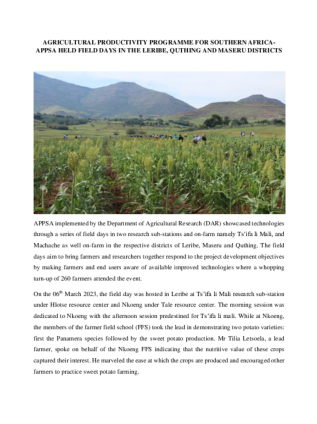
APPSA implemented by the Department of Agricultural Research (DAR) showcased technologies through a series of field days in two research sub-stations and on-farm namely Ts’ifa li Mali, and Machache as well on-farm in the respective districts of Leribe, Maseru and Quthing. The field days aim to bring farmers and researchers together respond to the project development objectives by making farmers and end users aware of available improved technologies where a whopping turn-up of 260 farmers attended the event.

Author or Institution as Author
Department of Agricultural Research
Language
Category

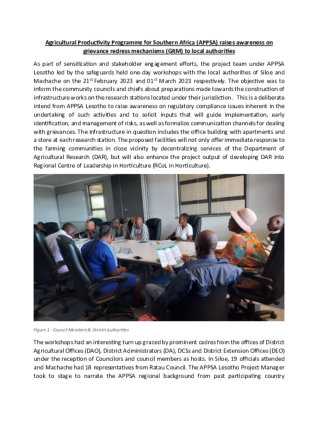
Agricultural Productivity Programme for Southern Africa (APPSA) raises awareness on grievance redress mechanisms (GRM) to local authorities in Lesotho

Type
File
Date of Publication
Mar 01, 2023
Description/Abstract

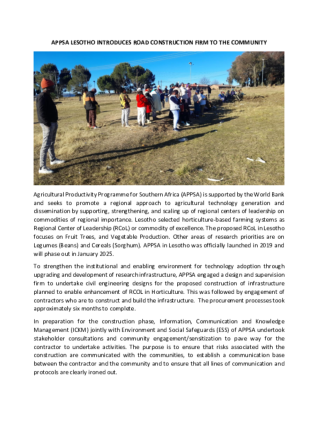
As part of sensitization and stakeholder engagement efforts, the project team under APPSA Lesotho led by the safeguards held one-day workshops with the local authorities of Siloe and Machache on the 21st February 2023 and 01st March 2023 respectively. The objective was to inform the community councils and chiefs about preparations made towards the construction of infrastructure works on the research stations located under their jurisdiction.

Author or Institution as Author
Department of Agricultural Research
Language
Category

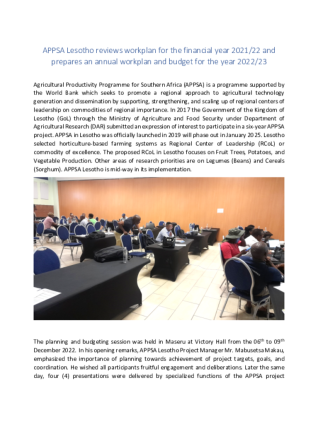
APPSA Lesotho reviews workplan for the financial year 2021/22 and prepares an annual workplan and budget for the year 2022/23

File
Date of Publication
Jan 01, 2023
Description/Abstract

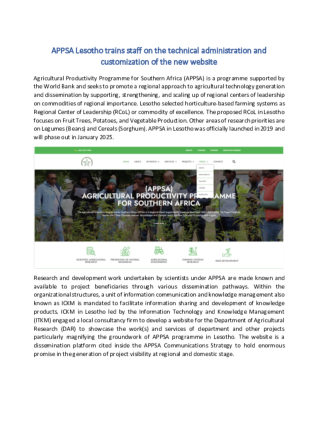
Agricultural Productivity Programme for Southern Africa (APPSA) is a programme supported by the World Bank which seeks to promote a regional approach to agricultural technology generation and dissemination by supporting, strengthening, and scaling up of regional centers of leadership on commodities of regional importance. 

Author or Institution as Author
Department of Agricultural Research of Lesotho
Category

APPSA Lesotho reviews workplan for the financial year 2021/22 and prepares an annual workplan and budget for the year 2022/23

File
Date of Publication
Jan 01, 2023
Description/Abstract

Agricultural Productivity Programme for Southern Africa (APPSA) is a programme supported by the World Bank which seeks to promote a regional approach to agricultural technology generation and dissemination by supporting, strengthening, and scaling up of regional centers of leadership on commodities of regional importance. 

Author or Institution as Author
Department of Agricultural Research of Lesotho
Category

ROLE OF GENETIC RESOURCES FROM DIFFERENT GEGRAPHIC AND CLIMATIC REGIONS IN SIMULTANEOUS BREEDING FOR HIGH QUALITY PROTEIN MAIZE (HQPM) AND STRESS TOLERANCE

Type
File
Description/Abstract

Due to the low biological value of proteins of common maize, it was reinitiated breeding for high protein quality maize (HQPM) using three genetic systems, namely: opaque-2 gene, endosperm modifier genes and enhancer genes, which are increasing lysine and tryptophan content in opaque-2 background In order to alleviate effect of abiotic and biotic stress factors, the genotypes with tolerance to those factors were included. Genetic resources originating from North, Central and South America, then West, Central and Southern Africa and gene bank of Maize Research Institute “Zemun Polje” were used. Combining breeding approaches in selection of genetic resources, field plot techniques and laboratory analysis, it was created large number of early QPM varieties, inbred lines and hybrids with modified endosperm and high yield potential under poor and good growing conditions. Created lines exhibited high combining ability in conventional and non-conventional hybrids. Yield trials showed that QPM hybrids are competing with commercial hybrids of common maize.

Author or Institution as Author
DENIC, M.
Co-authors

MICIC, D.I, STANKOVIC, G., MARKOVIC, K., ZILIC, S., JANCIC, V.L., CHAUQUE, P., FATO, P., SENETE, C., MARIOTE, D. and HAA, W.

Language
Category

APPROACHES IN BREEDING FOR HIGH QUALITY PROTEIN MAIZE

Type
File
Description/Abstract

Maize is the principal crop and major staple food in the most African and South American countries. The main problem in human nutrition in developing countries, and in livestock feed in developed countries, is insufficient production and poor quality of cereal proteins. In the case of maize, due to the very low content of essential amino acids lysine and tryptophan in grain endosperm, biological value is very low, which is main limiting factor of common maize in human nutrition and feeding of monogastric animals. Quality protein maize (QPM) can help in solving of this problem. Maize production also faces serious constraints caused by agro-ecological conditions and poor socio-economic situation. To alleviate the effect of the constraints, selected genotypes with more desirable traits and appropriate field-plot techniques to create multiple-stress conditions, were used. It was found that, in downy mildew nursery distance up to 35 m from spreader plot is providing sufficient down load of spores for plant infection, provided that the testing breeding materials are planted towards to down-stream direction of the dominant wind. Using these breeding approaches large number of early, white and flint synthetics, composites and inbred lines were created with resistance or tolerance to downy mildew (DMR), maize streak virus (SR) and drought (DT). Created genotypes exhibited very good kernel modification and yield potential under low and normal inputs. In the case of synthetics and composites, besides tolerance to multiple stress factors, they were competing in yield with local QPM and normal maize checks. In the case of created inbred lines high combining ability was exhibited both in non-conventional and conventional maize hybrids. Trial data revealed that in the most cases the best entries were over-yielding the best checks.

Author or Institution as Author
DENIC, M.
Co-authors

CHAQUE, P., FATO, P., SENETE, C., MARIOTE, D. and HAAG, W.

Language
Category

Selection of maize progenies for tryptophan content and grain yield

Type
File
Date of Publication
Feb 01, 2016
Description/Abstract

The incrementation of lysine, tryptophan and maize protein nutritional value in locals where maize is staple food could contribute significantly to improving the population nutritional status. The objective of this study was to estimate variance and average components related to the maize protein quality based on tryptophan and grain yield analysis, and to select from the early generations progenies which best complement with the tester for both characters. The laboratory analyses were carried out by using colorimetric reactions and the statistical analyses were based on mixed model. The experiment was set out in partially balanced square lattice with 144 treatments, two replications and 12 blocks. The estimations, associated with the assessed treatment performances made it possible to infer that both populations are promising for recurrent selection and suggested good experimental precision. The selective accuracy demonstrated the possibility of obtaining gains by selecting in both characters. For tryptophan content, the specific combining ability presented small magnitude value due the qualitative inheritance and, the additive effects might have been more important. The shrinkage effect in grain yield was more noticeable than the tryptophan content. Over 25% of the progenies contributed positively to the tryptophan content and only 3.65% to grain yield.

Author or Institution as Author
Senete, C.T.
Co-authors

 Fato, P., Massitela, J., Tamele, O.H. and de Souza, J.C.

Language

APPSA-Lesotho engages a consultancy firm to develop a Management Information System (MIS)

Type
File
Date of Publication
Nov 01, 2022
Description/Abstract

APPSA Lesotho engaged a South African based consultancy firm on the drawn terms of reference to develop the Management Information System (MIS). The agreement reached between APPSA and the consultants resulted in the establishment of a series of back-and-forth communication to gain in-depth understanding on the direction of the proposed MIS

Author or Institution as Author
Department of Agriculture
Language
Category

APPSA LESOTHO LAUNCHES COMPENDIUM OF STORIES

Type
File
Date of Publication
Nov 01, 2022
Description/Abstract

The compendium is a compilation of stories about project activities (research and development, agricultural extension, trainings, project management and monitoring) implemented under APPSA Lesotho. It is the mandate of the Communication Working Group (CWG) to manage project communication and technology dissemination for visibility and awareness, knowledge sharing and collaboration among stakeholders. The roles of Technology Dissemination Office; and Information Technology and Knowledge Management are responsible for ensuring the functionality and delivery of the objectives of the CWG.

Author or Institution as Author
Department of Agricultural Research
Language
Category

Effect of plant density on seed cotton yield

Type
File
Date of Publication
Nov 01, 2022
Description/Abstract

Cotton (Gossypium hirsutum L.) is an important cash crop for small-scale farmers in Mozambique. The yield is dependent on various factors of plant management, and this can be affected by variations in plant density. In Mozambique the cotton crop is mainly growed in plant and row space arrangement corresponding to 50,000 plants per hectare, which is considered low resulting in low cotton yielding.The goal of this study, was to evaluate the effect of plant density in cotton yield, Gossypium hirsutum L. The experiment was conducted in Namialo village, in a randomized complete block design with four replications in a split-plot, where the main plot was distance between the plants within the rows (15, 20, 25, 30 cm) and distance between the rows (50, 75, 100 cm) as subplots randomized in each plot, making plant from 33000 to 133000 plants per hectare. Results of this experiment showed no significant interaction between the distance between the rows and plants on cotton yield, number of bolls per plant and plant height. In addition, as the distance between the plants increased, the number of bolls per plant also increased. This experiment empathize that the combination of 70 cm between the rows and 20 cm between the plants, with a total density of about 71400 plants per hectare resulted in a highest yield.

Author or Institution as Author
SYLLA, N.A.
Co-authors

MALEIA, M.P.; ABUDO, J.

Language
Category
Subscribe to Partner Collections Content

Funding Partners