The Participatory Integrated Climate Services for Agriculture (PICSA Approach

Date of Publication
Feb 01, 2020
Description/Abstract

Critical farming and household decisions depend upon the weather, for example, the amount of rain that falls, the length and start date of the rainfall season, the timing of dry spells, and the timing of temperature extremes. Such aspects of the weather vary considerably from year-to-year. PICSA is an approach that aims to help farmers address this challenge and has been used in more than 20 countries across three continents.

PICSA places farmers at the centre of its approach, and helps them to address the above challenges through integrating:

  1. Communication of historical climate information, as well as seasonal and short term forecasts, in a way that is relevant and useful for farmers.
  2. Exploring crop, livestock and livelihood options available to farmers that may help them deal with climate and weather-related challenges.
  3. Using participatory decision-making tools that assist farmers to make informed decisions when planning their activities.
Author or Institution as Author
University of Reading
Co-authors

Prof. Peter Dorward

Institution
University of Reading
Language
Category
Resource Type
Citation

University of Reading (2011) The Participatory Integrated Climate Services for Agriculture( PICSA)

The Economics of Land Degradation(ELD) CAMPUS learning and teaching toolkit (French)

Date of Publication
Feb 01, 2020
Description/Abstract

The ELD Initiative; Problem dimension – Land degradation vs. sustainable land management; Natural capital and ecosystem services valuation – the rationale behind; Steps of an ELD study; Communication, outreach and policy impact; Identification and selection of ecosystem services; Evaluation of ecosystem services; Cost-benefit analysis

Author or Institution as Author
ELD CAMPUS
Institution
ELD Initiative
Language
Category
Resource Type
Citation

ELD Initiative (2019) ELD Campus

The Economics of Land Degradation(ELD) CAMPUS learning and teaching toolkit

Date of Publication
Jan 01, 2020
Description/Abstract

The Economics of Land Degradation (ELD) Initiative aims to create awareness about the costs of land degradation and the benefits of sustainable land management (SLM).


ELD Campus provides high-level training and capacity improvement for policymakers, scientists and academics who want to contribute to the prevention of land degradation across the world. It is available in French and English.


There are 9 thematic modules that cover the following topics:


  1. The ELD Initiative
  2. Problem dimension – Land degradation vs. sustainable land management
  3. Natural capital and ecosystem services valuation – the rationale behind
  4. Steps of an ELD study
  5. Communication, outreach and policy impact
  6. Identification and selection of ecosystem services
  7. Evaluation of ecosystem services
  8. Cost-benefit analysis


Besides lectures, scripts and exercises, there are also quizzes to test your knowledge afterwards. Moreover the modules include helpful links and further reading materials.


Author or Institution as Author
ELD CAMPUS
Co-authors

The economics of land Degradation (ELD) CAMPUS

Institution
The Economics of Land Degradation(ELD)
Language
Category
Resource Type
Citation

ELD Initiative (2012) ELD CAMPUS

Synthesizing agricultural research findings in Malawi Guide to Good Agriculture Practices in Malawi

Date of Publication
Jan 01, 2019
Description/Abstract

Guide to Good Agriculture Practices in MalawiiFOREWORDThe government of Malawi recognizes the importance of using well researched and vetted Good Agricultural Practices (GAPs) in promoting sustainable agricultural production in the country to eliminate hunger and malnutrition. The Sustainable Agricultural Production Programme (SAPP), one of the initiatives that Government of Malawi (GoM) has putin place to address some of the problems that smallholder farmers face in their production activitiesis contributing to poverty reduction and improved food security among rural populations through achieving a viable and sustainable smallholder agricultural sector employing good agricultural practices (GAPs) in Malawi. The program is being implemented in 6 districts of Chitipa, Nkhotakota, Lilongwe, Balaka, Chiradzulu and Blantyre. The government of Malawi, through SAPP noted the shortfalls in the implementation of the GAPs and commissioned a synthesis of the research findings in Malawi and the region to inform on the GAPs which are ready to go and where best fit to advise the extension and technical person and their applicability. The exercise developed user friendly tools which can be used by the extension personnel in advising the most befitting GAPs in their areas of operations. TheMinistry of Agriculture,Water and Irrigation Developmentis committed to support all the stakeholders supporting agricultural production in the country to adoptthe application of the tools developed.

Author or Institution as Author
IFAD, SUSTAINABLE AGRICULTURE PRODUCTION PROGRAMME,MINISTRY OF AGRICULTURE, MALAWI
Institution
Ministry of Agriculture, Malawi
Category
Resource Type
Citation

Malawi Government, Synthesizing agricultural research findings in MalawiGuide to Good Agriculture Practices in Malawi retrieved from http://sapp.mw/wp-content/uploads/2019/09/Updated-SAPP-Guide-to-Good-Ag… on 9th September, 2019

SAPP SUCCESS STORIES

Date of Publication
Mar 01, 2018
Description/Abstract

In this second edition of the Sustainable Agriculture Production Program (SAPP) Success Stories, we present achievements of smallholder farmers who have adopted various sustainable good agriculture practices with the support from SAPP.SAPP is being implemented in six districts in Malawi namely; Blantyre, Chiradzulu, Balaka, Lilongwe, Nkhotakota and Chitipa. In all those districts the programme has made significant differences in farmer’s lives in the areas of farmer adoption of sustainable good agriculture practices as well as in adaptive research and seed certification.In this second edition, you will get a picture of how farmer’s lives have changed since the introduction of the programme. Topical areas that have been covered include; seed multiplication of ground nuts, chicken production, agribusiness and nutrition, rocket stoves, conservation agriculture, other farming technologies and crop diversification.We hope our selection of success stories will inspire you to adopt and practice sustainable good agriculture practices which will in turn improve the country’s economic growth.

Author or Institution as Author
IFAD, SUSTAINABLE AGRICULTURE PRODUCTION PROGRAMME,MINISTRY OF AGRICULTURE, MALAWII
Institution
Ministry of Agriculture, Malawi
Language
Category
Resource Type
Citation

Malawi Government, SAPP Success Stories retrieved from sapp.mw/wp-content/uploads/2019/09/SAPP-STORIES-FINAL.pdf on 13th September,2019

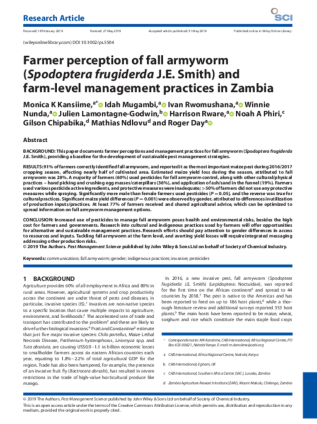
Farmer perception of fall armyworm (Spodoptera frugiderda J.E. Smith) and farm-level management practices in Zambia

Type
File
Date of Publication
May 01, 2019
Description/Abstract

BACKGROUND:Thispaperdocumentsfarmerperceptionsandmanagementpracticesforfallarmyworm(Spodopterafrugiderda J.E.Smith),providingabaselineforthedevelopmentofsustainablepestmanagementstrategies.
RESULTS:91%offarmerscorrectlyidentifiedfallarmyworm,andreporteditasthemostimportantmaizepestduring2016/2017 cropping season, affecting nearly half of cultivated area. Estimated maize yield loss during the season, attributed to fall armywormwas28%.Amajorityoffarmers(60%)usedpesticidesforfallarmywormcontrol,alongwithothercultural/physical practices – handpickingandcrushingeggmasses/caterpillars(36%),andapplicationofash/sandinthefunnel(19%).Farmers usedvariouspesticideactiveingredients,andprotectivemeasureswereinadequate;>50%offarmersdidnotuseanyprotective measures while spraying. Significantly more male than female farmers used pesticides (P=0.05), and the reverse was true for culturalpractices.Significantmaizeyielddifferences(P=0.001)wereobservedbygender,attributedtodifferencesinutilization of production inputs/practices. At least 77% of farmers received and shared agricultural advice, which can be optimized to spreadinformationonfallarmywormmanagementoptions.
CONCLUSION: Increased use of pesticides to manage fall armyworm poses health and environmental risks, besides the high cost for farmers and governments. Research into cultural and indigenous practices used by farmers will offer opportunities for alternative and sustainable management practices. Research efforts should pay attention to gender differences in access to resources and inputs. Tackling fall armyworm at the farm level, and averting yield losses will require integrated messaging addressingotherproductionrisks. 

Author or Institution as Author
Monica K Kansiime
Co-authors

Idah Mugambi, Ivan Rwomushana, Winnie Nunda, Julien Lamontagne-Godwin, Harrison Rware, Noah A Phiri, Gilson Chipabika, Mathias Ndlovu and Roger Daya

Institution
Pest Management Science
Language
Category
Resource Type
Citation

Kansiime, M., Mugambi, I., Rwomushana, I., Nunda, W., Godwin, J., Rware, H., Phiri, N., Chipabika, G., Ndlovu, M., & Daya, R. (2019). Farmer perception of fall armyworm (Spodoptera frugiderda J.E. Smith) and farm-level management practices in Zambia. Pest Management Science. [Online]. Available at: wileyonlinelibrary.com/journal/ps


Sustainability assessment of farming systems in the Philippines with the RISE tool

Date of Publication
Sep 01, 2018
Description/Abstract

The Sector Project Sustainable Agriculture in cooperation with GIZ Philippines and the Agricultural Training Institute (ATI) conducted RISE analyses with the objective to compare different production systems in the Philippian provinces Leyte and Southern Leyte.

Author or Institution as Author
GIZ
Co-authors

Bern University of Applied Sciences School of Agricultural, Forest and Food Sciences HAFL Response-Inducing Sustainability Evaluation RISE

Institution
GIZ
Language
Category
Resource Type
Citation

Christian Thalmann,(2018) Sustainability assessment of farming systems in the Philippines with the RISE tool, pg30. Bern University of Applied Sciences, School of Agricultural, Forest and Food Sciences, Zollikofen: Switzerland

LESOTHO HOLDS A ONE DAY CAADP BIENNIAL REVIEW WORKSHOP

Date of Publication
Aug 01, 2019
Description/Abstract

The Ministry of Agriculture and Food Security (MAFS) in Lesotho held a one-day Comprehensive Africa Agriculture Development Programme (CAADP) Second Malabo Declaration Biennial Review (BR) Report Validation Workshop for all stakeholders in the agricultural sector. CAADP is Africa's Policy Framework for Agriculture and Agriculture-led development. It is aimed at reducing poverty and increasing food security in the continent through at least 10% public budget allocation to the sector in order to achieve at least 6% agriculture annual growth rate.
The Principal Secretary (PS) of MAFS, Mr. Malefetsane Nchaka officially opened the Workshop and thanked the participants for their attendance. He encouraged them to own the CAADP process as a sector and should not only be the responsibility of MAFS as the leading Ministry. He also acknowledged the presence of Regional Strategic Analysis and Knowledge Support System (ReSAKSS) at the validation workshop The PS mentioned that the first BR report was presented in January 2018 at the AU Ordinary Session, and Lesotho’s score was 3.7 out of 10 which did not reflect well on the country. The PS further encouraged the sector to do more in whatever may be required by asking the participants to provide with data as required so that when this current BR report is presented, Lesotho should have a better score than the 2018 score. 
  
The Lesotho CAADP Focal Person, Mr. Khesa presented the report on the results of the first Biennial Review where among the seven commitments, Lesotho scored an overall of only 3.7/10. Based on this score, the following were the recommendations that the country needs to consider in order to achieve a far better score in the next biennial review reporting. The recommendations were:
•    Lesotho should increase public agriculture expenditure as share of total public expenditure in line with the Malabo Declaration commitments, and stem the decline in the area of irrigated land.
•    The country should do more to integrate the youth and women in agricultural value chains.
•    The country should strengthen agriculture data collection and management systems (monitoring and evaluation) to ensure that missing under and unreported indicators are reported in the next round of the Biennial Review. Data was not available on the following areas: 
I.    Post-Harvest Loss;
II.    Farm Pastoral and Fisher Households that are resilient to climate change and weather related risks; and
III.    Participation of women in agriculture with access to finance.

The next Biennial workshop will be held in 2021. 
 

Author or Institution as Author
Rethabile Nchee
Institution
Department of Agricultural Research-Lesotho
Language
Category
Resource Type

Investigating the Type of Gene Action Conditioning Tolerance to Aluminum (Al) Toxicity in Tropical Maize

Date of Publication
May 01, 2009
Description/Abstract

Maize is a third important cereal crop in the world after wheat and rice. In Zambia, it is an important staple crop. Its production is however hampered by both biotic and abiotic factors. Among the abiotic factors, Aluminum (Al) toxicity causes high yield losses and is directly linked to acidic soils. Application of lime can ameliorate this problem, but it is expensive for small scale farmers.
Developing maize varieties that are tolerant to Al toxicity is cheaper and feasible for small scale farmers. The purpose of this research was to investigate the type of gene action conditioning tolerance to aluminum toxicity in tropical maize. Eleven inbred lines were mated in an 8 male (4 moderately tolerant and 4 susceptible) x 3 female (resistant) North Carolina Design II. Results revealed that general combining ability (GCA) effects due to both males and females were highly significant (P≤ 0.001) for root biomass. The shoot length GCA effects due to both male and female respectively were significant (P≤ 0.01). Similarly, the GCA effects due to females and males for root length were significant, P≤ 0.01 and P≤ 0.05 respectively. The genotype CML 511 had the most desirable significant GCA effect value (1.40) for root length among the male lines while CML 538 had the most desirable significant GCA effect value (0.92) among the female lines. The baker’s ratio for root length was found to be 0.49 implying that both additive and non-additive gene action were important in conditioning aluminum toxicity tolerance in tropical maize.

Author or Institution as Author
Victoria Ndeke
Co-authors

Langa Tembo

Language
Resource Type
Citation

Ndeke V., & Tembo L. Investigating the Type of Gene Action Conditioning Tolerance to Aluminum (Al)
Toxicity in Tropical Maize (2019). 2(4): 1-8, 2019

What are vulnerabilities; who is vulnerable to climate change?

Date of Publication
Jul 01, 2019
Description/Abstract

The term vulnerable has become both a noun and verb, and now overshadows the significance of the term, vulnerabilities. For some time now, the term vulnerable has been used to refer to almost everything, yet vulnerabilities refer to the inability to withstand the effects of the hostile environment, while vulnerable refers to the possibility of being attacked, harmed – either physically or emotionally.

Author or Institution as Author
NewsDay
Co-authors

Peter Makwanya

Institution
NewsDay
Language
Resource Type
Subscribe to Curated Content

Funding Partners