Sustainable Food Systems in Sub-Saharan Africa Plant Derived Nutritious Foods— Volume 1

Type
Date of Publication
Apr 02, 2026
Description/Abstract

Africa is one of the most food-insecure regions of the world, hosting about 282 million undernourished people, accounting for 38% of the global total of 735 million; and hence the access to adequate and nutritious food remains a big chal-lenge. Degraded land resources, low agronomic productivity, and low nutrient dense foods are the major causes of malnourishment including micronutrient deficiencies in Sub Saharan Africa (SSA). More than 50% of people in SSA suffer from Zn deficiency, and 57% of pregnant women suffer from Fe deficiency anemia. Soil and water are fundamental resources for livelihoods and food security in Africa as 60% of people in SSA derive their livelihoods from these resources.

Co-authors

Bal Ram Singh · Liveness Jessica Banda · Andy Safalaoh · Agnes Mwangwela · Ruth Haug · Lars Olav Eik ·Jennifer Joy West · Rattan Lal Editors

Institution
LUANAR
Language
Category
Citation

Singh et al , (2026). Sustainable Food Systems in Sub-Saharan Africa: Plant-Derived Nutritious Foods—Volume 1, Springer

Potential for production and use of liquid biofuels as a strategy for developing green and circular economies in Southern Africa

Type
File
Date of Publication
Feb 20, 2026
Description/Abstract

The Southern African Development Community (SADC) responded to global calls to address environmental challenges such as high greenhouse gas (GHG) emissions through the use of liquid biofuels. This study assessed the potential of liquid biofuel production in the SADC region with data collected in Malawi, Mozambique, South Africa and Zimbabwe. The results showed that the liquid biofuel industry is struggling. Countries do not have enough resources to support the industry effectively and there is overreliance on international sponsors. In terms of policy and regulatory frameworks most countries are doing well. However, these policies are not implemented effectively. Most countries use sugar-cane to produce bioethanol. Over the years countries, such as Malawi, have attempted to incorporate crops such as cassava (Manihot esculenta) and castor bean (Ricinus communis). Although the industry is not performing well it has contributed massively to livelihood development in all the region

Author or Institution as Author
Prof Cliff Dlamini
Co-authors

RP Tshidzumba, T Gotore, G Kabia, RSM Munjoyo & D Kachamba

Language
Category
Resource Type
Citation

CS Dlamini, RP Tshidzumba, T Gotore, G Kabia, RSM Munjoyo & D Kachamba (17 Feb 2026): Potential for production and use of liquid biofuels as a strategy for developing green and circular economies in Southern Africa, Southern Forests: a Journal of Forest Science, DOI: 10.2989/20702620.2025.2567051

Contact Information

* Corresponding author: CDlamini@ccardesa.org.

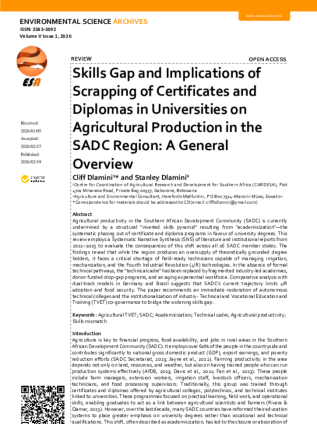
Skills Gap and Implications of Scrapping of Certificates and Diplomas in Universities on Agricultural Production in the SADC Region: A General Overview

Type
File
Date of Publication
Feb 20, 2026
Description/Abstract

Agricultural productivity in the Southern African Development Community (SADC) is currently undermined by a structural "inverted skills pyramid" resulting from "academicization"—the systematic phasing out of certificate and diploma programs in favour of university degrees. This review employs a Systematic Narrative Synthesis (SNS) of literature and institutional reports from 2021–2025 to evaluate the consequences of this shift across all 16 SADC member states. The findings reveal that while the region produces an oversupply of theoretically grounded degree holders, it faces a critical shortage of field-ready technicians capable of managing irrigation, mechanization, and the Fourth Industrial Revolution (4IR) technologies. In the absence of formal technical pathways, the "technical cadre" has been replaced by fragmented industry-led academies, donor-funded stop-gap programs, and an aging experiential workforce. Comparative analysis with dual-track models in Germany and Brazil suggests that SADC’s current trajectory limits 4IR adoption and food security. The paper recommends an immediate restoration of autonomous technical colleges and the institutionalization of industry- Technical and Vocational Education and Training (TVET) co-governance to bridge the widening skills gap.

Author or Institution as Author
Prof. Cliff Dlamini
Co-authors

Mr. Stanley Dlamini

Language
Topic
Category
Resource Type
Citation

 Dlamini C and Dlamini S (2026) Skills Gap and Implications of Scrapping of Certificates and Diplomas in Universities on Agricultural Production in the SADC Region: A General Overview. Environmental Science Archives 5(1): 166-17

Contact Information

Centre for Coordination of Agricultural Research and Development for Southern Africa (CARDESA), Plot 4701 Mmaraka Road, Private Bag 00357, Gaborone, Botswana 2Agriculture and Environmental Consultant, Herefords Matfuntini, PO Box 7514-Manzini-M200, Eswatini *Correspondence for materials should be addressed to CD (email: cliffsdlamini@ymail.com)

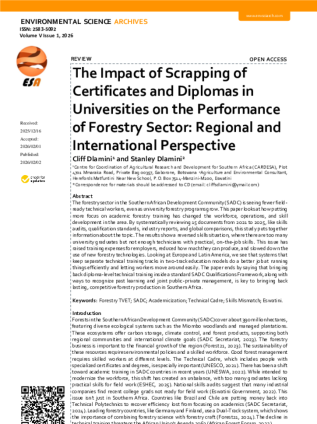
The Impact of Scrapping of Certificates and Diplomas in Universities on the Performance of Forestry Sector: Regional and International Perspective

Type
File
Date of Publication
Feb 20, 2026
Description/Abstract

The forestry sector in the Southern African Development Community (SADC) is seeing fewer fieldready technical workers, even as university forestry programs grow. This paper looks at how putting more focus on academic forestry training has changed the workforce, operations, and skill development in the area. By systematically reviewing 15 documents from 2021 to 2025, like skills audits, qualification standards, industry reports, and global comparisons, this study puts together information about the topic. The results show a reversed skills situation, where there are too many university graduates but not enough technicians with practical, on-the-job skills. This issue has raised training expenses for employers, reduced how much they can produce, and slowed down the use of new forestry technologies. Looking at Europe and Latin America, we see that systems that keep separate technical training tracks in two-track education models do a better job at running things efficiently and letting workers move around easily. The paper ends by saying that bringing back diploma-level technical training inside a standard SADC Qualifications Framework, along with ways to recognize past learning and joint public-private management, is key to bringing back lasting, competitive forestry production in Southern Africa.

Author or Institution as Author
Prof. Cliff Dlamini
Co-authors

Mr.  Stanley Dlamini

Language
Topic
Category
Resource Type
Citation

Dlamini C and Dlamini S (2026) The Impact of Scrapping of Certificates and Diplomas in Universities on the Performance of Forestry Sector: Regional and International Perspective. EnvironmentalScience Archives 5(1): 115-126

Contact Information

1Centre for Coordination of Agricultural Research and Development for Southern Africa (CARDESA), Plot 4701 Mmaraka Road, Private Bag 00357, Gaborone, Botswana 2Agriculture and Environmental Consultant, Herefords Matfuntini Near New School, P.O. Box 7514-Manzini-M200, Eswatini *Correspondence for materials should be addressed to CD (email: cliffsdlamini@ymail.com)
Plano de Gestão Ambiental e Social - Centro Regional de Liderança da Mandioca: Malanje-Angola

Date of Publication
Oct 01, 2023
Description/Abstract

Plano de Gestão Ambiental e Social - Centro Regional de Liderança da Mandioca: Malanje-Angola

Author or Institution as Author
Instituto de Investigação Agronómica (IIA)
Category

Plano de Gestão de Resíduos - Centro Regional de Liderança da Mandioca: Malanje-Angola

Date of Publication
Oct 01, 2023
Description/Abstract

Plano de Gestão de Resíduos - Centro Regional de Liderança da Mandioca: Malanje-Angola

Author or Institution as Author
Instituto de Investigação Agronómica (IIA)
Language
Category

Plano de Gestão de Água - Centro Regional de Liderança da Mandioca: Malanje-Angola

Date of Publication
Oct 01, 2023
Description/Abstract

Plano de Gestão de Água - Centro Regional de Liderança da Mandioca: Malanje-Angola

Author or Institution as Author
Instituto de Investigação Agronómica (IIA)
Category

Estudo de Impacto Ambiental e Social - Centro Regional de Liderança da Mandioca: Malanje-Angola

Date of Publication
Oct 01, 2023
Description/Abstract

Estudo de Impacto Ambiental e Social - Centro Regional de Liderança da Mandioca: Malanje-Angola

Author or Institution as Author
Instituto de Investigação Agronómica (IIA)
Category

Plano de Gestão da Biodiversidade - Centro Regional de Liderança da Mandioca: Malanje-Angola

Type
Date of Publication
Oct 01, 2023
Description/Abstract

Plano de Gestão da Biodiversidade - Centro Regional de Liderança da Mandioca: Malanje-Angola

Author or Institution as Author
Instituto de Investigação Agronómica (IIA)
Language
Category

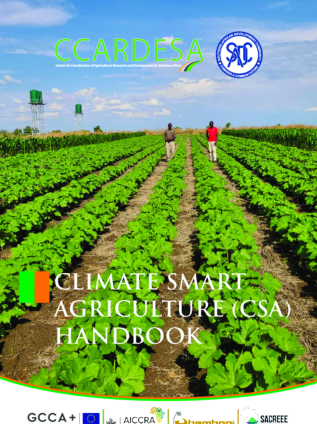
Climate Smart Agriculture (CSA) HandBook

Type
File
Date of Publication
Aug 01, 2023
Description/Abstract

This Climate Smart Agriculture (CSA) handbook has been developed as a resource material for use by CSA practitioners in providing training, policy advocacy, and upscaling CSA technologies and practices for improving sustainable productivity, adapting to the effects of climate change, and mitigating climate change.

Author or Institution as Author
CCARDESA
Co-authors

AICCRA, CGIAR, GCCA+

Institution
CCARDESA
Language
Category
Resource Type
Citation

CCARDESA (2023), Climate Smart Agriculture (CSA) Handbook (1st ed.) Gaborone, Botswana.

Subscribe to Decision Tool

Funding Partners