Estudo de Mercado e Rentabilidade da Semente Básica do IIAM na Zona Sul

Type
Date of Publication
Oct 01, 2021
Description/Abstract

A provisão de semente básica de boa qualidade e em quantidade que satisfaça a demanda dos diferentes clientes é um imperativo para garantia da segurança alimentar. Nos últimos dez anos o IIAM libertou várias variedades de arroz, nomeadamente: Simão, Tumbeta, Huwa, Nene, Limpopo, Macassane, Muyaki, V-Moz, Vassamate, e L38. Estas variedades são adaptadas às condições agroecológicas de Moçambique e demonstraram maior rendimento potencial, tolerância a pestes e doenças e são preferidas pelos produtores e consumidores. Apesar deste avanço, a cadeia de fornecimento da semente de arroz é dominada pelo sistema informal que prove cerca de 98 % da semente utilizada pelos produtores. O IIAM pretende aumentar o uso de semente melhorada pelos produtores através da produção e venda de semente básica de arroz a diferentes clientes (produtores de semente).
O estudo consistiu no levantamento de dados por meio diagnóstico rural rápido (Rapid Rural Appraisal) aos produtores de semente básica em de Matutuine, regadio de Chókwè e Limpopo e na EAC. 
A pesquisa compreendeu três etapas: a primeira consistiu da revisão de documentos relevantes para este exercício. A segunda etapa compreendeu a planificação e o desenvolvimento dos instrumentos de recolha de dados e informações e a terceira compreendeu a realização do trabalho de campo. Para o trabalho de campo, duas equipas deslocaram-se a Matutuine e Chókwè entre os dias 13 e 16 de Outubro e 25 e 31 de Outubro de 2010, respectivamente. No Chókwè, à equipa realizou duas secções de trabalho com os técnicos do IIAM do sector de arroz para análise situacional, e da estrutura de mercado, carta tecnológica e viabilidade económica preliminar do negócio. Na sequência, a equipa de pesquisa realizou entrevistas semiestruturadas a intervenientes-chave da cadeia de semente no Regadio do Chókwè (SDAE; Laboratório de Sementes, e os produtores). 
No Chókwè, de um total de 20 produtores de semente de arroz da lista fornecida pelo Laboratório de Sementes, 19 foram entrevistados para captar suas experiências e expectativas em relação a produção e negócio de semente de arroz. Para análise da viabilidade económica e financeira do projeto foram usados os seguintes critérios: Valor Atual Líquido (VAL), Taxa Interna de Retorno (TIR) rácio Benefício Custo (B/C) e a Margem de contribuição (MC) .
Os resultados do estudo sugerem que o negócio de produção de semente básica de arroz representa uma oportunidade considerando que o arroz é bem conhecido e estabelecido na província de Gaza, e o arroz representa uma cultura de bandeira da região.
As análises foram feitas considerando dois contextos: (i) no caso em que não se consideram os custos de investimento e (ii) no caso em que se tem em conta os custos de investimento que têm a ver principalmente com os custos da reabilitação do regadio, efectuado em 2018 no âmbito do projecto APPSA. No caso em que não se consideram os custos de investimento os resultados sugerem em todos os cenários , a lucratividade positiva; O indicador margens das contribuições (MC) avaliadas por cenários, também teve resultados satisfatórios, mostrando-se estes suficientes para serem subtraídos e consecutivamente para o pagamento dos custos variáveis e custos fixos do negócio e ainda gerar lucros.
No cenário 1 o preço break-even point é 43 Meticais o quilo, sugerindo que o IIAM vendendo o quilo por 110Mt ultrapassou já o preço break-even point. Neste mesmo cenário o rendimento mínimo aceitável para a actividade ser rentável é de 1,551 quilos por hectar que igualmente o IIAM já ultrapassou porque actualmente o rendimento é 4,000 quilos por hectar.
Considerando os custos de investimento não é viável a produção de semente básica de arroz, o que pode estar relacionado ao baixo rendimento por hectar e perdas que se verificam na Estacão Agrária do Chókwè. A aquisição de auto-combinada demostrou ter a capacidade de melhorar a eficiência produtiva e como consequência dobrar as receitas líquidas. No entanto, a aquisição da auto-combinada não garantirá a obtenção do rendimento potencial das variedades; é preciso olhar pra outras questões técnicas, como o assoreamento das valas de drenagem, o controlo dos pássaros, de entre vários outros.
Com vista a aumentar a preposição de valor de mercado o estudo recomenda: (i) melhorarias nas infra-estruturas de armazenamento; (ii) aquisição de nova auto combinada; (iii) monitoria dos processos de produção/inspecção, e (iv) celebração de contractos antecipados de compra e venda com as empresas fomentadoras. O IIAM deve também explorar a oportunidade de expandir o negócio de semente básica para o Baixo Limpopo e Matutuine, onde existe um grande potencial.

 
Author or Institution as Author
Tomás Sitoe
Co-authors

João Mudema, Arminda Manica, Américo Humulane, Sérgio Piloto, Guido Veríssimo, Declério Mucachua e José Benevides Pedro

Institution
Agricultural Research Institute of Mozambique
Language
Category
Citation

Sitoe, T.; Mudema, J.; Manica, A.; Humulane, A.; Piloto, S.; Veríssimo, G.; Mucachua, D. e Pedro, J. (2021).Estudo de mercado e rentabilidade da semente básica do IIAM na Zona Sul. Instituto de Investigação Agrária de Moçambique. Maputo. p.25

Rainfall trend and variability in semi-arid northern Namibia: Implications for smallholder agricultural production

Type
File
Date of Publication
Oct 01, 2021
Description/Abstract

Rainfall defines livelihood patterns among agrarian communities of the climate-change vulnerable semi-arid SubSaharan Africa. However, it remains inadequately studied, resulting in ineffective water management policies and weak agricultural growth in the region. Monthly rainfall data collected between 1987 and 2018 at four stations along a 1200 km climatic gradient in northern Namibia were analyzed for annual, seasonal, and monthly trends and variability. Descriptive measures and the Mann-Kendall test were used for rainfall characterization and trend detection, respectively. Results showed an annually increasing rainfall trend, but with a downward trend in the dry season decreasing by -0.14 mm year–1 and an upward trend in the rainy season increasing by 7.74 mm year–1 across the study area. The rainy-season mean monthly rainfall showed predominantly increasing trends, while the dry-season ones exhibited insignificant decreasing trends. The study detected a decreasing rainfall gradient from the northeast towards the northwest with a range of 156.8 mm and concomitant increasing spatial-temporal variability. The upward rainfall trend has implications for rainy season floods, whereas the downward trend suggests dry season drought intensification in the area. These results could be useful for rainwater management planning in the study area and other dryland regions.

Author or Institution as Author
S. K. Awala
Co-authors

K. Hove,*, M. A. Wanga, J. S. Valombola, and O. D. Mwandemele

Institution
University of Namibia and Ministry of Agriculture, Water and Land Reform
Language
Category
Citation

MAWL, (2019) Rainfall trend and variability in semi-arid northern Namibia: Implications for smallholder agricultural production,pg21

Farmers Hold a Mini Exhibition of Maize and Bean Seed Under the APPSA Sub Project

Type
File
Date of Publication
Oct 01, 2021
Description/Abstract

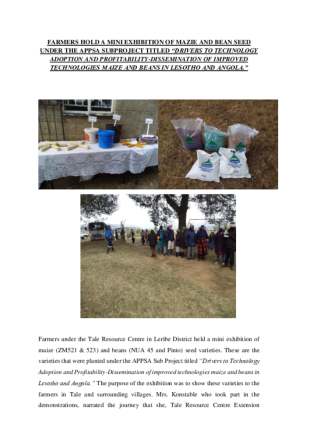
This a short article on the mini exhibition that farmers under the Tale Agricultural Resource Centre did. The purpose was to show to other farmers the maize and bean varieties that were planted under the APPSA funded sub project, so that they can learn how they perform, where to get the seed and try them in this up coming summer cropping season. This is important because these varieties have been proven to withstand calamities of climate change. 

Author or Institution as Author
Rethabile Nchee
Institution
Department of Agricultural Research
Language
Category
Resource Type
Citation

DAR, (2021). Farmers Hold a Mini Exhibition of Maize and Bean Seed Under the  APPSA Sub Project,pg.2

APPSA-LESOTHO SENSITIZATION CAMPAIGNS

Type
File
Date of Publication
Jan 01, 2021
Description/Abstract

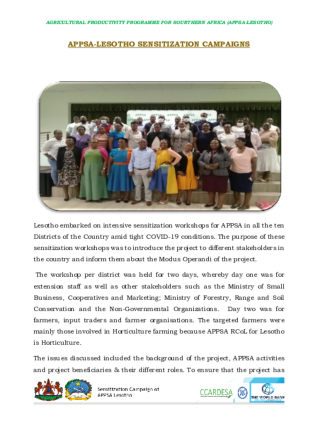
The Ministry of Agriculture and Food Security in Lesotho though the Department of Agricultural Research (DAR) recieved funding to participate in the  Agricultural Productivity Programme for Southern Africa (APPSA) for six years (2020-2025). The objective of APPSA is to increase the availability of improved agricultural technologies in participating countries in the SADC region.  One of the  components of APPSA talks about supporting technology dissemination activities (extension, strengthening of innovation systems), hence the DAR felt it imperative that the differnt stakeholders within the agricultural sector in Lesotho needed to be made aware of the existence and operations of APPSA in Lesotho. This article gives a summary of the sensitzation campaigns that were held in all ten districts of the country.  


Author or Institution as Author
RETHABILE NCHEE
Co-authors

Mr. Lefutso Ramokoatsi

Institution
Department of Agricultural Research
Language
Category
Resource Type

Lesotho undertakes a survey on Drivers to Technology Adoption and Profitability-Dissemination of improved maize and bean technologies – APPSA funded sub-project.

Type
File
Date of Publication
Oct 01, 2020
Description/Abstract

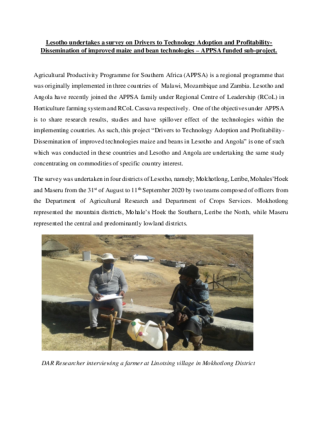
This is a brief report on the survey that Lesotho through its Department of Agricultural Research did as one of its activities under APPSA Project. The same survey was undertaken in countries that first took part in the APPSA Project. The data is currently being processed and the results will be published for consumption of different audiences. 

Author or Institution as Author
RETHABILE NCHEE
Institution
THE DEPARTMENT OF AGRICULTURAL RESEARCH
Language
Category
Resource Type

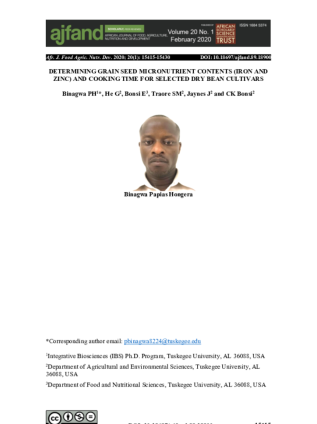
DETERMINING GRAIN SEED MICRONUTRIENT CONTENTS (IRON AND ZINC) AND COOKING TIME FOR SELECTED DRY BEAN CULTIVARS

File
Date of Publication
Feb 01, 2020
Description/Abstract

ABSTRACT

Micronutrient deficiencies caused by lack of Iron (Fe), Zinc (Zn) and Vitamin A in the human body have negative effect with regard to health issues worldwide. Imbalances of these nutrients in the human body create a significant risk of illness and mortality among children under five years of age, pregnant women and lactating mothers. Some of the food crops that thought to reduce micronutrients include rice, sweet potato, dry bean, sorghum, corn, barley, and finger millet have been biofortified through ways of agronomic practices, conventional breeding, or modern biotechnology. Despite the fact that dry beans address Fe and Zn deficiencies based on recommended dietary allowances (RDA),  they often take a long time to cook. Many communities have limited cooking resources which make them rely on burning wood, charcoal or other biofuels that require more time and money. This study identified dry bean cultivars with enhanced Fe and Zn concentration levels and fast cooking time from 200 cultivars. Experiments were conducted under a complete randomized block design with two replications, 200 cultivars, and two different agro-ecologies. Iron and Zinc concentration levels were determined from the harvested seed grains of each bean cultivar using X-Ray Fluorescence while cooking time of similar cultivars were determined using the Mattson cooker. The variation of Fe and Zn concentration was significantly different at (p<0.001) among the treatments and environments. The range was between 46.76 mg/kg to 107.25 mg/kg for Fe and 21.70 mg/kg to 42.35 mg/kg for Zn concentration. From two testing sites, the concentration of Fe was higher at Lyamungo than SARI and Zn showed inversely proportional to these tested sites which means that the environment and soils were not homogenous in terms of soil health. The highest water uptake was 61.54% and the lowest was 3.70% and the higher the water uptake the lower the cooking time. Fast cooking time was ~15 min and the longest was ~76 min. Small seed-sized cultivars showed fast cooking time than large-seeded. These two traits in identified cultivars will enhance dry bean consumption, which will contribute to alleviating micronutrient deficiencies in this global growing population.


Key words: Micronutrient deficiencies, Biofortification, Cultivars, Cooking time, Vulnerable group, Variation

Author or Institution as Author
Binagwa et al.
Co-authors

He G2, Bonsi E3, Traore SM2, Jaynes J2 and CK Bonsi2

Language
Category
Resource Type
Citation

Binagwa PH1*, He G2, Bonsi E3, Traore SM2, Jaynes J2 and CK Bonsi (2020). DETERMINING GRAIN SEED MICRONUTRIENT CONTENTS (IRON AND ZINC) AND COOKING TIME FOR SELECTED DRY BEAN CULTIVARS. Afr. J. Food Agric. Nutr. Dev. 2020; 20(1): 15415-15430                         DOI: 10.18697/ajfand.89.18900

THE MINISTRY OF AGRICULTURE AND FOOD SECURITY (MAFS) IN LESOTHO HOLDS THE NATIONAL CONSERVATION AGRICULTURE TASK FORCE (NCATF) MEETING.

Type
File
Date of Publication
Dec 01, 2019
Description/Abstract

This article is about a meeting that was converned for the Lesotho National Conservation Agriculture Task Force. It was a revival meeting that was last held about two years ago. The importance of such a meeting is to bring stakeholders in the agricultural sector in Lesotho to deliberate on the issues of Conservation Agriculture and how it can be supported and strenghened in order to address this "monster" called climate change.

Author or Institution as Author
Rethabile Nchee
Institution
Department of Agricultural Research-Lesotho
Language
Category
Resource Type

Cassava Brown Streak Disease and Ugandan cassava brown streak virus Reported for the First Time in Zambia

Type
File
Date of Publication
Jul 01, 2018
Description/Abstract

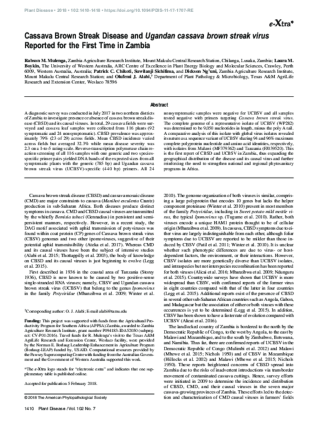
A diagnostic survey was conducted in July 2017 in two northern districts of Zambia to investigate presence or absence of cassava brown streak disease (CBSD) and its causal viruses. In total, 29 cassava fields were surveyed and cassava leaf samples were collected from 116 plants (92 symptomatic and 24 non-symptomatic). CBSD prevalence was approximately 79% (23 of 29) across fields. Mean CBSD incidence varied across fields but averaged 32.3% while mean disease severity was 2.3 on a 1-to-5 rating scale. Reverse-transcription polymerase chain reaction screening of all 116 samples with one generic and two species specific primer pairs yielded DNA bands of the expected sizes from all symptomatic plants with the generic (785 bp) and Ugandan cassava brown streak virus (UCBSV)-specific (440 bp) primers. All 24 non-symptomatic samples were negative for UCBSV and all samples tested negative with primers targeting Cassava brown streak virus. The complete genome of a representative isolate of UCBSV (WP282) was determined to be 9,050 nucleotides in length, minus the poly A tail. A comparative analysis of this isolate with global virus isolates revealed its nature as a sequence variant of UCBSV sharing 94 and 96% maximum complete polyprotein nucleotide and amino acid identities, respectively, with isolates from Malawi (MF379362) and Tanzania (FJ039520). This is the first report of CBSD and UCBSV in Zambia, thus expanding the geographical distribution of the disease and its causal virus and further reinforcing the need to strengthen national and regional phytosanitary programs in Africa.

Author or Institution as Author
Rabson M. Mulenga, Zambia Agriculture Research Institute, Mount Makulu Central Research Station, Chilanga, Lusaka, Zambia
Co-authors

Laura M. Boykin, The University of Western Australia, ARC Centre of Excellence in Plant Energy Biology and Molecular Sciences, Crawley, Perth 6009, Western Australia, Australia;

Patrick C. Chikoti, Suwilanji Sichilima, and Dickson Ng’uni, Zambia Agriculture Research Institute, Mount Makulu Central Research Station;

Olufemi J. Alabi, Department of Plant Pathology & Microbiology, Texas A&M AgriLife Research and Extension Center, Weslaco 78596

Institution
The American Phytopathological Society
Language
Category
Resource Type
Citation

Mulenga, M. R., Boykin, M. L., Chikoti, P. C., Sichilima, S., Ng’uni, D., Alabi, J. O. (2018). Cassava Brown Streak Disease and Ugandan cassava brown streak virus Reported for the First Time in Zambia. Plant Diseases, [online] Vol (102) (7), 1410-1418. Availble at: h://https://apsjournals.apsnet.org/doi/full/10.1094/PDIS-11-17-1707-RE

Knowledge and Practice of Pesticides use among Small Holder farmers in Zambia

Type
File
Date of Publication
Sep 01, 2019
Description/Abstract

Pesticides are essential for the control of infestation of disease, insect pests and weeds on different crops. Due to wide usage of synthetic pesticides which may lead to increased exposure and associated environmental and health risks among small-holder farmers in Zambia, a study was undertaken to understand how knowledgeable farmers are on pesticide use and practices. A total of 418 small scale farmers were randomly sampled from Mkushi, Mpongwe, Luangwa, Mbala, Solwezi, Chipata and Kalomo Districts of Zambia. Data pertaining to types of pesticides use, handling, storage and disposal was solicited using structured questionnaires. The data collected was analyzed using SPSS. Findings revealed that of the sampled farmers 43%, 30%, 25% and 17% used Glyphosate, Dicamba, Paraquat and Atrazine respectively as herbicides in Maize. 21% and 14% used Cypermethrine and Monocrotophos respectively as insecticides in both Maize and Soybean. 81% of the sampled farmers used empty containers for either storing drinking water or salt while only 15% wore protective clothing when applying pesticides. Pesticide mishandling occurred regardless of the amount of experience a farmer had using pesticides. 68% of the sampled farmers had never received any formal basic training in pestic ide use, hence a clear knowledge gap. The fact that receipt of basic training was the main predictor of a farmers’ level of knowledge on pesticide use, a farmer who had received basic training in appropriate chemical pesticides use, as opposed to one who had not, had a better chance of using chemical pesticides safely and in the right quantities.

Author or Institution as Author
Mutinta J. Malambo, ZARI
Co-authors

Mweshi Mukanga2 , James Nyirenda3 , Bupe Kabamba4 , Robert K. Salati5 

Institution
International journal of Horticulture, Agriculture and Food science(IJHAF)
Language
Category
Citation

Malambo, M.J,  Mukanga, M.,  Nyirenda, J., Kabamba, B., & Salati, K.R,. (2010). Knowledge and Practice of Pesticides use among Small Holder farmers in Zambia. International journal of Horticulture, Agriculture and Food science(IJHAF). pp184-190. Available at:https://dx.doi.org/10.22161/ijhaf.3.4.5 [05/09/2019] 

Farmer perception of fall armyworm (Spodoptera frugiderda J.E. Smith) and farm-level management practices in Zambia

Type
File
Date of Publication
May 01, 2019
Description/Abstract

BACKGROUND:Thispaperdocumentsfarmerperceptionsandmanagementpracticesforfallarmyworm(Spodopterafrugiderda J.E.Smith),providingabaselineforthedevelopmentofsustainablepestmanagementstrategies.
RESULTS:91%offarmerscorrectlyidentifiedfallarmyworm,andreporteditasthemostimportantmaizepestduring2016/2017 cropping season, affecting nearly half of cultivated area. Estimated maize yield loss during the season, attributed to fall armywormwas28%.Amajorityoffarmers(60%)usedpesticidesforfallarmywormcontrol,alongwithothercultural/physical practices – handpickingandcrushingeggmasses/caterpillars(36%),andapplicationofash/sandinthefunnel(19%).Farmers usedvariouspesticideactiveingredients,andprotectivemeasureswereinadequate;>50%offarmersdidnotuseanyprotective measures while spraying. Significantly more male than female farmers used pesticides (P=0.05), and the reverse was true for culturalpractices.Significantmaizeyielddifferences(P=0.001)wereobservedbygender,attributedtodifferencesinutilization of production inputs/practices. At least 77% of farmers received and shared agricultural advice, which can be optimized to spreadinformationonfallarmywormmanagementoptions.
CONCLUSION: Increased use of pesticides to manage fall armyworm poses health and environmental risks, besides the high cost for farmers and governments. Research into cultural and indigenous practices used by farmers will offer opportunities for alternative and sustainable management practices. Research efforts should pay attention to gender differences in access to resources and inputs. Tackling fall armyworm at the farm level, and averting yield losses will require integrated messaging addressingotherproductionrisks. 

Author or Institution as Author
Monica K Kansiime
Co-authors

Idah Mugambi, Ivan Rwomushana, Winnie Nunda, Julien Lamontagne-Godwin, Harrison Rware, Noah A Phiri, Gilson Chipabika, Mathias Ndlovu and Roger Daya

Institution
Pest Management Science
Language
Category
Resource Type
Citation

Kansiime, M., Mugambi, I., Rwomushana, I., Nunda, W., Godwin, J., Rware, H., Phiri, N., Chipabika, G., Ndlovu, M., & Daya, R. (2019). Farmer perception of fall armyworm (Spodoptera frugiderda J.E. Smith) and farm-level management practices in Zambia. Pest Management Science. [Online]. Available at: wileyonlinelibrary.com/journal/ps


Subscribe to Journal Article

Funding Partners