Local knowledge and use of cactus (Nopalea cochenillifera (L.) Salm-dyck) as feed for small ruminants in rural communities of Malawi and Mozambique

Type
File
Date of Publication
Jun 01, 2021
Description/Abstract

The present research was conducted to determine the knowledge of farmers from Malawi and Mozambique on the use of cactus (Noppolea Cochenillinifera L. Sam-Dyck) as fodder for small ruminants in dry season. The study took place in Mzimba, Mchinji and Chikwawa districts (in Malawi) and Manhiça, Changara and Lichinga districts (in Mozambique), where 450 farmers keeping ruminants were surveyed through semi-structured interviews. Each respondent was interviewed alone in Chewa and/or English (in Malawi) and Tsonga, Nyungwe, Yao and/or Portuguese (in Mozambique). During the interview, farmers were shown pictures stuck on a poster and numbered (no name), where they recognized the species, mentioned the local name and shared their experience on cactus as fodder. The legend of the images on the poster were listed on separate page to which farmers did not have access. Respondents were allowed to explain the preparation procedure before cacti were given to animals. They were asked to mention other uses of cactus in their region. Related uses were grouped in terms of frequency of mention. Interviews were recorded as audios on a Samsung Galax J1 cellular phone and a notepad. In addition, a literature search was undertaken in order to find some of the most common species of cactus in Africa (emphasis was given to East and Southern Africa). Images displaying stems, spines, leaves, flowers and fruits of cacti were collected. The study concluded that most farmers and probably other residents from the districts and villages where the present study was conducted knew cactus as medicine, edible fruit, ornament and live fence. The knowledge of cacti as fodder both in Malawi and Mozambique was negligible.

Author or Institution as Author
Macalane, S.E.
Co-authors

Safalaoh, A.C.L., Chigwa, F.C., Jere, W.W.L., de Araújo, G.G.L.

Language
Category

Effect of plant density on seed cotton yield

Type
File
Date of Publication
Nov 01, 2022
Description/Abstract

Cotton (Gossypium hirsutum L.) is an important cash crop for small-scale farmers in Mozambique. The yield is dependent on various factors of plant management, and this can be affected by variations in plant density. In Mozambique the cotton crop is mainly growed in plant and row space arrangement corresponding to 50,000 plants per hectare, which is considered low resulting in low cotton yielding.The goal of this study, was to evaluate the effect of plant density in cotton yield, Gossypium hirsutum L. The experiment was conducted in Namialo village, in a randomized complete block design with four replications in a split-plot, where the main plot was distance between the plants within the rows (15, 20, 25, 30 cm) and distance between the rows (50, 75, 100 cm) as subplots randomized in each plot, making plant from 33000 to 133000 plants per hectare. Results of this experiment showed no significant interaction between the distance between the rows and plants on cotton yield, number of bolls per plant and plant height. In addition, as the distance between the plants increased, the number of bolls per plant also increased. This experiment empathize that the combination of 70 cm between the rows and 20 cm between the plants, with a total density of about 71400 plants per hectare resulted in a highest yield.

Author or Institution as Author
SYLLA, N.A.
Co-authors

MALEIA, M.P.; ABUDO, J.

Language
Category

Agricultural Zoning and Recommendation of Pigeon Pea Cultivars in Mozambique

Type
File
Date of Publication
Nov 01, 2022
Description/Abstract

Pigeon pea is one of the important legumes for export and domestic consumption in Mozambique. The objective was to evaluate the performance of the genotypes and to stratify environments for agricultural zoning and subsequent recommendation. The experiments were conducted in the northern region of Mozambique, to evaluate grain yield, in randomized blocks, with three replications and 20 long-maturing genotypes, in the 2016/2017 season in four environments. The results were obtained through the joint analysis and the complementarity of information from the biometric methodologies of Eberhart and Russell, Centroid and GGE-biplot aiming at better use of the significant GXE interaction. A mega-environment (Nampula and Namapa) was observed, of which Namapa district was the most discriminating and representative. The genotypes suggested for a recommendation as cultivars showed average performance. The ICEAP01490 genotype was of specific adaptability to favorable environments (Nametil and Namapa district) and high stability, is recommended for medium to high technology environments and the ICEAP01498 genotype was of specific adaptability to unfavorable environments (Nampula and Montepuez district), is recommended for low technology environments. The ICEAP01409 genotype can be indicated for a general recommendation. The ideal genotype with high mean, general adaptability and high stability was not observed, suggesting evaluations in more environments.

Author or Institution as Author
Pedro, C.
Co-authors

Donça, M.C.B., Somueque, S. I., Barbosa, I. P., de Souza, J. E., Dique, J. E. L., Gimo, S. T., and Cruz, C.D

Language
Category

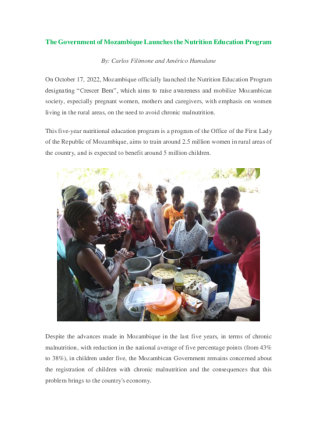
The Government of Mozambique Launches the Nutrition Education Program

Type
File
Date of Publication
Oct 01, 2022
Description/Abstract

On October 17, 2022, Mozambique officially launched the Nutrition Education Program designating “Crescer Bem”, which aims to raise awareness and mobilize Mozambican society, especially pregnant women, mothers and caregivers, with emphasis on women living in the rural areas, on the need to avoid chronic malnutrition.

Author or Institution as Author
Carlos Filimone
Co-authors

Americo Humulane

Institution
INSTITUTO DE INVESTIGAÇÃO AGRÁRIA DE MOÇAMBIQUE (IIAM)
Category

Contribution of Forest Ecosystem Services Toward Food Security and Nutrition

Type
File
Date of Publication
Sep 01, 2022
Description/Abstract

This chapter discusses how forest ecosystem services (FES) can contribute toward food security in the context of Sustainable Development Goal 2, which seeks to end hunger, achieve food security and improved nutrition, and promote sustainable agriculture.

Author or Institution as Author
Dr Cliff Dlamini
Institution
Eswatini National Trust Commission, Lobamba, Swaziland
Language
Category
Resource Type
Citation

Dlamini, C.S. (2019) Contribution of Forest Ecosystem Services Toward Food Security and Nutrition. In: Leal Filho W., Azul A., Brandli L., Özuyar P., Wall T. (eds) Zero Hunger. Encyclopedia of the UN Sustainable Development Goals. Springer, Cham


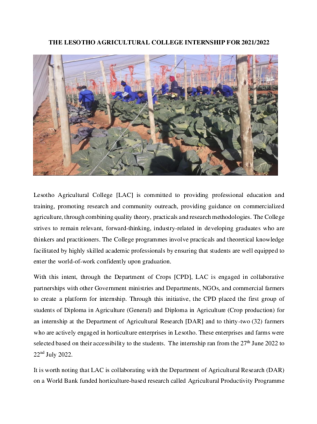
Lesotho Agricultural College (LAC) student internship at the Department of Agricultural Research

Type
File
Date of Publication
Aug 01, 2022
Description/Abstract

Lesotho Agricultural College [LAC] is committed to providing professional education and training, promoting research and community outreach, providing guidance on commercialized agriculture, through combining quality theory, practicals and research methodologies. The College strives to remain relevant, forward-thinking, industry-related in developing graduates who are thinkers and practitioners. The College programmes involve practicals and theoretical knowledge facilitated by highly skilled academic professionals by ensuring that students are well equipped to enter the world-of-work confidently upon graduation.

With this intent, through the Department of Crops [CPD], LAC is engaged in collaborative partnerships with other Government ministries and Departments, NGOs, and commercial farmers to create a platform for internship. Through this initiative, the CPD placed the first group of students of Diploma in Agriculture (General) and Diploma in Agriculture (Crop production) for an internship at the Department of Agricultural Research [DAR] and to thirty-two (32) farmers who are actively engaged in horticulture enterprises in Lesotho. These enterprises and farms were selected based on their accessibility to the students. The internship ran from the 27th June 2022 to 22nd July 2022.

Author or Institution as Author
Department of Agricultural Research
Co-authors

Lesotho Agricultural College

Language
Category

Sound and Cohesively Implemented Rural Development Strategies: A Missing Link in Africa’s Fight Against Poverty?

Date of Publication
Jun 01, 2022
Description/Abstract

Success in fighting poverty in Africa will largely depend on the extent to which rural poverty is reduced as it is largely a rural phenomenon. By examining the rural development strategies of the East African Community, Economic Community of West African States and the Association of South East Asian Nations, the purpose of this study was to determine their relationship to rural poverty reduction. The Rural Development Strategy Soundness Model and Rural Web Model tools were used to examine the soundness and cohesiveness of implementation, respectively. The results showed that rural poverty declined where a rural development strategy had both been sound and cohesively implemented. We concluded that a positive correlation exists between a sound and cohesively implemented rural development strategy and rural poverty reduction. We deduced from this that the former is a missing link in Africa’s fight against rural poverty

Author or Institution as Author
Martin Muchero
Co-authors

Charles L. Machethe

Language
Category
Resource Type
Citation

Tichaona Muchero & Charles L. Machethe (2021): Sound and cohesively implemented rural development strategies: A missing link in Africa’s fight against Poverty? Development Southern Africa

Sound and Cohesively Implemented Rural Development Strategies: A Missing Link in Africa’s Fight Against Poverty?

Date of Publication
Jun 01, 2022
Description/Abstract

Success in fighting poverty in Africa will largely depend on the extent to which rural poverty is reduced as it is largely a rural phenomenon. By examining the rural development strategies of the East African Community, Economic Community of West African States and the Association of South East Asian Nations, the purpose of this study was to determine their relationship to rural poverty reduction. The Rural Development Strategy Soundness Model and Rural Web Model tools were used to examine the soundness and cohesiveness of implementation, respectively. The results showed that rural poverty declined where a rural development strategy had both been sound and cohesively implemented. We concluded that a positive correlation exists between a sound and cohesively implemented rural development strategy and rural poverty reduction. We deduced from this that the former is a missing link in Africa’s fight against rural poverty

Author or Institution as Author
Martin Muchero
Co-authors

Charles L. Machethe

Language
Category
Resource Type
Citation

Tichaona Muchero & Charles L. Machethe (2021): Sound and cohesively implemented rural development strategies: A missing link in Africa’s fight against Poverty? Development Southern Africa

National Agricultural Policy (NAP) for Lesotho Diagnostic Report Validation Workshop

Type
Date of Publication
Mar 01, 2022
Description/Abstract

This article is about the worshop that was held for the diffent stakehoders in Lesotho to present the diagnostic report on the work done for the development of the National Agricultural Policy for Lesotho. 

Author or Institution as Author
Rethabile Nchee
Institution
Department of Agricultural Research
Language
Category
Resource Type

Protein and iron contents and bio accessibility in local modified diets for children aged 6 to 23 months in Bukoba, Tanzania

Type
File
Date of Publication
Dec 01, 2017
Description/Abstract

Micronutrient deficiencies often occur as part of a cycle of malnutrition and may be coupled with protein energy malnutrition. One of the measure to fight malnutrition is through participatory dietary modification was used. Five recipes of banana-based porridges from two EAHB ‘nshakala’ and AAB ‘bira’ banana varieties and three maize-based porridges were formulated in combination with other ingredients. The contents of Iron and protein in separate ingredients and in modified recipes were analysed using flame atomic absorption spectrophotometry and Kjeldahl´s method, respectively, and bio-accessibility of iron was estimated using invitro simulating gastrointestinal digestion method. Beans were a good source of both iron and protein while groundnuts flour was a good source of protein. Contribution of iron and protein in recommended daily allowance (RDA) ranged from 75.3 to 458% and 106 to 146% in a portion of 500g respectively. Iron bioaccessibility in all recipes ranged from 7.4% to 31.1%. Iron in porridge recipes (6OFSP, 7B) was more bio-accessible. The developed and improved recipes showed great potential of contributing substantially to iron and protein needs of children 6-23 months. The importance of food diversification for intake of iron and protein is discussed.

Author or Institution as Author
Nkuba et al.
Co-authors

Kinabo Joyce;  Mwanri Akwilina Wendelin and Ekesa Beatrice

Institution
Tanzania Food and Nutrition Center
Language
Category
Citation

Nkuba et.al (2017): Protein and iron contents and bio accessibility in local modified diets for children aged 6 to 23 months in Bukoba, Tanzania. African Journal of Food Science and Technology (ISSN: 2141-5455) Vol. 8(9) pp. 162-170, December, 2017 DOI: http:/dx.doi.org/10.14303/ajfst.2017.152 Available online @http://www.interesjournals.org/AJFST Copyright ©2017 International Research Journals

Subscribe to Journal Article

Funding Partners