VARIETY CATALOGUE OF COMMON BEANS (Phaseolus Vulgaris) IN TANZANIA

Date of Publication
Dec 01, 2022
Description/Abstract

COMMON BEANS (Phaseolus Vulgaris) RESEARCH IN TANZANIA

Common bean (Phaseolus vulgaris L.) plays a paramount role in the livelihoods of smallholder farmers in Tanzania; as a food security crop and source of income.  Both the cultivated area and bean production level has increased over the years since 1995. The upward trend can be attributable to research efforts by National Agricultural Research System (NARS) in collaboration with CIAT/PABRA which have resulted in identification and development of several improved bean varieties tolerant to environmental stresses. This has increased bean productivity from 0.5 MT/Ha in 1974 to 1.4 t/ha in 2021 (FAOSTAT, 2022).

However, bean production in the country is limited by several biotic and non-biotic constraints. Major constraints include, genetically low yielding varieties, diseases, insect pests and poor soil fertility, especially low soil nitrogen and phosphorus. In view of both the diversity of the constraints and the fact that common bean is largely a “resource -poor farmer’s crop”; development and dissemination of improved bean genotypes is the most viable option for promoting bean productivity in Tanzania.

Frequent droughts in most East and Central African countries have led to food shortages, malnutrition, social instability and reliance on food aid (IGAD, 2007). This scenario has underscored the need for improved crop varieties and associated technologies which assure farmers of a reasonable harvest in rapidly changing production environments.

Due to high demand for beans, partly as a result of rapid population growth, its demand has outstripped supply, with some countries in the region becoming net bean importers. The overall objective for the bean research Programme is to contribute to the attainment of sustainable food self-sufficient at household and national level, increase income generation, employment growth and enhanced earnings through the development and dissemination of appropriate and environmentally friendly technologies.

COMMON BEANS (Phaseolus Vulgaris) VARIETIES RELEASED IN TANZANIA

 The bean research program under the Tanzania Agricultural Research Institute (TARI) has released high productive, multiple tolerant and nutrient dense common bean varieties. This catalogue gives a description of 41 released bean varieties among them six (6) are climbing types and 35 bush types. For each variety, the catalogue provides identification, morphological and agronomic characteristics, and recommended production areas.


Author or Institution as Author
Tanzania Agricultural Research Institute (TARI)
Co-authors

Ndimbo, M., Shida, N., Mbiu, J., Kilango, M., Madata, C., Binagwa, P. and Kasuga, R. (2022). Variety Catalogue of Common Beans (Phaseolus Vulgaris) in Tanzania.  TARI Research Publication No.1Ndimbo, M., Shida, N., Mbiu, J., Kilango, M., Madata, C., Binagwa, P. and Kasuga, R. (2022). Variety Catalogue of Common Beans (Phaseolus Vulgaris) in Tanzania.  TARI Research Publication No.1

Institution
Tanzania Agricultural Research Institute
Language
Category
Resource Type
Citation

Ndimbo, M., Shida, N., Mbiu, J., Kilango, M., Madata, C., Binagwa, P. and Kasuga, R. (2022). Variety Catalogue of Common Beans (Phaseolus Vulgaris) in Tanzania.  TARI Research Publication No.1

The Better Life Book

Date of Publication
Jun 01, 2022
Description/Abstract

The Better Life Book will bring hope by giving answers to our food and income needs. The book will help us as a community and as families to: Ÿ increase crop harvests without expensive inputs (like fertilizers and other chemicals), Ÿ protect and benefit from the natural resources such as wildlife, Ÿ build a foundation for community leaders to solve problems, Ÿ secure a better future for our families, and Ÿ leave fertile, productive land for our children's future.

Author or Institution as Author
COMACO
Co-authors

GIZ

Institution
COMACO
Language
Category
Resource Type
Citation

Community Markets for Conservation (2015), COMACO Better life Book 2018, Zambia

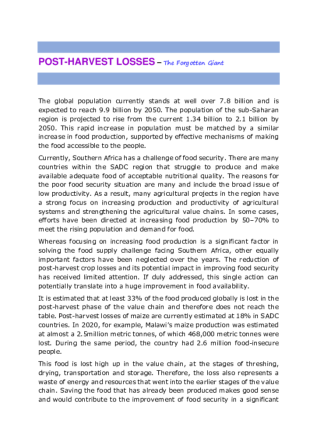
Post-Harvest Losses-The Forgotten Giant

Type
File
Date of Publication
Oct 01, 2021
Description/Abstract

The article is about Post Harvest Losses. 

Author or Institution as Author
CCARDESA
Co-authors

Dr Simon Mwale

Institution
CCARDESA
Language
Category
Resource Type
Citation

Mwale, S. 2021 Post-Harvest Losses; The forgotten Giant,2pgs. 

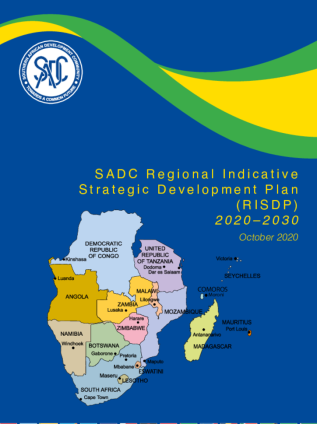
SADC Regional Indicative Strategic Development Plan (RISDP) 2020–2030

Type
File
Date of Publication
Aug 01, 2021
Description/Abstract

The Southern African Development Community’s (SADC) Regional Indicative Strategic Development Plan (RISDP) 2020–2030 draws impetus from the organisation’s Vision 2050, which envisages “a peaceful, inclusive, competitive, middle- to high-income industrialised region, where all citizens enjoy sustainable economic well-being, justice, and freedom”.

Author or Institution as Author
SADC
Institution
SADC
Language
Category
Citation

Southern African Development Community (SADC) Regional Indicative Strategic Development Plan (RISDP) 2020–2030, Gaborone, Botswana, 2020.

Climate Smart Fertiliser Application Options

Type
File
Date of Publication
Mar 01, 2021
Description/Abstract

This Decision Tool aims to help field-level extension staff make climate-smart decisions on which fertiliser application option best suits their farmers’ context. This tool is not designed as a technical guide to implementation. It is designed to assist extension staff in making climate-smart decisions on improvements to their farming systems with their clients/farmers.

Author or Institution as Author
CCARDESA
Co-authors

ACCRA Programme

Institution
CCARDESA
Language
Category
Resource Type
Citation

CCARDESA 2019. Knowledge Product 21. Climate Smart Fertiliser Application Options

CCARDESA Secretariat, Gaborone, Botswana.pg16

Climate Smart Pest and Disease Control Options for Sorghum &Maize

Type
File
Date of Publication
Mar 01, 2021
Description/Abstract

This Decision Tool aims to help field-level extension staff make climate-smart decisions on which pest and disease control options best suit their farmers’ context. This tool is not designed as a technical guide to implementation; it is intended to assist extension staff in making climate-smart decisions on improvements to their farming systems with their clients/farmers.

Author or Institution as Author
CCARDESA
Co-authors

ACCRA Programme

Institution
CCARDESA
Language
Category
Resource Type
Citation

CCARDESA 2019. Knowledge Product 19. Climate Smart Pest and Disease Control Options for Sorghum &Maize. CCARDESA Secretariat, Gaborone, Botswana.pg18


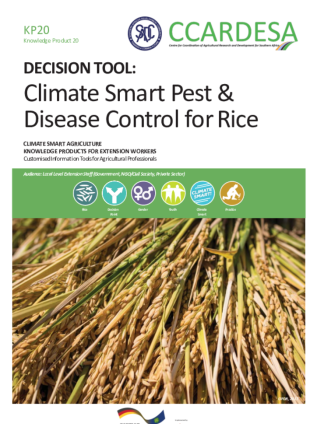
Climate Smart Pest & Disease Control for Rice

Type
File
Date of Publication
Mar 01, 2021
Description/Abstract

This Decision Tool aims to help field-level extension staff make climate-smart decisions on which pest and disease control option best suits their farmers’ context. This tool is not designed as a technical guide to implementation. It is designed to assist extension staff in making climate-smart decisions on improvements to their farming systems with their clients. Reference to technical guides relevant to the practices and technologies outlined are included at the end of the tool.

Author or Institution as Author
CCARDESA
Co-authors

ACCRA Programme 

Institution
CCARDESA
Language
Category
Resource Type
Citation

CCARDESA 2019. Knowledge Product 20. Climate Smart Pest & Disease Control for Rice: CCARDESA Secretariat, Gaborone, Botswana.pg14


CCARDESA Medium-Term Operational Plan 2021-2025

Type
File
Date of Publication
Mar 01, 2021
Description/Abstract

The Centre for Coordination of Agricultural Research and Development for Southern Africa (CCARDESA) is a subsidiary implementing institution of the Southern African Development Community (SADC) Secretariat. This MTOP for CCARDESA’s is based on the CCARDESA long-term Strategic Plan (2018 - 2028) and the Agricultural Innovation Systems (AIS) paradigm for Agricultural Research for Development (AR4D) to align R&D organizations to sub-sector, sector and ultimately, national and regional development objectives.

Author or Institution as Author
CCARDESA
Language
Category
Resource Type

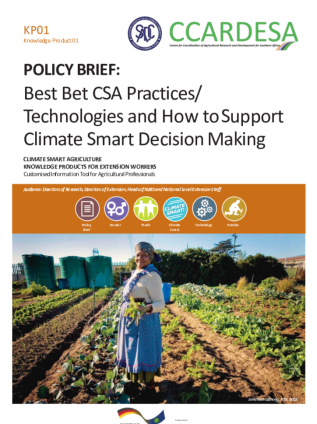
Best Bet CSA Practices/ Technologies and How to Support Climate Smart Decision Making

Type
File
Date of Publication
Mar 01, 2021
Description/Abstract

CSA goes beyond innovative technologies and practices like drought-resistant varieties or soil and water conservation measures. To achieve the multiple objectives of productivity, food security, enhanced farmer resilience and reduced greenhouse gas emissions, CSA must adopt a systems perspective. A systems approach aims to view a problem as part of an entire system, rather than considering problems in isolation.

Author or Institution as Author
CCARDESA
Co-authors

ACCRA Programme

Institution
CCARDESA
Language
Category
Resource Type
Citation

CCARDESA 2019. Knowledge Product 01: Best Bet CSA Practices/ Technologies and How to Support Climate-Smart Decision Making: CCARDESA Secretariat, Gaborone, Botswana.pg12


Assurance indicielle : Comment fonctionne t-elle et est-ce respectueux du climat ?

Type
File
Date of Publication
Mar 01, 2021
Description/Abstract

L'agriculture intelligente face au climat (AIC) est une approche visant à réorienter les systèmes agricoles pour soutenir durablement et efficacement la sécurité alimentaire1. L'AIC comprend des actions à différents niveaux, depuis les parcelles agricoles, les systèmes agricoles et les paysages jusqu'aux contextes nationaux et mondiaux. 

Author or Institution as Author
CCARDESA
Co-authors

ACCRA Programme

Institution
CCARDESA
Language
Category
Resource Type
Citation

CCARDESA 2019:  KP24 Outil de Connaissance 24. Assurance indicielle : Comment fonctionne t-elle et est-ce respectueux du climat ? CCARDESA Secretariat, Gaborone, Botswana.pg10 


Subscribe to Decision Tool

Funding Partners