Green Climate Fund (GCF) - Safeguards: Gender

Type
File
Date of Publication
Dec 01, 2018
Description/Abstract

International Climate Finance Funds require certain safeguards. For accessing the Green Climate Fund (GCF) Gender Assessments and Action Plans need to be developed, because impacts of climate change affect women and men differently. Women are the hardest hit by dramatic shifts in climatic conditions. Women’s mortality from climate-related disasters is higher than that of men. Compared to men, domestic burdens (e.g. collection of firewood and water) of women increase substantially with various manifestations of climate change.

Author or Institution as Author
Frank Udo Hoeggel
Institution
Green Climate Fund
Language
Resource Type
Citation

Hoeggel, F.U. (2018). Green Climate Fund (GCF) - Safeguards: Gender.

Green Climate Fund (GCF) - Safeguards: the GCF Indigenous Peoples Policy

Type
File
Date of Publication
Dec 01, 2018
Description/Abstract

International Climate Finance Funds require certain safeguards. As an example, the Green Climate Fund (GCF) has a Indigenous Peoples Policy that reflects the importance of fully and effectively engaging with indigenous peoples in the design, development and implementation of the strategies and activities to be financed by GCF, while respecting their rights.

Author or Institution as Author
Frank Udo Hoeggel
Institution
Green Climate fund (GCF)
Language
Resource Type
Citation

Hoeggel, F.U. (2018). Green Climate Fund (GCF) - Safeguards: the GCF Indigenous Peoples Policy.

The Promotion of Science and Technology for Agricultural Development (PSTAD) in the SADC Region

Type
File
Date of Publication
Oct 01, 2013
Description/Abstract

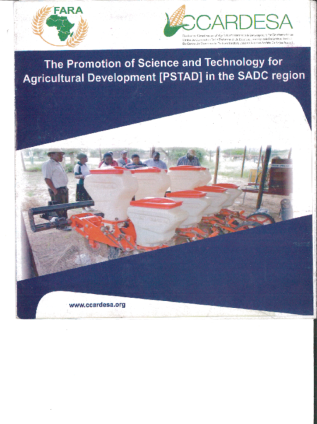
This brochure presents the 'Promotion of Science and Technology for Agricultural Development (PSTAD) in the SADC region' project, which has been implemented by CCARDESA.

The project was supported by the Forum for Agricultural Research in Africa (FARA), and implemented sub-regional organisations (SROs) and National Agricultural Research Systems (NARS) in 34 African countries with funding from the African Development Bank. In the SADC sub region, PSTAD was being implemented in Angola, Malawi, Madagascar, Mozambique, Lesotho and Zambia.

The goal of the PSTAD project was to increase agricultural production and contribute to the achievement of food security and poverty reduction in Africa. Its main objective was to build the African agricultural research knowledge management capacity and support the dissemination and adoption of new and proven agricultural technologies.

Author or Institution as Author
CCARDESA
Institution
CCARDESA
Language
Resource Type
Citation

CCARDESA (2013). The Promotion of Science and Technology for Agricultural Development (PSTAD) in the SADC Region. Gaborone, Botswana.

CCARDESA's Climate Change Adaptation Strategy

Type
File
Date of Publication
May 01, 2015
Description/Abstract

CCARDESA's Climate Change Adaptation Strategy: Evidence from CCARPASA Project.

This brief outlines the challenge of adapting to climate change, identifies recent engagement and practices, and proposes future regional and country-level responses, with a focus on the constraints and conditions of smallholder farmers in the region, and the natural resources base upon which agriculture depends. This CCARDESA Climate Change Adaptation Strategy eventually becomes an integral part of CCARDESA's Medium Term Operational Plan (MTOP) and longterm overall strategy to deliver its mandate in an effective manner.

Author or Institution as Author
CCARDESA
Institution
CCARDESA
Language
Category
Resource Type
Citation

CCARDESA (2015). CCARDESA's Climate Change Adaptation Strategy.

CCARDESA - Environmental and social Management Framework

Type
File
Date of Publication
Mar 01, 2014
Description/Abstract

Implementation of the CCARDESA Mid Term Operational Plan (MTOP) is expected to have a positive impact on the environment by supporting the development and dissemination of agricultural technologies that promote sustainable use of land and water. The MTOP will also contribute towards reducing the vulnerability of poor rural households to climate shocks by promoting the adoption of climate smart agricultural practices. There is no doubt that CCARDESA’s footprint could be significant if no measures were put in place to guide the social and environmental responsibility of the work conducted in the sub-region.

Author or Institution as Author
CCARDESA
Institution
CCARDESA
Language
Category
Resource Type
Citation

CCARDESA (2014). Environmental and social management framework and pest management plan for CCARDESA. Gaborone, Botswana

Governance Manual - CCARDESA

Type
File
Date of Publication
Jul 01, 2011
Description/Abstract

This Governance Manual is a guide to CCARDESA’s governance institutions (Ministers responsible for Agriculture and Food Security, the General Assembly, CCARDESA Board of Directors and CCARDESA Secretariat) in the conduct of their responsibilities and duties. It is also a reference document for all CCARDESA stakeholders who wish to know how CCARDESA is governed. It assures development partners that CCARDESA observes the principles of good governance to which they are bound in allocating their resources.

Author or Institution as Author
CCARDESA
Institution
CCARDESA
Language
Category
Resource Type
Citation

CCARDESA (2011). Governance Manual. Gaborone, Botswana.

Climate change and variability assessment of maize value chain farming system in Malawi, Zambia and Zimbabwe - Vulnerability Assessment Report

Type
File
Date of Publication
Apr 01, 2018
Description/Abstract

This study examines the vulnerability to climate variability and change of the conventional maize value chain in the mid and low altitude agro-ecological zones of Malawi, agro-ecological zone II of Zambia and agro-ecological zone III of Zimbabwe. 

Author or Institution as Author
Munyaradzi Mutenje (CIMMYT)
Co-authors

Christian Thierfelder (CIMMYT), Mulundu Mwila (ZARI), Mphatso Gama (MACHINGA ADD) and Sepo Marongwe (AGRITEX)

Institution
CIMMYT
Language
Category
Resource Type
Citation

Mutenje, M. (2018). Climate change and variability assessment of maize value chain farming system in Malawi, Zambia and Zimbabwe. Vulnerability Assessment Report.

GCF Funding Proposal - Zambia: Gender Assessment

Type
File
Date of Publication
Apr 01, 2018
Description/Abstract

Gender Assessment and Action Plan - Zambia Renewable Energy Financing Framework

This gender assessment provides a summary of the gender equality situation in Zambia with a specific focus on women’s financial inclusion in the energy sector. The assessment identifies potential entry points to promote women’s participation as business leaders and owners in renewable and clean energy.

Language
Resource Type
Citation

Zambian Goverment (2018). Gender Assessment. Zambia Renewable Energy Financing Framework. Proposal for the Green Climate Fund (GCF).

GCF Funding Proposal - Namibia: Gender Action Plan

Type
File
Date of Publication
Mar 01, 2016
Description/Abstract

Gender Action Plan for Namibia's GCF Proposal: Climate Resilient Agriculture in three of the Vulnerable Extreme northern crop growing regions (CRAVE).

Author or Institution as Author
Environmental Investment Fund of Namibia
Institution
Environmental Investment Fund of Namibia
Language
Resource Type
Citation

Environmental Investment Fund of Namibia (2016). Gender Action Plan. Climate Resilient Agriculture in three of the Vulnerable Extreme northern crop growing regions (CRAVE). Proposal for the Green Climate Fund (GCF).

GCF Funding Proposal - Namibia: Gender Assessment

Type
File
Date of Publication
Mar 01, 2016
Description/Abstract

Gender Assessment Report for Namibia's GCF proposal: Climate Resilient Agriculture in three of the Vulnerable Extreme northern crop growing regions (CRAVE).

Author or Institution as Author
Environmental Investment Fund of Namibia
Institution
Environmental Investment Fund of Namibia
Language
Resource Type
Citation

Environmental Investment Fund of Namibia (2016). Gender Assessment. Climate Resilient Agriculture in three of the Vulnerable Extreme northern crop growing regions (CRAVE). Proposal for the Green Climate Fund (GCF).

Subscribe to CCARDESA Content

Funding Partners