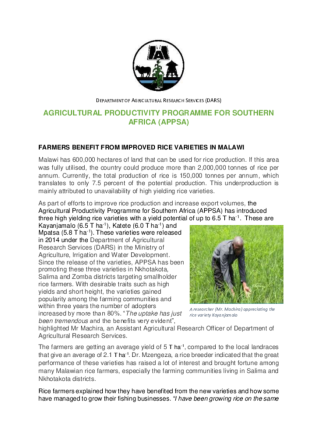
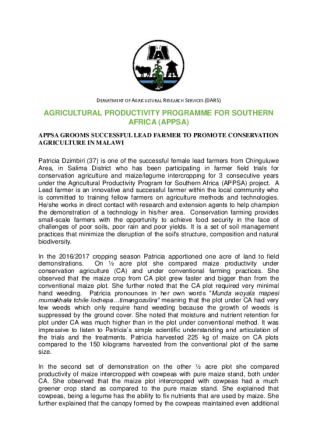
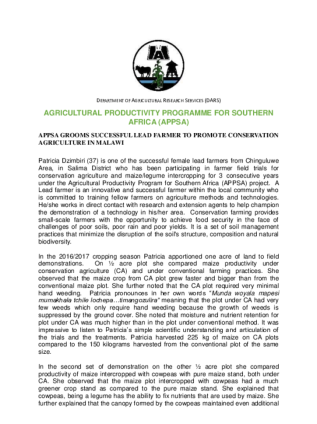
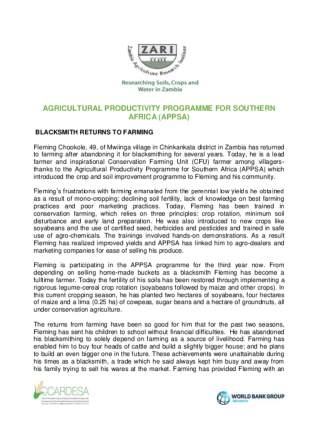
Groundnuts Seed Production Saves Farmers Against Falling Prices of “White Gold” In Petauke
Groundnuts farming
Groundnuts farming
APPSA Impact in onservation Farming
Impact story
Impact story
Dr. Baitsi Podisi from CCARDESA sat for an interview on the weekely radio programme Farmers Diary, on Gabz FM. The interview was originally aired on Thursday 18 April 2019. For more on Farmers Diary please visit: http://www.gabzfm.com/index.php/gabzfm-show-details/id/15/farmers-diary/
Farmers Diary. Gabz FM. 18 April 2019. Radi., Gaborone, Botswana.
This brochure describes the new CCARDESA ICKM System.
CCARDESA (2018). Regional Information, Communication and Knowledge Management (ICKM) System.
The Green Climate Fund (GCF) is the newest actor in the multilateral climate finance architecture and became fully operational in 2015, approving USD 168 million for its first eight projects just weeks before COP 21. The GCF is an operating entity of the Financial Mechanism of the UNFCCC. A legally independent institution hosted by South Korea, it has its own secretariat and the World Bank as its interim trustee but functions under the guidance of, and is accountable to, the UNFCCC COP. The 24 GCF Board members, with equal representation of developed and developing countries, and support from the secretariat have been working to operationalise the fund since their first meeting in August 2012. This year the GCF further developed essential policies and frameworks to receive, manage, programme and disburse finance as well as measure and account for its results and impacts. It also accredited its first 20 implementing entities. The initial resource mobilisation effort that began in June 2014, raised USD 10.2 billion from 37 contributing countries (including eight developing countries). In 2015, USD 5.8 billion of pledged finance was formalised through contribution agreements. Heading into COP 21 in Paris, this Climate Finance Fundamental provides a snapshot of the operationalisation and functions of the Fund. The Fund’s role in a post-2020 climate regime as the major finance channel under the Convention as well as the scale of its resourcing remain to be clarified and confirmed in Paris. Past editions of this Climate Finance Fundamental detail the design and operationalisation phases of the Fund.
Schalatek, L. and Nakhooda, S. and Watson, C. (2015). The Green Climate Fund - Climate Finance Fundamentals. Climate Funds Update. Heinrich Böll Stiftung North America and Overseas Development Institute, Washington DC and London

The objective of this user’s guide is to assist accredited entities to develop a concept note (CN) to be submitted to the Green Climate Fund ("Fund").
As a voluntary step, accredited entities may use the concept note to present a summary of a proposed project/programme to the Fund in order to receive feedback and recommendations from the Secretariat on whether the concept is broadly aligned with the Fund’s objectives. The recommendation will clarify whether the concept is endorsed, not endorsed with a possibility of resubmission, or rejected.
Green Climate Fund (2015). Concept Note User's Guide.
The Green Climate Fund (GCF) is a new global fund created to support the efforts of developing countries to respond to the challenge of climate change. GCF helps developing countries limit or reduce their greenhouse gas (GHG) emissions and adapt to climate change. It seeks to promote a paradigm shift to low-emission and climate-resilient development, taking into account the needs of nations that are particularly vulnerable to climate change impacts.
Green Climate Fund (2018). Green Climate Fund (GCF) - Basic information.
International Climate Finance Funds require certain safeguards.
In carrying out its mandate of promoting a paradigm shift towards low-emission and climate-resilient development pathways in the context of sustainable development, GCF will effectively and equitably manage environmental and social risks and impacts, and improve outcomes of all GCF-financed activities.
Hoeggel, F.U. (2018). Green Climate Fund (GCF) - Safeguards: Environmental and Social.