The Climate Smart Agriculture(CSA) Initiatives in Mozambique

Type
File
Date of Publication
Jun 01, 2020
Description/Abstract

This presentation highlights the Climate Smart Agriculture CSA) Initiatives in Mozambique

Author or Institution as Author
Ministry of Agriculture Mozambique
Institution
CCARDESA
Language
Resource Type
Citation

Ministry of Agriculture Mozambique(2020), The Climate Smart Agriculture Initiatives in Mozambique, pg.22

The Climate Smart Agriculture(CSA) Initiatives in Zimbabwe

Type
File
Date of Publication
Jun 01, 2020
Description/Abstract

This presentation highlights the Climate Smart Agriculture (CSA) in Zimbabwe

Author or Institution as Author
Ministry of Agriculture Zimbabwe
Co-authors

Dumisani Kutywayo

Institution
CCARDESA
Language
Resource Type
Citation

Dumisani Kutywayo,(2020), The Climate-Smart Agriculture(CSA) Intiatives in Zimbabwe, Pg.17

The Climate Smart Agriculture(CSA) Initiatives in Eswatini.

Type
File
Date of Publication
Jun 01, 2020
Description/Abstract

This presentation highlights the Climate Smart Agriculture Initiatives and priorities of the kingdom of Eswatini.

Author or Institution as Author
Ministry of Agriculture Eswatini
Co-authors

C. Tfwala, N.J. Dlamini and S. Dlamini

Institution
CCARDESA
Language
Resource Type
Citation

C. Tfwala, N.J. Dlamini and S. Dlamini (2020) The Climate-Smart Agriculture Initiatives in Eswatini, Pg.12

The Next Steps of the CAADXP4 Project Launch Meeting

Type
File
Date of Publication
Jun 01, 2020
Description/Abstract

The presentation gives a detailed outline of the next steps of the CAADPXP Project Launch held in Lusaka, Zambia

Author or Institution as Author
Moses Musikanga
Institution
CCARDESA
Language
Resource Type
Citation

S. Musikanga (2020), The Next Steps of CAADXP4 Launch Project, Pg.5

An Overview of the Comprehensive Africa Agriculture Development Programme ex-Pillar 4 (CAADP-XP4)

Type
File
Date of Publication
Jun 01, 2020
Description/Abstract

This presentation gives an overview of the CAADXP4 Project

Author or Institution as Author
Futhi Magagula
Institution
CCARDESA
Language
Resource Type
Citation

F.Magagula(2020), Overview of the CAADPX4 Project, Pg.20

CCARDESA Positioned for Climate Smart Agriculture Part 2

Type
File
Date of Publication
Jun 01, 2020
Description/Abstract

This is an article that introduces the modus operandi of CAADXP4 Project.

Author or Institution as Author
Dr. Simon Mwale
Institution
CCARDESA
Language
Resource Type
Citation

S.Mwale(2020) CCARDESA positioned for Climate-Smart Agriculture(CSA) Part 2

CCARDESA Positioned for Climate Smart Agriculture Part 1

Type
File
Date of Publication
Jun 01, 2020
Description/Abstract

This the article that introduced the CAADPXP4 programme of the CCARDESA secretariat

Author or Institution as Author
Dr. Simon Mwale
Institution
CCARDESA
Language
Resource Type
Citation

S.Mwale(2020) CCARDESA Positioned for Climate Smart Agriculture Part 1, 

APPSA Builds Capacity of Agricultural Researchers and Farmers in the SADC Region

Type
File
Date of Publication
Jun 01, 2020
Description/Abstract

Huge volumes of investments have been made in agricultural development projects worldwide; however, some of the projects fail because of lack or shortage of well- trained local expertise. Advice, lessons, and technical guidance are equally important in ensuring success and sustainability of agricultural projects. Human capital has been placed at the heart of knowledge production and is considered as one of the main forces that underlie countries’ ability to absorb and assimilate new technologies. Shortage of skills especially in developing countries has been identified as one of the key barriers to successful delivery and implementation of new agricultural technologies. It is therefore important that project designers incorporate capacity development strategies during project design phase to ensure that there is a plan of capacity building for relevant stakeholders.

Language
Category
Resource Type

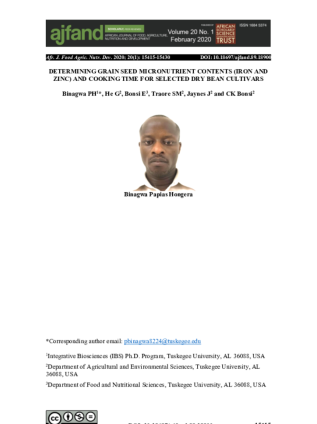
DETERMINING GRAIN SEED MICRONUTRIENT CONTENTS (IRON AND ZINC) AND COOKING TIME FOR SELECTED DRY BEAN CULTIVARS

File
Date of Publication
Feb 01, 2020
Description/Abstract

ABSTRACT

Micronutrient deficiencies caused by lack of Iron (Fe), Zinc (Zn) and Vitamin A in the human body have negative effect with regard to health issues worldwide. Imbalances of these nutrients in the human body create a significant risk of illness and mortality among children under five years of age, pregnant women and lactating mothers. Some of the food crops that thought to reduce micronutrients include rice, sweet potato, dry bean, sorghum, corn, barley, and finger millet have been biofortified through ways of agronomic practices, conventional breeding, or modern biotechnology. Despite the fact that dry beans address Fe and Zn deficiencies based on recommended dietary allowances (RDA),  they often take a long time to cook. Many communities have limited cooking resources which make them rely on burning wood, charcoal or other biofuels that require more time and money. This study identified dry bean cultivars with enhanced Fe and Zn concentration levels and fast cooking time from 200 cultivars. Experiments were conducted under a complete randomized block design with two replications, 200 cultivars, and two different agro-ecologies. Iron and Zinc concentration levels were determined from the harvested seed grains of each bean cultivar using X-Ray Fluorescence while cooking time of similar cultivars were determined using the Mattson cooker. The variation of Fe and Zn concentration was significantly different at (p<0.001) among the treatments and environments. The range was between 46.76 mg/kg to 107.25 mg/kg for Fe and 21.70 mg/kg to 42.35 mg/kg for Zn concentration. From two testing sites, the concentration of Fe was higher at Lyamungo than SARI and Zn showed inversely proportional to these tested sites which means that the environment and soils were not homogenous in terms of soil health. The highest water uptake was 61.54% and the lowest was 3.70% and the higher the water uptake the lower the cooking time. Fast cooking time was ~15 min and the longest was ~76 min. Small seed-sized cultivars showed fast cooking time than large-seeded. These two traits in identified cultivars will enhance dry bean consumption, which will contribute to alleviating micronutrient deficiencies in this global growing population.


Key words: Micronutrient deficiencies, Biofortification, Cultivars, Cooking time, Vulnerable group, Variation

Author or Institution as Author
Binagwa et al.
Co-authors

He G2, Bonsi E3, Traore SM2, Jaynes J2 and CK Bonsi2

Language
Category
Resource Type
Citation

Binagwa PH1*, He G2, Bonsi E3, Traore SM2, Jaynes J2 and CK Bonsi (2020). DETERMINING GRAIN SEED MICRONUTRIENT CONTENTS (IRON AND ZINC) AND COOKING TIME FOR SELECTED DRY BEAN CULTIVARS. Afr. J. Food Agric. Nutr. Dev. 2020; 20(1): 15415-15430                         DOI: 10.18697/ajfand.89.18900

Policy Frameworks and Programmes

Type
File
Date of Publication
May 01, 2020
Description/Abstract

The presentation highlights the CSA Policy Frameworks and Programmes in Botswana 
 

Author or Institution as Author
Ministry of Agriculture-Botswana
Co-authors

Kethusegile Raphaka 

Institution
CCARDESA
Language
Resource Type
Citation

Kethusegile Raphaka (2020) Policy Frameworks and Programmes, Pg.7

Subscribe to CCARDESA Content

Funding Partners