Genetic Diversity of Mitochondrial DNA of Bemisia tabaci (Gennadius) (Hemiptera: Aleyrodidae) Associated with Cassava and the Occurrence of Cassava Mosaic Disease in Zambia

Type
File
Date of Publication
Sep 01, 2020
Description/Abstract

Bemisia tabaci is an important vector of cassava brown streak viruses and cassava mosaic begomoviruses, the causal agents of cassava brown streak disease and cassava mosaic disease (CMD), respectively. A study was carried out to determine the genetic variability of B. tabaci associated with cassava and the occurrence of CMD in Zambia in 2013 and 2015. Phylogenetic analysis showed the presence of only the sub-Saharan Africa 1 (SSA1) genetic group in Zambia. The SSA1 population had three population subgroups (SGs): SSA1-SG1, SSA1-SG2 and SSA1-SG3. All three SSA1 population subgroups occurred in Western Province. However, only SSA1-SG3 occurred in Eastern Province, while only SSA1-SG1 occurred in North Western and Luapula Provinces. Adult B. tabaci were most abundant in Western Province in 2013 (11.1/plant) and 2015 (10.8/plant), and least abundant (0.2/plant) in Northern Province in both 2013 and 2015. CMD was prevalent in all seven provinces surveyed, with the highest incidence recorded in Lusaka Province in both 2013 (78%) and 2015 (83.6%), and the lowest in Northern Province in both 2013 (26.6%) and 2015 (29.3%). Although SSA1-SG1 occurred at greater abundances than the other subgroups, there was no direct association demonstrated between whitefly subgroup and incidence of CMD. Establishing which B. tabaci genetic groups and populations are associated with CMD and their distribution in the country is a key factor in guiding the development of CMD control strategies for cassava-dependent households.

Author or Institution as Author
Patrick Chiza Chikoti
Co-authors

Mathias Tembo , James Peter Legg , Rudolph Rufini Shirima, Habibu Mugerwa and Peter Sseruwagi 

Institution
ZARI
Language
Category
Citation

Chikoti,P., Tembo, M., Legg . P.J., Shirima, R., Mugerwa, H., & Sseruwagi, P. (2020). Genetic Diversity of Mitochondrial DNA of Bemisia tabaci (Gennadius) (Hemiptera: Aleyrodidae) Associated with Cassava and the Occurrence of Cassava Mosaic Disease in Zambia. Insect

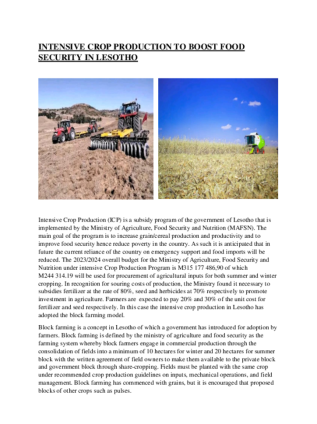
INTENSIVE CROP PRODUCTION TO BOOST FOOD SECURITY IN LESOTHO

Type
File
Date of Publication
Sep 01, 2023
Description/Abstract

The article is about the initiative taken by the government of Lesotho through the Ministry of Agriculture and Food Security, whereby Intebsive Crop Production through formation of blocks is practised in order to increase production. This is done in an effort to attain Food Security.

Author or Institution as Author
Mamoholi Mphutlane
Institution
Agricultural Information Services
Language
Category
Resource Type

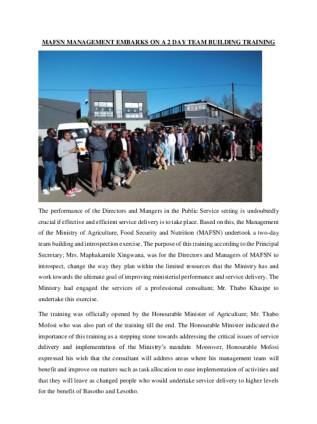
MAFSN MANAGEMENT EMBARKS ON A 2 DAY TEAM BUILDING TRAINING

Type
File
Date of Publication
Sep 01, 2023
Description/Abstract

This article is about the team building exercise that the Managment of the Ministry of Agriculture, Food Security and Nutrition undertook to "self introspect". The reasoning behind this training was the lack of coorination between the Ministry's Departments and its Donor Funded Projects which has led to the Minstry's clients suffering due to limitted and sometimes poorly provided services. The engaged consultant was able to creat awareness to the Managers on the dangers of the "silo mentality" and encouraged them to work together for the benefit of Basotho farmers. The participation of the Minister, PS and DPS gave participants moral and encouragement that the decisions and plans made during this traning will be implemented with full supoort from these three offices. 

Author or Institution as Author
RETHABILE NCHEE
Institution
Department of Agricultural Research
Language
Category
Resource Type

Smallholder Cassava Planting Material Movement and Grower Behavior in Zambia: Implications for the Management of Cassava Virus Diseases

Type
File
Date of Publication
Apr 01, 2021
Description/Abstract

Cassava (Manihot esculenta) is an important food crop across subSaharan Africa, where production is severely inhibited by two viral diseases, cassava mosaic disease (CMD) and cassava brown streak disease (CBSD), both propagated by a whitefly vector and via human-mediated movement of infected cassava stems. There is limited information on growers’ behavior related to movement of planting material, as well as growers’ perception and awareness of cassava diseases, despite the importance of these factors for disease control. This study surveyed a total of 96 cassava subsistence growers and their fields across five provinces in Zambia between 2015 and 2017 to address these knowledge gaps. CMD symptoms were observed in 81.6% of the fields, with an average incidence of 52% across the infected fields. No CBSD symptoms were observed. Most growers used planting materials from their own (94%) or nearby (<10 km) fields of family and friends, although several large transactions. over longer distances (10 to 350 km) occurred with friends (15 transactions), markets (1), middlemen (5), and nongovernmental organizations (6). Information related to cassava diseases and certified clean (diseasefree) seed reached only 48% of growers. The most frequent sources of information related to cassava diseases included nearby friends, family, and neighbors, while extension workers were the most highly preferred source of information. These data provide a benchmark on which to plan management approaches to controlling CMD and CBSD, which should include clean propagation material, increasing growers’ awareness of the diseases, and increasing information provided to farmers (specifically disease symptom recognition and disease management options).

Author or Institution as Author
Anna Maria Szyniszewska
Co-authors

Patrick Chiza Chikoti, Mathias Tembo,Rabson Mulenga, Christopher Aidan Gilligan, Frank van den Bosch, and Christopher Finn McQuaid

Institution
ZARI
Language
Category
Citation

Szyniszewska, A M.,  Chikoti, P., Tembo, M., Mulenga, R., Gilligan, C A., Bosch, F V D,& McQuaid,  C M., (2021). Smallholder Cassava Planting Material Movement and Grower Behavior in Zambia: Implications for the Management of Cassava Virus Diseases. Disease Control and Integrated Management

Bamboo Production in Malawi - A Case of Mr. Goodman

Date of Publication
Dec 01, 2022
Description/Abstract

The pangs of climate change are real coupled with the rampant deforestation that is happening due to increased land pressure. This is an inspirational video where Mr. Andrew Goodmans is advocating for farmers to grow Giant Bamboo. Bamboos can cater for household and community needs in less than five years. The household only needs 10 bamboo seedling at afordable price.

Author or Institution as Author
Department of Agricultural Research Services, Ministry of Agriculture, Malawi
Co-authors

Ben Chisama

Institution
Department of Agricultural Research Services, Ministry of Agriculture, Malawi
Language
Category
Resource Type
Citation

    Chisama, B., 2022.  Bamboo Production in Malawi: A Case of Mr. Goodman. Department of Agricultural Research Services, Ministry of Agriculture, Malawi

Malawi is now exporting its Mangoes to South Africa _ Part 2

Date of Publication
Dec 01, 2022
Description/Abstract

This video demonstrates a new cost effective and innovative approach of in-Country Research Teams to conduct a phytosanitary and other assessments of their produce, capture them on a video and send it to the potential market.  In turn, the potential buyers watches the video and make a recommendation and approves whether to open their market to the seller/producer or not. Consequently, the market players saved a lot of time and financial resources for a team of deligates was supposed to travel from the South Africa to Malawi. This Video resulted in the opening up of the South African Market to Malawian mangoes, Right now (since 2023), Malawi is exporting Mangoes to South Africa.

NPPO-Malawi compiled two videos of pre-harvest and post-harvest handling processes that were inspected at Malawi Mangoes Limited in Salama. The video shows how the client complied with the requirements for the export markets including South Africa. NPPO-Malawi conducted the field inspections in three stages as outlined on the Import Permit: 1) Flowering; 2) Fruiting and 3) Harvest and post-harvest stages. This is Part 1 of the videos.

Author or Institution as Author
Department of Agricultural Research Services, Ministry of Agriculture, Malawi
Institution
Department of Agricultural Research Services, Ministry of Agriculture, Malawi
Language
Category
Resource Type
Citation

Ministry of Agriculture (2022). Mango Export Requirements and Assessments conducted by the NPPO Malawi. NPPO Malawi, The Director of Agricultural Research Services P.O. Box 30779 Lilongwe Malawi.  

Malawi is now exporting its Mangoes to South Africa _ Part 1

Date of Publication
Dec 01, 2022
Description/Abstract

This video demonstrates a new cost effective and innovative approach of in-Country Research Teams to conduct a phytosanitary and other assessments of their produce, capture them on a video and send it to the potential market.  In turn, the potential buyers watches the video and make a recommendation and approves whether to open their market to the seller/producer or not. Consequently, the market players saved a lot of time and financial resources for a team of deligates was supposed to travel from the South Africa to Malawi. This Video resulted in the opening up of the South African Market to Malawian mangoes, Right now (since 2023), Malawi is exporting Mangoes to South Africa.

NPPO-Malawi compiled two videos of pre-harvest and post-harvest handling processes that were inspected at Malawi Mangoes Limited in Salama. The video shows how the client complied with the requirements for the export markets including South Africa. NPPO-Malawi conducted the field inspections in three stages as outlined on the Import Permit: 1) Flowering; 2) Fruiting and 3) Harvest and post-harvest stages. This is Part 1 of the videos.

Author or Institution as Author
Department of Agricultural Research Services, Ministry of Agriculture, Malawi
Co-authors

Department of Agricultural Research Services, Ministry of Agriculture, Malawi

Institution
Department of Agricultural Research Services, Ministry of Agriculture, Malawi
Language
Category
Resource Type
Citation

Ministry of Agriculture (2022). Mango Export Requirements and Assessments conducted by the NPPO Malawi. NPPO Malawi, The Director of Agricultural Research Services P.O. Box 30779 Lilongwe Malawi.  

Maize and groundnut crop production among rural households in Zambia: Implications in the management of aflatoxins

Type
File
Date of Publication
Jul 01, 2023
Description/Abstract

Maize and groundnut are important crops for both commercial and smallholder farming in Zambia, whose production is being threatened by their susceptibility to aflatoxin contamination. Despite this threat, there is limited knowledge of household growers’ behaviour and applications related to suitable agricultural management practices, as well as growers’ perception and knowledge of aflatoxins and their effects. This limited knowledge has major implications for acute human health effects such as liver cirrhosis and death, cancer, stunting in children, immune system suppression, impaired food conversion, and reduced livestock productivity and/or increased livestock mortality. This cross-sectional survey of smallholder household growers in Zambia was conducted to identify the gaps in the knowledge and application of aflatoxin-associated agricultural management practices. A sample of 3865 maize- and groundnut-producing smallholder farm households were selected in 27 priority districts implementing the Scaling Up Nutrition (SUN)/First 1000 Most Critical Days Programme (MCDP) Phase II. Among the five pre-harvest management practices for maize and groundnuts – namely, controlling weeds, timely planting, controlling pests, and applying basal and top-dressing fertilisers – few households (8%) reported practising all of them. Among the recommended techniques for harvesting and handling maize and groundnuts, the most common harvest-management practices under maize production were drying (95.2% of households) and sorting at harvest (72%). In contrast, very few households (2%) practised at least three of four maize harvest management practices. Similarly, very few households (10%) practised at least 4 of the 6 groundnut harvest-management measures. Comparatively, post-harvest and storage management practices were more commonly practised, although most households did not practise all six post-harvest and storage management measures. Overall, very few households (1% for maize and 4% for groundnuts) were observed to be practising at least 12 of the 14 recommended management practices, implying that there are considerable gaps in the implementation of aflatoxin-related management practices along all stages of maize and groundnut production, consequently posing a significant threat to health and contributing to malnutrition levels in Zambia. As such, there is a need to develop tailored interventions and trainings for farming households, extension officers, and frontline health workers to prevent and manage aflatoxin contamination at different stages of crop production. Furthermore, the elimination of policy constraints, practical barriers of affordability and consumer awareness, and the value attached to the commercial product of Aflasafe, noted to reduce aflatoxin contamination by 80–100%, are of utmost urgency.

Author or Institution as Author
Mathias Tembo
Co-authors

Mary Lubungu, Fwasa K. Singogo, Mike Mwanza, Mathews Onyango,  Patricia Sakala, Mary Pat Selvaggio, Edna Berhane

Institution
ZARI, IAPRI, NFNC, Khulisa
Language
Category
Citation

Tembo,M.,* ,Lubungu ,M.,  Singogo ,F., Mwanza, M.,Onyango, M., Sakala, P., Selvaggio,M., & Berhane,E., (2023). Maize and groundnut crop production among rural households in Zambia: Implications in the management of aflatoxins [online] Food Control


An assessment of the potential for scaling Malawi’s wheat production for domestic consumption and export

Date of Publication
Nov 01, 2022
Description/Abstract

Despite having potential, Malawi’s wheat production has been characterized by low production and productivity. The prospects for scaling up wheat production in Malawi are based on the suitability of different areas for wheat production, increase in global prices and existence of large and growing domestic and regional export markets. Scaling production of wheat in Malawi will fail unless challenges are addressed. These include overreliance on rainfed production, limited access to improved varieties for wheat, fertilizers, capacity building in best agronomic practices, and lack of access to existing lucrative markets. There is need to conduct a value chain analysis with key stakeholders to assist in developing the value chain

Author or Institution as Author
MwAPATA Institute
Co-authors

Anderson Gondwe and Joyce Minofu

Institution
MwAPATA Institute
Language
Resource Type
Citation

Gondwe, A., and Minofu, J. (2022). An assessment of the potential for scaling Malawi’s wheat production for domestic consumption and export. Published by MwAPATA Institute, Lundu Street, Off Chayamba Road, Area 10/386, P.O. Box 30883, Capital City, Lilongwe 3, Malawi.

Subscribe to English

Funding Partners