Vectors of Maize Lethal Necrosis Disease
This brochure gives a short overview of the Maize lethal necrosis disease and provides the most important information on it.
CCARDESA (2015). Maize lethal necrosis disease. APPSA
This brochure gives a short overview of the Maize lethal necrosis disease and provides the most important information on it.
CCARDESA (2015). Maize lethal necrosis disease. APPSA
A study was conducted to determine the influence of climate variability on livestock population dynamics in Kgalagadi district. Data on NAO, ENSO and SSTs indices were regressed and correlated against regional rainfall for kgalagadi region and livestock populations. Regional rainfall data was also related to livestock population dynamics. The results suggested that NAO, ENSO and SSTs were not good predictors of regional rainfall variability and livestock population dynamics (P > 0.05). The regional rainfall was highly variable and accounted for fluctuations on cattle and goat populations (P < 0.05) but not sheep population. Goat population appeared more sensitive to rainfall variability than other livestock species. Cattle death rate was also strongly influenced by rainfall variability whereas other livestock performance indicators were not significantly accounted for by rainfall variability. The results suggest that management need to be improved to buffer impact of climate variability on livestock population.
Kgosikoma (PhD, Olaotswe Ernest. (2019). EFFECTS OF CLIMATE VARIABILITY ON LIVESTOCK POPULATION DYNAMICS AND COMMUNITY DROUGHT MANAGEMENT IN KGALAGADI , BOTSWANA.
The eastern communal conservancies are situated along the western fringe of the Kalahari basin. Under a very short rainfall gradient, the vegetation abruptly changes from microphyllous Acacia-dominated savannas to mesophyll savannas, dominated by Terminalia sericea and Combretum spp. We hypothesise that this is caused by changes in soil moisture availability brought about by changes in soil texture from loamy soils to deep sands (the ‘inverse texture effect’). For this analysis, we used vegetation and soils data derived from a recognisance survey of the natural resources of the study area. As the sites in the soil and vegetation surveys did not overlap, it was decided to use only synoptic data for the plant associations in the analysis. Non-metric multidimesional scaling ordination was utilised as ordination technique of the vegetation data and various environmental parameters, including soil texture, soil hydraulic parameters, climatic and fire regime parameters, were overlaid as biplots onto the resulting graph, as were various plant functional attributes particularly related to climatic conditions. The main environmental gradient identified within the study area is the rainfall gradient. This relatively short gradient, however, does not explain the marked change in vegetation observed within the study area. This change is attributed to the change in soil type, in particular, the soil texture and the associated soil hydraulic parameters of the soil. This gradient is closely correlated to leaf size, explaining the change from microphyll savannas to mesophyll savannas along the change from loamy to sandy soils. One of the lesser understood mechanisms for the survival of these mesophyll plants on sandy soils seems to be a deep root system, which is actively involved in water redistribution within the soil profile – by hydraulic lift, inverse hydraulic lift and stem flow.
Strohbach, B.J. & Kutuahuripa, J.T., 2014, ‘Vegetation of the eastern communal conservancies in Namibia: II. Environmental drivers’, Koedoe 56(1), Art. #1117, 12 pages. http:// dx.doi.org/10.4102/koedoe. v56i1.1117
The CCARDESA Fraud and Irregularities policy sets out a framework for prevention, identification, reporting investigation and resolution of allegations of financial irregularity and/or fraud made against employees and/or others associated with CCARDESA.
CCARDESA aims to reinforce its risk management strategies by formalising its position on fraud and irregularities through the implementation of this fraud and irregularities policy. CCARDESA, with all its governance structures, supports and fosters a culture of zero tolerance to fraud and irregularities in all the activities.
North-central Namibia is more vulnerable to effects of climate change and variability. Combined effects of environmental degradation, social vulnerability to poverty and a changing climate will compromise subsistence farming in north-central Namibia (NCN). This will make subsistence and small-scale farmers in the region more vulnerable to projected changes in the climate system. Thus, the aim of this article was to examine factors contributing to subsistence farmers’ vulnerability to impacts of climate change. The article further discusses different aspects of human vulnerability and existing adaptation strategies in response to impacts of climate related disasters experienced over the past three to four decades in NCN. Qualitative and quantitative research approaches and methodology were employed to obtain information from subsistence farmers in north-central Namibia. The socio-demographic characteristics of Ohangwena, Oshana and Omusati Region reveals high levels of unemployment, high adult and elderly population and high dependency on agricultural livelihood system. These indicators help understand levels of household vulnerability. The study concludes that households interviewed revealed low levels of adaptive capacity due to exposure to climate risks and combined effects of social, political and cultural factors. This article provided an understanding that is required to inform the adaptation pathways relevant for NCN.
Angula, Margaret & Kaundjua, Maria Bernadethe. (2016). The changing climate and human vulnerability in north-central Namibia. Jàmbá: Journal of Disaster Risk Studies. 8. 10.4102/jamba.v8i2.200.
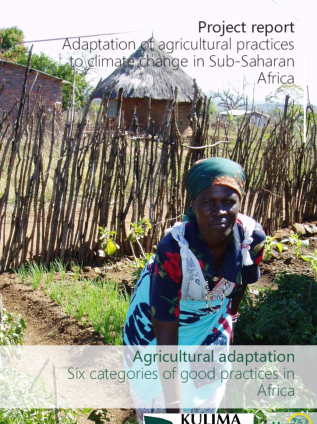
The purpose of this study was to undertake an empirical investigation of adaptation “good practices” and define six categories of actions that can be practically considered by governments for scaling-up in order to reduce the risks of climate change.
The focus is on what needs to be in place, in terms of the enabling environment, in order for the good practices to be effectively transferred to other contexts. The report thus intends to provide governments with practical options to consider in order to undertake agricultural adaptation to climate change, based on tangible and proven practices.
Six case study countries were chosen for empirical investigation of adaptation. Within Burkina Faso, Cameroon, Ethiopia, South Africa, Togo and Zambia, agricultural subsectors were chosen to represent various crops and livestock grown under different production systems. The purpose was to ensure that subsectors were investigated in more than one country so that there would be scope to compare different contexts. Categories considered for each adaptation practice were: proof of concept; robustness under projected climate change; environmental and social externalities; acceptability to farmers; accessibility to farmers; productivity; access to markets; support of appropriate institutions; level of government support; effects on women; and then a criteria to capture co-benefits, such as mitigation, biodiversity conservation, or multiple production objectives.
As a result the following six good practice categories are: use of improved seeds; soil fertility management; changing timing of farming practice; changing crop/livestock distribution and density; tillage and associated practices; and diversification.
Tennigkeit, T. and Vincent, K. (2015). Adaptation of agricultural practices to climate change in sub-Saharan Africa - Six categories of good practices in Africa. Gesellschaft für Internationale Zusammenarbeit, GIZ
These training materials have been produced to foster the capacity of key members of local communities to practically implement RWHI systems in a cost-efficient manner. The specific target group of these capacity building materials are local community members who are directly involved in the replication and scale-up of RWHI technologies and practices, i.e. local artisans and small-scale enterpreneurs in the field of rural water supply management and offseason small-scale irrigation on one hand, and educated smallholder farmers with previous knowledge and experience in this field who are interested to replicate and scaleup RWHI systems. Whereas these training materials are specifically tailored to members of local communities, the know-how and language used in this manual may not be suitable for uneducated readers.
Therefore, these training materials intend to provide a selection of key information and know-how that can be used to support proper planning, design and construction of cost-efficient RWHI technologies and practices in arid and semi-arid areas of sub-Saharan Africa. Further, this manual also suggests other relevant technical manuals for local communities which specifically focus on each of the RWHI technologies and practices. It is strongly recommended that reference is also made to these materials with the help of experienced professionals in this field of knowledge.
De Trincheria, J., Oduor, A., Ngigi, S., Oremo, F.O., Ngondi, J., van Steenbergen, F., Nyawasha, R.W., Dawit, D., Mussera, P.V., Woldearegay, K., Koelman, E.M., Malesu, M., Famba, S., Simane, B., Wuta, M., Oguge, N.O., Leal Filho, W. (2017). Training materials for local communities on rainwater harvesting irrigation management: Capacity building on the use of rainwater for off-season small-scale irrigation in arid and semi-arid areas of sub-saharan Africa. AFRHINET Project. Hamburg University of Applied Sciences, Hamburg, Germany.
These advanced training materials have been produced to foster the capacity of practitioners from private, nongovernmental and public sectors on one hand, and academics and scientists on the other, to practically implement cost-efficient RWHI technologies and practices in arid and semi-arid areas.
Therefore, these training materials intend to provide the required information to support proper planning, design and construction of cost-efficient RWHI technologies and practices, with special emphasis on the specific problems encountered in Ethiopia, Kenya, Mozambique and Zimbabwe. Further, this manual also suggests relevant technical manuals which specifically focus on each of the RWHI technologies and practices. It is strongly recommended that reference is also made on this additional materials with help from experienced professionals in this field of knowledge.
De Trincheria, J., Oduor, A., Ngigi, S., Oremo, F.O., Ngondi, J., van Steenbergen, F., Nyawasha, R.W., Dawit, D., Mussera, P.V., Woldearegay, K., Koelman, E.M., Malesu, M., Famba, S., Simane, B., Wuta, M., Oguge, N.O., Leal Filho, W. (2017). Advanced training materials on rainwater harvesting irrigation management in arid and semi-arid areas of sub-saharan Africa: Technical capacity building on the use of rainwater for off-season smallscale irrigation in Ethiopia, Kenya, Mozambique and Zimbabwe. AFRHINET Project. Hamburg University of Applied Sciences, Hamburg, Germany
These recommendations are a compilation of 2 regional studies at sub-Saharan Africa level which focused on research and technology transfer in the field of rainwater harvesting irrigatio nmanagement on one hand (section 3), and effective policy recommendations on the use of rainwater for off-season small-scale irrigation on the other (section 4). The regional studies upon which this transnational study is based come from the analysis of national studies in Ethiopia, Kenya, Mozambique and Zimbabwe.
The overall goal of the research and technology transfer strategy is to foster the replication, transfer and scaling up of innovative, cost-efficient and market-oriented RWHI technologies and practices in arid and semi-arid areas of sub-Saharan Africa. Thus, this report aims to discuss different technology transfer options in order to encourage uptake of innovative technologies and practices in this field of knowledge.
The main goal of the policy recommendations is to foster the replication, scaling-up and market-uptake of RWHI technologies and practices, and the inclusion of RWHI management into regional, national and local agricultural, irrigation and rural water management policies. The focus area is sub-Saharan Africa with a special emphasis on Ethiopia, Kenya, Mozambique and Zimbabwe. This is meant to support a market-oriented replication and scalingup of RWHI management in sub-Saharan Africa, and contribute to policy reforms that adequately recognise the role of rainwater harvesting for off-season small-scale irrigation in arid and semi-arid areas.
De Trincheria, J., Wuta, M., Ngigi, S., Nyawasha, R.W., Oremo, F.O., Oguge, N.O., Asrat, P., Dawit, D., Simane, B., Brito, R., Malanço,, J., Mussera, P.V., Niquice, C., Famba, S., Leal Filho, W. (2017). Transnational policy and technology transfer recommendations on the use of rainwater for off-season small-scale irrigation in sub-Saharan Africa: Fostering innovation and replication of rainwater harvesting irrigation strategies in arid and semi-arid areas of Ethiopia, Kenya, Mozambique and Zimbabwe. AFRHINET Project, Hamburg University Applied Sciences, Hamburg, Germany.
This study has been produced with the overall goal to document and analyse exisiting best practices in the field of RWHI management in sub-Saharan Africa, with a special focus on Ethiopia, Kenya, Mozambique and Zimbabwe. This is meant to determine the suitability of RWHI management under multivariate biophysical and socioeconomic conditions. The best practices include specific information and know-how on the performance, cost-efficiency and impacts of RWHI technologies. This information and know-how intends to contribute on the capitalisation of successful and unsuccessful experiences in the field of RWHI management in order to identify best practices which can then be replicated, adapted, improved and scaled-up, leading to greater impacts and benefits on one hand, and effective policies and investments on the other.
De Trincheria, J., Dawit, D., Famba, S., Leal Filho, W., Malesu, M., Mussera, P.V., Ngigi, S., Niquice, C., Nyawasha, R.W., Oduor, A., Oguge, N.O., Oremo, F.O., Simane, B., van Steenbergen, F., Wuta, M. (2017). Best practices on the use of rainwater for off-season small-scale irrigation: Fostering the replication and scaling-up of rainwater harvesting irrigation management in arid and semi-arid areas of sub-Saharan Africa. AFRHINET Project, Hamburg University of Applied Sciences, Hamburg, Germany.