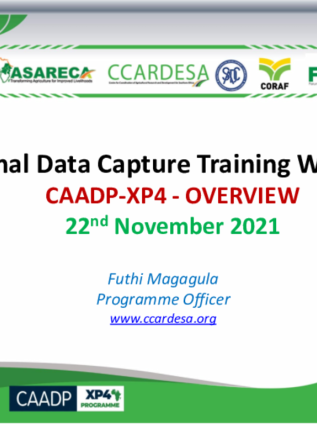
CAADP-XP4 Overview Presentation

Type
File
Date of Publication
Nov 01, 2021
Description/Abstract

This is an overview of the CAADP-XP4 Programme

Author or Institution as Author
CCARDESA
Co-authors

Ms. Futhi Magagula

Institution
CCARDESA
Language
Resource Type
Citation

F. Magagula(2021) Comprehensive for Africa Agricultural Development Programme Ex-Pillar 4 .Pg. 25, Gaborone. Botswana

Technical Guidelines: Document for preparing country Biennial Review report on progress made for achieving the Malabo Declaration Goals and Targets

Type
File
Date of Publication
Nov 01, 2021
Description/Abstract

Document for preparing country Biennial Review report on progress made for achieving the Malabo Declaration Goals and Targets

Author or Institution as Author
NEPAD
Language

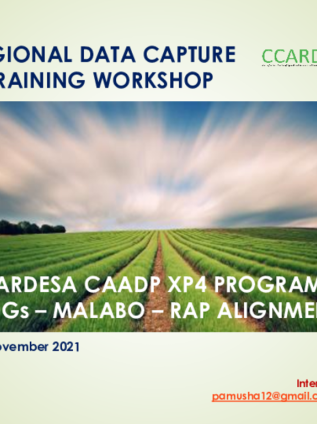
SDGs, MALABO & RAP Alignment

Type
File
Date of Publication
Nov 01, 2021
Description/Abstract

This is an overview of the alignment of the SDGs, Malabo and the Rap

Author or Institution as Author
CCARDESA
Co-authors

Mr Martin Muchero 

Institution
CCARDESA
Language
Resource Type
Citation

M.Muchero, SDGs, Malabo & RAP aligment ,pg18, Gaborone, Botswana

Overview of Part 1 CAADP, MALABO & RAP Linkages

Type
File
Date of Publication
Nov 01, 2021
Description/Abstract

This is an overview of the CAADP,MALABO & RAP linkages

Author or Institution as Author
CCARDESA
Co-authors

Mr Martin Muchero

Institution
CCARDESA
Language
Resource Type
Citation

M, Muchero (2021) CAADP,MALABO & RAP Linkages, pg. 26

Protein and iron contents and bio accessibility in local modified diets for children aged 6 to 23 months in Bukoba, Tanzania

Type
File
Date of Publication
Dec 01, 2017
Description/Abstract

Micronutrient deficiencies often occur as part of a cycle of malnutrition and may be coupled with protein energy malnutrition. One of the measure to fight malnutrition is through participatory dietary modification was used. Five recipes of banana-based porridges from two EAHB ‘nshakala’ and AAB ‘bira’ banana varieties and three maize-based porridges were formulated in combination with other ingredients. The contents of Iron and protein in separate ingredients and in modified recipes were analysed using flame atomic absorption spectrophotometry and Kjeldahl´s method, respectively, and bio-accessibility of iron was estimated using invitro simulating gastrointestinal digestion method. Beans were a good source of both iron and protein while groundnuts flour was a good source of protein. Contribution of iron and protein in recommended daily allowance (RDA) ranged from 75.3 to 458% and 106 to 146% in a portion of 500g respectively. Iron bioaccessibility in all recipes ranged from 7.4% to 31.1%. Iron in porridge recipes (6OFSP, 7B) was more bio-accessible. The developed and improved recipes showed great potential of contributing substantially to iron and protein needs of children 6-23 months. The importance of food diversification for intake of iron and protein is discussed.

Author or Institution as Author
Nkuba et al.
Co-authors

Kinabo Joyce;  Mwanri Akwilina Wendelin and Ekesa Beatrice

Institution
Tanzania Food and Nutrition Center
Language
Category
Citation

Nkuba et.al (2017): Protein and iron contents and bio accessibility in local modified diets for children aged 6 to 23 months in Bukoba, Tanzania. African Journal of Food Science and Technology (ISSN: 2141-5455) Vol. 8(9) pp. 162-170, December, 2017 DOI: http:/dx.doi.org/10.14303/ajfst.2017.152 Available online @http://www.interesjournals.org/AJFST Copyright ©2017 International Research Journals

Terms of Reference: Maintenance and Upgrade of the CCARDESA Website & Related Platforms

Type
File
Date of Publication
Oct 01, 2021
Description/Abstract

Terms of Reference: Maintenance and Upgrade of the CCARDESA Website & Related Platforms

Author or Institution as Author
CCARDESA
Institution
CCARDESA
Language
Category
Resource Type

Rainfall trend and variability in semi-arid northern Namibia: Implications for smallholder agricultural production

Type
File
Date of Publication
Oct 01, 2021
Description/Abstract

Rainfall defines livelihood patterns among agrarian communities of the climate-change vulnerable semi-arid SubSaharan Africa. However, it remains inadequately studied, resulting in ineffective water management policies and weak agricultural growth in the region. Monthly rainfall data collected between 1987 and 2018 at four stations along a 1200 km climatic gradient in northern Namibia were analyzed for annual, seasonal, and monthly trends and variability. Descriptive measures and the Mann-Kendall test were used for rainfall characterization and trend detection, respectively. Results showed an annually increasing rainfall trend, but with a downward trend in the dry season decreasing by -0.14 mm year–1 and an upward trend in the rainy season increasing by 7.74 mm year–1 across the study area. The rainy-season mean monthly rainfall showed predominantly increasing trends, while the dry-season ones exhibited insignificant decreasing trends. The study detected a decreasing rainfall gradient from the northeast towards the northwest with a range of 156.8 mm and concomitant increasing spatial-temporal variability. The upward rainfall trend has implications for rainy season floods, whereas the downward trend suggests dry season drought intensification in the area. These results could be useful for rainwater management planning in the study area and other dryland regions.

Author or Institution as Author
S. K. Awala
Co-authors

K. Hove,*, M. A. Wanga, J. S. Valombola, and O. D. Mwandemele

Institution
University of Namibia and Ministry of Agriculture, Water and Land Reform
Language
Category
Citation

MAWL, (2019) Rainfall trend and variability in semi-arid northern Namibia: Implications for smallholder agricultural production,pg21

Farmers Hold a Mini Exhibition of Maize and Bean Seed Under the APPSA Sub Project

Type
File
Date of Publication
Oct 01, 2021
Description/Abstract

This a short article on the mini exhibition that farmers under the Tale Agricultural Resource Centre did. The purpose was to show to other farmers the maize and bean varieties that were planted under the APPSA funded sub project, so that they can learn how they perform, where to get the seed and try them in this up coming summer cropping season. This is important because these varieties have been proven to withstand calamities of climate change. 

Author or Institution as Author
Rethabile Nchee
Institution
Department of Agricultural Research
Language
Category
Resource Type
Citation

DAR, (2021). Farmers Hold a Mini Exhibition of Maize and Bean Seed Under the  APPSA Sub Project,pg.2

A Report on the Level of Access and Competencies of Stakeholders on Virtual Communications, e-Delivery and Decisions Support Tools.

Type
File
Date of Publication
Oct 01, 2021
Description/Abstract

This document is a survey of competences of CCARDESA stakeholders in virtual platforms .

Author or Institution as Author
CCARDESA
Co-authors

Kwame Crane 

Institution
CCARDESA
Language
Resource Type
Citation

CCARDESA, (2020).  A report on the level of access and competencies of stakeholders on virtual  communications, e-delivery and decisions support tools.pg15

SHEP approach to improve farmers’ livelihoods

Date of Publication
Oct 01, 2021
Description/Abstract

The article was published after a Training of Trainers (ToT) for the Smallholder Empowerment Programs (SHEP) at Bunda College with support from the SAFE initiative. SHEP originally emerged through trial and error in the process of technical cooperation between Kenya and Japan for improving Kenya’s agricultural extension services. The cooperation started in 2006 and the SHEP Approach was developed as an innovative
method of agricultural extension services backed by the disciplines of economics and psychology. SHEP is an approach in agricultural extension that facilitates small-scale farmers to conduct market-oriented agriculture. The above-mentioned agricultural extension project in Kenya that utilized this method doubled the farming income of 2,500 targeted farmers in just two years. In the opening speech of the 5th Tokyo International Conference on African  Development in 2013, Japanese Prime Minister Shinzo Abe expressed his desire to change African Agriculture from “Grow and Sell” to “Grow to Sell”. Building off of this, the Japan International Cooperation Agency (JICA) has been working with the Kenyan government to spread the knowledge of SHEP to agricultural extension officials and extension staff in other African countries. Currently, over twenty African countries are implementing the SHEP Approach.

Author or Institution as Author
LUANAR
Co-authors

Patricia Ngwale

Institution
LUANAR
Language
Category
Resource Type
Subscribe to English

Funding Partners