Satellite Data for Improved Monitoring of Farm Productivity and Early Warning Systems in Botswana

Date of Publication
Jun 01, 2023
Description/Abstract

Despite the adaptation and mitigation measures that have been put in place to counter the negative effects of climate change and food insecurity, more than 57.8 million people in the Southern African Development Community (SADC) population need food assistance in 2023 due to poor harvests (APA 2023). In Botswana, alone, close to 37,000 people need food assistance (FAO, 2022). This comes against the backdrop of declining agricultural productivity attributed to several factors including high cost of inputs, high incidence of pests and diseases, low input use and extreme weather conditions such as droughts, floods, and erratic rainfalls (FAO 2022).

Author or Institution as Author
Joshua Sikhu Okonya
Co-authors

Enock Warinda, Moses Odeke, Baitsi Podisi, Futhi Magagula, Cliff Sibusiso Dlamini, Andrew Farrow, Felicia O. Akinyemi, Reason L. Machete, Benedict Kayombo, Joseph Tuyishimire, Kenneth Mubea, & Wellington Michael

Institution
Digital Earth Africa
Language
Category
Resource Type
Citation

Okonya, J.S. Warinda, E. Odeke, M. Podisi, B. Magagula, F. Dlamini, C. S.  Farrow, A. Akinyemi, F.O. Machete, R.L. Kayombo, B. Tuyishimire, J. Mubea, K. & Michael, W. (2023). Satellite Data for Improved Monitoring of Farm Productivity and Early Warning Systems in Botswana. Policy Brief Botswana, June 2023.

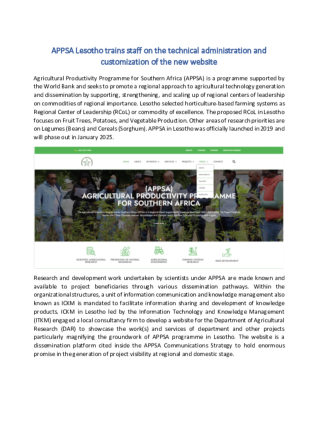
APPSA Lesotho trains staff on the technical administration and customization of the new website

Type
File
Date of Publication
May 01, 2023
Description/Abstract

Five officials comprising of three (3) Information technology Officers from the Ministry of Agriculture Food Security and Nutrition (MAFSN); One Information technology Officer from DAR as well as the ITKM Specialist from APPSA Project Implementation Unit (PIU) attended the website training in Maseru, Lesotho from the 10th – 11th May, 2023. The training was designed to improve the skills on the customization and administration of the DAR website to respond to growing demands from external and internal stakeholders. Five officials comprising of three (3) Information technology Officers from the Ministry of Agriculture Food Security and Nutrition (MAFSN); One Information technology Officer from DAR as well as the ITKM Specialist from APPSA Project Implementation Unit (PIU) attended the website training in Maseru, Lesotho from the 10th – 11th May, 2023. The training was designed to improve the skills on the customization and administration of the DAR website to respond to growing demands from external and internal stakeholders.

Author or Institution as Author
Department of Agricultural Research
Language
Category

Terms Of Reference: Training Services In Malabo Commitments and Biannual Review Reporting at a National Knowledge Management & Malabo Workshop in Namibia and Mozambique

Type
File
Date of Publication
May 01, 2023
Description/Abstract

TORS: Training Services In Malabo Commitments and Biannual Review Reporting at a National Knowledge Management & Malabo Workshop in Namibia and Mozambique


Author or Institution as Author
CCARDESA
Language
Category
Resource Type

Regional Multi-stakeholder Dialogue on Vulnerable Farmers’ Access to Fertilisers Report

Type
File
Date of Publication
Apr 01, 2023
Description/Abstract

The Centre for Coordination of Agricultural Research and Development for Southern Africa (CCARDESA) in collaboration with the Food and Agriculture Organization of the United Nations (FAO), organized a Regional Multi-stakeholder Dialogue event on Vulnerable Farmers’ Access to Fertilizer from 4th to 6th October 2022 in Mbabane, Eswatini.

Author or Institution as Author
CCARDESA
Institution
CCARDESA
Language
Category
Resource Type
Citation

CCARDESA,2022,Regional Multi-stakeholder Dialogueon Vulnerable Farmers’ Access to Fertilisers: Sharing Good Practices, Innovations and Viable Options.Pg.15, Gaborone-Botswana

Tomato variety JUPITER

Date of Publication
Mar 01, 2023
Description/Abstract

The Food and Agricultural Research and Extension Institute, through its new variety introduction and evaluation programme, have identified a tomato variety Jupiter adapted to both humid and sub-humid regions of the island. Jupiter is a semideterminate cooking tomato variety with high-yielding potential and suitable for both fresh market and processing. The plant bears long oblong fruits which are preferred by growers and highly appreciated by consumers.

Author or Institution as Author
Food and Agricultural Research and Extension Institute (FAREI)
Institution
Food and Agricultural Research and Extension Institute (FAREI)
Language
Category
Resource Type
Citation

FAREI, (2022). Tomato variety JUPITER. Mauritius VOD/2022/1 R ev1.0

Onion Variety 243

Date of Publication
Mar 01, 2023
Description/Abstract

Onion 243 is a short-day yellow hybrid variety with high yield potential and is suitable for storage. Plants have a uniform fall over of leaves at maturity. Bulbs are globular, uniform, medium-sized, and firm. Yield is comparable to hybrid varieties which are commercially cultivated locally. The variety adapts well to onion-growing regions except in coastal areas having sandy soil.

Author or Institution as Author
Food and Agricultural Research and Extension Institute (FAREI)
Institution
Food and Agricultural Research and Extension Institute (FAREI)
Language
Category
Resource Type
Citation

FAREI, (2022). Onion Variety 243. Mauritius AD/2022/1 Rev 1.0.

Guidelines for Extraction of Tomato Seeds

Date of Publication
Mar 01, 2023
Description/Abstract

Guidelines for Extraction of Tomato Seeds

Author or Institution as Author
Food and Agricultural Research and Extension Institute (FAREI)
Institution
Food and Agricultural Research and Extension Institute (FAREI)
Language
Category
Resource Type
Citation

FAREI, (2022). Guidelines for Extraction of Tomato Seeds.

Herbicide Fluazifop-P-butyl for control of annual and perennial grasses

Date of Publication
Mar 01, 2023
Description/Abstract

Fluazifop-P-butyl 150 g/L is a systemic, post-emergence herbicide that can be used for the control of annual and perennial grasses. Trials carried out at the FAREI on the effect of fluazifop-P-butyl on these two types of grasses have shown that the herbicide is not phytotoxic to crops such as potato, onion, carrot, creepers, peanut, and banana, as well as non-gramineae ornamentals. Weeds turn yellow or red and weed control is usually completed within 3 to 5 weeks after application

Author or Institution as Author
Food and Agricultural Research and Extension Institute (FAREI)
Institution
Food and Agricultural Research and Extension Institute (FAREI)
Language
Category
Resource Type
Citation

FAREI. (2022). Herbicide Fluazifop-P-butyl for control of annual and perennial grasses. Recommendation Sheet. Mauritius AD/2022/1 Rev 1.0

Sorghum Production in Northern Namibia: Farmers’ Perceived Constraints and Trait Preferences

Date of Publication
Mar 01, 2023
Description/Abstract

Sorghum (Sorghum bicolor [L.] Moench) is a valuable crop in the dry regions of the world, including Namibia. Due to the intensity and recurrence of drought and heat stress in the traditional sorghum growing areas, there is a need to breed and deploy new generation farmer-preferred and climate-smart cultivars to serve the diverse value chains. Therefore, the objectives of this study were to assess the present state of sorghum production in northern Namibia and document farmers’ perceived production constraints and trait preferences in new varieties to guide drought-tolerance breeding. A survey was conducted using a participatory rural appraisal in the following six selected sorghum-growing constituencies in Namibia: Kapako and Mpungu (Kavango West Region), Eenhana and Endola (Ohangwena Region), and Katima Mulilo Rural and Kongola (Zambezi Region). Data were collected using a structured questionnaire involving 198 farmers in 14 sampled villages across the regions. Results revealed variable trends in sorghum production among respondent farmers when disaggregated by gender, age, number of households, education level, cropping systems, types of varieties grown, and perceived production constraints. An equal proportion of male and female respondent farmers cultivate sorghum, suggesting the value of the crop to both genders in Namibia. Most respondent farmers (63.6%) were in productive age groups of <40 years old. In the study areas, low-yielding landrace varieties, namely Ekoko, Okambete, Makonga, Kamburo, Nkutji, Katoma, Fuba, Dommy, Kawumbe, and Okatombo, were widely cultivated, and most of the farmers did not use chemical fertilizers to cultivate sorghum. Farmers’ perceived sorghum production constraints in the study areas included recurrent drought, declining soil fertility, insect pest damage, high cost of production inputs, unavailability of improved seed, lack of alternative improved varieties with farmers’ preferred traits, lack of organic manure, limited access to market and limited extension service. The key farmers’ preferred traits in a new sorghum variety included high grain yield, early maturity, and tolerance to drought, in the field and storage insect pests. The study recommends genetic improvement and new variety deployment of sorghum with the described farmers-preferred traits to increase the sustainable production of the crop in Namibia.

Author or Institution as Author
Wanga, M.A.
Co-authors

Shemelis, H. and Mengistu, G.

Institution
MDPI
Language
Category
Resource Type
Citation

Wanga, M.A.; Shimelis, H.; Mengistu, G. Sorghum Production in Northern Namibia: Farmers’ Perceived Constraints and Trait Preferences. Sustainability 2022, 14, 10266.

Available at: https://doi.org/10.3390/ su141610266

Genotype by environment interaction of newly developed sorghum lines in Namibia

Date of Publication
Mar 01, 2023
Description/Abstract

The magnitude of genotype by environment interaction (GEI) is crucial for selecting high performing and adapted genotypes for targeted breeding. The aim of the study was to determine GEI of newly-developed mutant and traditional sorghum lines for grain yield and yield related traits for drought-prone areas of Namibia. Fifty sorghum genotypes were evaluated under feld conditions using a 10×5 alpha lattice design with three replications. The experiments were carried out in four environments with two growing seasons in Namibia. Data were collected on grain yield and related traits and subjected to the Additive Main Efects and Multiplicative Interaction (AMMI) model. The AMMI model showed that 93.9% of the total genetic variation was attributed to days to 50% fowering (DF), while 94.04% of the variation was due to plant height (PH), 86.52%  to panicle weight (PW), 70.67% to thousand-grain weight (TGW), and 90.68% to grain yield (GY). The larger variations attributed to genotypic efects for PL (36.3%), TGW (33.2%) and PH (20.7%) are useful for genotype selection for yield related traits. Based on a multi-trait biplot and Best Linear Unbiased Prediction (BLUPs) analyses of the GEI data across all drought-prone testing environments, the medium maturity mutant line designated as L7P9-13 was selected as the best yielding (2 tons/ha) and recommended for drought-prone area of Namibia

Author or Institution as Author
Wanga, M.A.
Co-authors

Shimelis, H. and Mashilo, J.

Institution
Springer
Language
Category
Resource Type
Citation

Wanga, M.A., Shimelis, H. and Mashilo, J. (2022). Genotype by environment interaction of newly developed sorghum lines in Namibia. Euphytica (2022) 218:147

Available at: https://doi.org/10.1007/s10681-022-03099-5

Subscribe to English

Funding Partners