Smallholder Cassava Planting Material Movement and Grower Behavior in Zambia: Implications for the Management of Cassava Virus Diseases

Type
File
Date of Publication
Apr 01, 2021
Description/Abstract

Cassava (Manihot esculenta) is an important food crop across subSaharan Africa, where production is severely inhibited by two viral diseases, cassava mosaic disease (CMD) and cassava brown streak disease (CBSD), both propagated by a whitefly vector and via human-mediated movement of infected cassava stems. There is limited information on growers’ behavior related to movement of planting material, as well as growers’ perception and awareness of cassava diseases, despite the importance of these factors for disease control. This study surveyed a total of 96 cassava subsistence growers and their fields across five provinces in Zambia between 2015 and 2017 to address these knowledge gaps. CMD symptoms were observed in 81.6% of the fields, with an average incidence of 52% across the infected fields. No CBSD symptoms were observed. Most growers used planting materials from their own (94%) or nearby (<10 km) fields of family and friends, although several large transactions. over longer distances (10 to 350 km) occurred with friends (15 transactions), markets (1), middlemen (5), and nongovernmental organizations (6). Information related to cassava diseases and certified clean (diseasefree) seed reached only 48% of growers. The most frequent sources of information related to cassava diseases included nearby friends, family, and neighbors, while extension workers were the most highly preferred source of information. These data provide a benchmark on which to plan management approaches to controlling CMD and CBSD, which should include clean propagation material, increasing growers’ awareness of the diseases, and increasing information provided to farmers (specifically disease symptom recognition and disease management options).

Author or Institution as Author
Anna Maria Szyniszewska
Co-authors

Patrick Chiza Chikoti, Mathias Tembo,Rabson Mulenga, Christopher Aidan Gilligan, Frank van den Bosch, and Christopher Finn McQuaid

Institution
ZARI
Language
Category
Citation

Szyniszewska, A M.,  Chikoti, P., Tembo, M., Mulenga, R., Gilligan, C A., Bosch, F V D,& McQuaid,  C M., (2021). Smallholder Cassava Planting Material Movement and Grower Behavior in Zambia: Implications for the Management of Cassava Virus Diseases. Disease Control and Integrated Management

Expansion and impact of cassava brown streak and cassava mosaic diseases in Africa: A review

Type
File
Date of Publication
Oct 01, 2022
Description/Abstract

Africa produces over half of global cassava; however, the continent’s average yield is below the potential yields achieved under experimental conditions. Many factors contributing to low yield  include lack of quality varieties, poor soils, limited access to capital, competition for labour, as well  as pests and diseases. Plant diseases are the major biotic constraints to cassava production and have  caused considerable food insecurity in Africa. Although there has been some level of disease  management which has contributed to the increase in cassava production, the two viral diseases:  cassava mosaic disease (CMD) and cassava brown streak disease (CBSD) still claim between 30- 16 40% and upto 70%, respectively of Africa’s cassava harvest. Given the importance of the two  diseases in Africa, we review the expansion of CBSD and CMD; impacts of the two diseases on food  security and how they can be managed. We provide insights in the spread of the two diseases,  management efforts, and future directions

Author or Institution as Author
Patrick C. Chikoti1*, Mathias Tembo1
Institution
ZARI
Category
Citation

Chikoti,P., & Tembo.,M, (2022). Expansion and impact of cassava brown streak and cassava mosaic diseases in Africa: A review [online]. Available at Frontiers | Publisher of peer-reviewed articles in open access journals (frontiersin.org)

Maize and groundnut crop production among rural households in Zambia: Implications in the management of aflatoxins

Type
File
Date of Publication
Jul 01, 2023
Description/Abstract

Maize and groundnut are important crops for both commercial and smallholder farming in Zambia, whose production is being threatened by their susceptibility to aflatoxin contamination. Despite this threat, there is limited knowledge of household growers’ behaviour and applications related to suitable agricultural management practices, as well as growers’ perception and knowledge of aflatoxins and their effects. This limited knowledge has major implications for acute human health effects such as liver cirrhosis and death, cancer, stunting in children, immune system suppression, impaired food conversion, and reduced livestock productivity and/or increased livestock mortality. This cross-sectional survey of smallholder household growers in Zambia was conducted to identify the gaps in the knowledge and application of aflatoxin-associated agricultural management practices. A sample of 3865 maize- and groundnut-producing smallholder farm households were selected in 27 priority districts implementing the Scaling Up Nutrition (SUN)/First 1000 Most Critical Days Programme (MCDP) Phase II. Among the five pre-harvest management practices for maize and groundnuts – namely, controlling weeds, timely planting, controlling pests, and applying basal and top-dressing fertilisers – few households (8%) reported practising all of them. Among the recommended techniques for harvesting and handling maize and groundnuts, the most common harvest-management practices under maize production were drying (95.2% of households) and sorting at harvest (72%). In contrast, very few households (2%) practised at least three of four maize harvest management practices. Similarly, very few households (10%) practised at least 4 of the 6 groundnut harvest-management measures. Comparatively, post-harvest and storage management practices were more commonly practised, although most households did not practise all six post-harvest and storage management measures. Overall, very few households (1% for maize and 4% for groundnuts) were observed to be practising at least 12 of the 14 recommended management practices, implying that there are considerable gaps in the implementation of aflatoxin-related management practices along all stages of maize and groundnut production, consequently posing a significant threat to health and contributing to malnutrition levels in Zambia. As such, there is a need to develop tailored interventions and trainings for farming households, extension officers, and frontline health workers to prevent and manage aflatoxin contamination at different stages of crop production. Furthermore, the elimination of policy constraints, practical barriers of affordability and consumer awareness, and the value attached to the commercial product of Aflasafe, noted to reduce aflatoxin contamination by 80–100%, are of utmost urgency.

Author or Institution as Author
Mathias Tembo
Co-authors

Mary Lubungu, Fwasa K. Singogo, Mike Mwanza, Mathews Onyango,  Patricia Sakala, Mary Pat Selvaggio, Edna Berhane

Institution
ZARI, IAPRI, NFNC, Khulisa
Language
Category
Citation

Tembo,M.,* ,Lubungu ,M.,  Singogo ,F., Mwanza, M.,Onyango, M., Sakala, P., Selvaggio,M., & Berhane,E., (2023). Maize and groundnut crop production among rural households in Zambia: Implications in the management of aflatoxins [online] Food Control


Genetic Divergence and Selection of Common Bean Genotypes with High Agronomic Performance in Mozambique

Type
File
Date of Publication
Dec 01, 2022
Description/Abstract

The deep knowledge of genetic diversity in access, in the breeding program, and the contribution of genetic factors as well as the phenotypic expression is of extreme importance for the development of new cultivars and maintenance of the program. This research aimed to study the genetic diversity and selection of the best common bean genotypes with high agronomic performance in the Agrarian Station of Sussundenga-Mozambique. Twenty-two common bean genotypes were evaluated in a randomized block design with three repetitions in the 2021/2022 agricultural season. The agronomic characteristics evaluated were: the number of days to flowering, plant height, plant architecture, number of pods per plant, the weight of 100 seeds, and grain yield. The data obtained were submitted to individual variance analysis, followed by the Scott-Knott grouping test. For the effect of genetic divergence between the genotypes, multivariate analysis was used based on the generalized Mahalanobis distance and Tocher optimization method, UPGMA, and canonical variables for the projection of distance in the 2D plane. It was also verified by the Cophenetic Correlation Coefficient. The Singh criterion (1981) was used, indicating the characteristics Number of pods per plant (42.81%), the weight of 100 seeds (19.59%), and Plant height (16.08%) as the most important for the genetic divergence of bean genotypes.

Author or Institution as Author
J. Dique
Co-authors

C. Pedro, C. Fernando, G. Silota, L. Savanguane, L. Bungala, P. Manhoca, A. Charimba, M. Miguel, M. Quinhentos, D. Dias, V. Carneiro

Institution
Agricultural Research Institute of Mozambique and others
Language
Category
Citation

Dique, J., Pedro C., Fernando, C., Silota, G., Savanguane, L., Bungala, L., Manhoca, P., Charimba, A., Miguel, M., Quinhentos, M., Dias, D., Carneiro, V. (2022. Genetic Divergence and Selection of Common Bean Genotypes with High Agronomic Performance in Mozambique. Journal of Agriculture, Food and Environment (JAFE). Vol 3 No 4 December 2022 Pages 27-33 e-ISSN 2708-5694

APPSA LESOTHO INTRODUCES ROAD CONSTRUCTION FIRM TO THE COMMUNITY

Type
File
Date of Publication
Jun 01, 2023
Description/Abstract

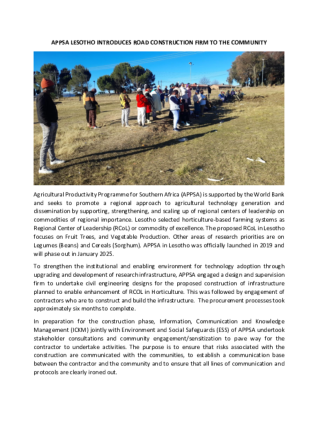
To strengthen the institutional and enabling environment for technology adoption through upgrading and development of research infrastructure, APPSA engaged a design and supervision firm to undertake civil engineering designs for the proposed construction of infrastructure planned to enable enhancement of RCOL in Horticulture. This was followed by engagement of contractors who are to construct and build the infrastructure.

Author or Institution as Author
Department of Agricultural Research
Language
Category

APPSA Lesotho trains staff on the technical administration and customization of the new website

Type
File
Date of Publication
May 01, 2023
Description/Abstract

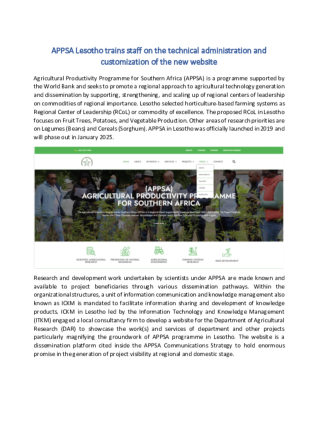
Five officials comprising of three (3) Information technology Officers from the Ministry of Agriculture Food Security and Nutrition (MAFSN); One Information technology Officer from DAR as well as the ITKM Specialist from APPSA Project Implementation Unit (PIU) attended the website training in Maseru, Lesotho from the 10th – 11th May, 2023. The training was designed to improve the skills on the customization and administration of the DAR website to respond to growing demands from external and internal stakeholders. Five officials comprising of three (3) Information technology Officers from the Ministry of Agriculture Food Security and Nutrition (MAFSN); One Information technology Officer from DAR as well as the ITKM Specialist from APPSA Project Implementation Unit (PIU) attended the website training in Maseru, Lesotho from the 10th – 11th May, 2023. The training was designed to improve the skills on the customization and administration of the DAR website to respond to growing demands from external and internal stakeholders.

Author or Institution as Author
Department of Agricultural Research
Language
Category

Sorghum Production in Northern Namibia: Farmers’ Perceived Constraints and Trait Preferences

Date of Publication
Mar 01, 2023
Description/Abstract

Sorghum (Sorghum bicolor [L.] Moench) is a valuable crop in the dry regions of the world, including Namibia. Due to the intensity and recurrence of drought and heat stress in the traditional sorghum growing areas, there is a need to breed and deploy new generation farmer-preferred and climate-smart cultivars to serve the diverse value chains. Therefore, the objectives of this study were to assess the present state of sorghum production in northern Namibia and document farmers’ perceived production constraints and trait preferences in new varieties to guide drought-tolerance breeding. A survey was conducted using a participatory rural appraisal in the following six selected sorghum-growing constituencies in Namibia: Kapako and Mpungu (Kavango West Region), Eenhana and Endola (Ohangwena Region), and Katima Mulilo Rural and Kongola (Zambezi Region). Data were collected using a structured questionnaire involving 198 farmers in 14 sampled villages across the regions. Results revealed variable trends in sorghum production among respondent farmers when disaggregated by gender, age, number of households, education level, cropping systems, types of varieties grown, and perceived production constraints. An equal proportion of male and female respondent farmers cultivate sorghum, suggesting the value of the crop to both genders in Namibia. Most respondent farmers (63.6%) were in productive age groups of <40 years old. In the study areas, low-yielding landrace varieties, namely Ekoko, Okambete, Makonga, Kamburo, Nkutji, Katoma, Fuba, Dommy, Kawumbe, and Okatombo, were widely cultivated, and most of the farmers did not use chemical fertilizers to cultivate sorghum. Farmers’ perceived sorghum production constraints in the study areas included recurrent drought, declining soil fertility, insect pest damage, high cost of production inputs, unavailability of improved seed, lack of alternative improved varieties with farmers’ preferred traits, lack of organic manure, limited access to market and limited extension service. The key farmers’ preferred traits in a new sorghum variety included high grain yield, early maturity, and tolerance to drought, in the field and storage insect pests. The study recommends genetic improvement and new variety deployment of sorghum with the described farmers-preferred traits to increase the sustainable production of the crop in Namibia.

Author or Institution as Author
Wanga, M.A.
Co-authors

Shemelis, H. and Mengistu, G.

Institution
MDPI
Language
Category
Resource Type
Citation

Wanga, M.A.; Shimelis, H.; Mengistu, G. Sorghum Production in Northern Namibia: Farmers’ Perceived Constraints and Trait Preferences. Sustainability 2022, 14, 10266.

Available at: https://doi.org/10.3390/ su141610266

Genotype by environment interaction of newly developed sorghum lines in Namibia

Date of Publication
Mar 01, 2023
Description/Abstract

The magnitude of genotype by environment interaction (GEI) is crucial for selecting high performing and adapted genotypes for targeted breeding. The aim of the study was to determine GEI of newly-developed mutant and traditional sorghum lines for grain yield and yield related traits for drought-prone areas of Namibia. Fifty sorghum genotypes were evaluated under feld conditions using a 10×5 alpha lattice design with three replications. The experiments were carried out in four environments with two growing seasons in Namibia. Data were collected on grain yield and related traits and subjected to the Additive Main Efects and Multiplicative Interaction (AMMI) model. The AMMI model showed that 93.9% of the total genetic variation was attributed to days to 50% fowering (DF), while 94.04% of the variation was due to plant height (PH), 86.52%  to panicle weight (PW), 70.67% to thousand-grain weight (TGW), and 90.68% to grain yield (GY). The larger variations attributed to genotypic efects for PL (36.3%), TGW (33.2%) and PH (20.7%) are useful for genotype selection for yield related traits. Based on a multi-trait biplot and Best Linear Unbiased Prediction (BLUPs) analyses of the GEI data across all drought-prone testing environments, the medium maturity mutant line designated as L7P9-13 was selected as the best yielding (2 tons/ha) and recommended for drought-prone area of Namibia

Author or Institution as Author
Wanga, M.A.
Co-authors

Shimelis, H. and Mashilo, J.

Institution
Springer
Language
Category
Resource Type
Citation

Wanga, M.A., Shimelis, H. and Mashilo, J. (2022). Genotype by environment interaction of newly developed sorghum lines in Namibia. Euphytica (2022) 218:147

Available at: https://doi.org/10.1007/s10681-022-03099-5

Genetic diversity in sorghum [Sorghum bicolor (L.) Moench] germplasm from Southern Africa as revealed by microsatellite markers and agro-morphological traits

Date of Publication
Mar 01, 2023
Description/Abstract

Cultivated sorghum [Sorghum bicolor (L.) Moench] is an important food security crop in the semi-arid regions of the world including Asia and Africa. Its genetic diversity is contained mostly in traditional varieties and modern cultivars used by farmers. In this study, agro-morphological traits and molecular markers were used to assess genetic diversity in 22 accessions of cultivated sorghum from five countries (Botswana, Namibia, Swaziland, Zambia and Zimbabwe) in the Southern African Development Community (SADC) region. The study revealed a significant variation among 22 accessions in both qualitative and quantitative morphological traits, indicating the accessions’ promising potential as breeding material. For molecular analysis, 11 microsatellite primer-pairs were used, and generated a total of 70 alleles across 20 accessions. Analysis of molecular variance revealed a high level of genetic variation; 67 % among the accessions and 10 % among the five countries. The patterns of genetic diversity and the relationships observed in this study should provide insights for genetic resource conservation and utilization of sorghum germplasm in the SADC region.

Author or Institution as Author
Motlhaodi, T.
Co-authors

Geleta, M., Chite, S., Fatih, M., Ortiz, R. and Bryngelsson, T.

Institution
Springer
Language
Category
Resource Type
Citation

Motlhaodi, T., Geleta, M., Chite, S., Fatih, M., Ortiz, R. and Bryngelsson, T. (2016). Genetic diversity in sorghum [Sorghum bicolor (L.) Moench] germplasm from Southern Africa as revealed by microsatellite markers and agro-morphological traits. Genet Resour Crop Evol (2017) 64:599–610. 

SSR marker development, genetic diversity and population structure analysis of Bambara groundnut [Vigna subterranea (L.) Verdc.] landraces

Date of Publication
Mar 01, 2023
Description/Abstract

We report here the development of 75 SSR markers for Bambara groundnut through various sequencing approaches and the subsequent utilization of these SSR markers and other marker types (DArT Arrays) for the analysis of genetic diversity, population structure and the selection of pure lines from landraces. To assess the level of genetic diversity in Bambara groundnut landrace collections, 68 and 201 polymorphic SSR and DArT markers, respectively, were assayed against 24 single individual seed from a core collection of landraces. Polymorphic information content (PIC) ranged from 0.08 to 0.89 with an average of 0.42 across all SSR polymorphic markers, with observed (Ho) and expected (He) heterozygosity of 0.01 and 0.5 respectively. For the population structure analysis, 12 SSR markers selected as highly polymorphic from the initial screen were assayed against 123 landrace accessions. The average PIC across the 12 SSR was 0.66 with an average Ho of 0.02 and an inbreeding coefficient (f) of 0.98, suggesting that seed derived from a single plant essentially represents an unselected variety. Based on the low level of Ho and high f observed in the landrace samples, a subset of 35 genotypes derived from the landraces were advanced for field trials in Botswana and scored for 37 phenotypic traits. These 35 individual genotypes were ranked for agronomic performance based on yield component factors and other qualitative traits after field evaluation. Five genotypes with good yield potential and adaptability were recommended as potential varieties for Botswanan agro-ecology.

Author or Institution as Author
Molosiwa, O.O.
Co-authors

Aliyu, S., Stadler, F., MAyes, K., Massawe, F., Kilian, A., and Mayes, S.

Institution
Springer
Language
Category
Resource Type
Citation

Molosiwa, O.O., Aliyu, S., Stadler, F., MAyes, K., Massawe, F., Kilian, A., and Mayes, S. (2015). SSR marker development, genetic diversity and population structure analysis of Bambara groundnut [Vigna subterranea (L.) Verdc.] landraces. Genet Resour Crop Evol (2015) 62:1225–1243

Available at: 10.1007/s10722-015-0226-6

Subscribe to Journal Article

Funding Partners