Commemorating 20 years of tackling climate change in Namibia, 1995-2015

Date of Publication
Nov 01, 2015
Description/Abstract

In two weeks’ time, the Secretariat of the United Nations Framework Convention on Climate Change (UNFCCC) will hold the 21st Conference of the Parties (COP 21) in Paris, France. Namibia has been a signatory to this international treaty since 1995 and is as such at an important juncture of commemorating the progress and lessons to come out of the past 20 years of responding to the challenges presented by climate change within the context of international development. Another important juncture in international development is that of the soon to be enacted intergovernmentally agreed set of targets, the Global Goals for Sustainable Development (SDGs). In less than two months, the SDGs will take effect when UN member states are expected to enact policies and legislation to realise them and their associated targets.

Author or Institution as Author
Van Wyk
Co-authors

Lesley-Anne

Institution
Hanns Seidel Foundation
Language
Category
Resource Type
Citation

Van Wyk, Lesley-Anne. Hanns Seidel Foundation Namibia, (2015). Commemorating twenty years of tackling climate change in Namibia, 1995-2015.

Communicating climate-smart agriculture, prospects, challenges

Date of Publication
Jun 01, 2016
Description/Abstract

Majority of farmers in Zimbabwe are small-scale based, poverty stricken and vulnerable to climate shocks, stresses and impacts. The small-scale farmers have no access to bank loans, crop insurance and other public interventions. This leaves them highly exposed, neglected and defenceless to climatic threats. The national input scheme, otherwise known as the Presidential Input Scheme, has its shortcomings and a few merits.

Language
Category
Resource Type
Citation

Peter Makwanya, (2016). Communicating climate-smart agriculture, prospects, challenges. https://www.newsday.co.zw/2016/07/communicating-climate-smart-agricultu…

African Agribusiness Incubators Network

Description/Abstract

AAIN is registered in Accra, Ghana as a private sector entity & internationally recognised as a Business Development Company.

Author or Institution as Author
GFAR
Institution
AAIN
Language
Category
Resource Type
Citation

African Agribusiness Incubators Network (AAIN), http://www.africaain.org.

Climate Smart Agriculture (CSA) Scoping Study: Case Study of South Africa

Date of Publication
Aug 01, 2016
Description/Abstract

This presentation is CSA scoping study which was undertaken in order to establish the status of CSA understanding and implementation in SA at different levels and to establish the current CSA Policy framework in South Africa in terms of effectiveness and equity.

Author or Institution as Author
 Pearson Mnkeni
Co-authors

Charles Mutengwa

Institution
University of Fort Hare
Language
Category
Resource Type
Citation

Pearson Mnkeni and Charles Mutengwa, (2016). FANRPAN, Climate Smart Agriculture (CSA) Scoping Study: Case Study of South Africa. p.31. 

Climate Change Elements of the SADC Regional Agricultural Policy (RAP)

Type
File
Date of Publication
Nov 01, 2017
Description/Abstract

This presentation made during the tackling climate change in agriculture training in Zimbabwe, talks about climate change elements and  interventions in the RAP.

Institution
CCARDESA
Language
Resource Type
Citation

CCARDESA, (2017).  Climate Change Elements of the SADC Regional Agricultural Policy (RAP). p.13.

Farmers and scientists celebrate SIMLESA achievements

Date of Publication
Nov 01, 2018
Description/Abstract

Maize is currently grown on 35 million hectares of land in Africa and is easily the most important staple food crop in the continent, feeding more than 200-300 million people and providing income security to millions of smallholder farmers. Nonetheless, African maize growers face many challenges, including lower than average yields, crop susceptibility to pests and diseases, and abiotic stresses such as droughts. They generally lack access to high yielding improved seed and other farming innovations that could help them overcome those challenges.

The Sustainable Intensification of Maize-Legume Systems for Food Security in Eastern and Southern Africa (SIMLESA) project, launched in 2010, supports farmers and partner organizations to achieve increased food production while minimizing pressure on the environment by using smallholder farmers’ resources more efficiently.

SIMLESA is led by the International Maize and Wheat Improvement Center (CIMMYT) and funded by the Australian Center for International Agricultural Research (ACIAR). It is implemented by national agricultural research systems, agribusinesses and farmers in partner countries: Ethiopia, Kenya, Malawi, Mozambique, Rwanda, Tanzania and Uganda.

A new video highlights the outcomes and achievements of the SIMLESA project and it features interviews with farmers and scientists.

Author or Institution as Author
Cowan C.
Language
Category
Resource Type

ACCRA Policy Baseline Report - Analysis of the Climate Change-related Elements in SADC Member States’ Agricultural and Food Security Policies

Type
File
Date of Publication
Jul 01, 2017
Description/Abstract

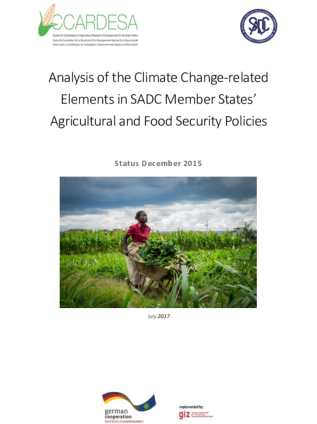
This  report  analyses  the  status  of  incorporation  of  climate  change  adaptation  and  climate-smart agriculture (CSA) measures in the SADC Member States’ agriculture and food security frameworks and policies. It  details the current situation in the SADC member states  with respect to  the existence of policies, strategies and programmes that were primarily designed to build resilience to climate change among famers.

Author or Institution as Author
Chikakula Miti and Wiebke Förch
Co-authors

Nathaniel Mtunji, Simon Mwale, Sarah Beerhalter

Language
Category
Resource Type
Citation

Miti, C. and Förch, W. and Mtunji, N. and Mwale, S. and Beerhalter, S. (2017). Analysis of the Climate Change-related Elements in SADC Member States’ Agricultural and Food Security Policies. ACCRA Policy Baseline Report.

Four Questions About Climate Smart Agriculture in Malawi

Date of Publication
Apr 01, 2014
Description/Abstract

Adapting to the negative impacts of climate change is a pressing challenge for  anyone engaged in the agricultural sector. Smallholder farmers are particularly vulnerable to these changes such as erratic weather patterns, increased water shortages, shorter growing seasons, and changes in plant and animals diseases and agricultural pests. As a result of these challenges, water availability and soil quality decline. The knowledge and skills that help farmers protect themselves against these changes are imperative. The Clinton Development Initiative(CDI) works with 25,000 smallholder farmers in Malawi to apply Climate Smart Agriculture (CSA) adaptation and mitigation techniques on their farms. We sat down with Austin Ngwira, CDI’s Director of Agriculture, to learn more about how CSA is helping improve farmers’ food security with techniques that are more resilient to climate change. Read our Q&A with Austin below.

Author or Institution as Author
Clinton Foundation
Language
Category
Resource Type

Review of Conservation Agriculture – Adaptation of Agriculture to Climate Change in Northern Namibia

Date of Publication
Nov 01, 2015
Description/Abstract

More than half of the 2.1 million people of Namibia live in the northern regions of the country. Furthermore, more than two thirds of the population depends on subsistence agriculture for their livelihood. Because Namibia's climate is already variable, and droughts are common, climate change is set to increase the already vulnerable community, of which most are women-led households.

Author or Institution as Author
Namibia
Institution
Namibia
Language
Resource Type
Citation

Namibia, 2015. Review of Conservation Agriculture – Adaptation of Agriculture to Climate Change in Northern Namibia.

FAO success stories on climate smart agriculture

Date of Publication
Nov 01, 2013
Description/Abstract

This booklet provides examples of climate-smart systems by showcasing some FAO success stories in various countries. The cases have been selected from the FAO Climate-Smart Agriculture (CSA) Sourcebook launched in 2013 to show the diversity of potential options across
different regions and agricultural systems also covering subjects such as biodiversity and gender.

Author or Institution as Author
Tanzania
Institution
Tanzania
Language
Resource Type
Citation

Tanzania, 2013.FAO success stories on climate smart agriculture.

Subscribe to English

Funding Partners