Prioritization Meetings Report. Proceedings of three national Prioritization Meetings held in Harare, Zimbabwe, Balaka, Malawi and Chipata, Zambia and Regional Synthesis Report held in Lusaka, Zambia

Type
File
Date of Publication
Aug 01, 2018
Description/Abstract

Under the project "Out-scaling climate-smart technologies to smallholder farmers in Malawi, Zambia and Zimbabwe" stakeholders aim to evaluate the impact of a changing climate on current farming systems and identify appropriate adaptation measures. This reports summarizes the process and outcomes of a two-staged process to identify and prioritize adaptation strategies designed to reduce the impact of climate change on smallholder farmers.

Meetings were held in-country (Malawi, Zambia and Zimbabwe) and in a regional workshop in Lusaka, Zambia to prioritize these technologies. With the exception of Zimbabwe, the meetings were well attended and went through a defined process to identify the technologies.

In both in-country meetings and the regional workshop the participants prioritized a range of options that were common. These were:

 Diversification (rotation and intercropping strategies)

 the use of drought-tolerant varieties

 Different forms of conservation agriculture seeding (ripping, direct seeding and basin planting)

 the use of organic manure

 Staggered planting

 Soil and water conservation

Irrigation and improved climate information services were often mentioned but the capital investments needed as well as the lack of infrastructure make this currently very challenging. This would require Governmental will to advance in the future.

The information gathered will inform the formulation of a feasibility study to be used as a base for developing a larger investment proposal for funding climate-smart agriculture in the region

Author or Institution as Author
CCARDESA
Language
Category
Resource Type
Citation

CCARDESA (2018). Prioritization Meetings Report. Proceedings of three national Prioritization Meetings held in Harare, Zimbabwe, Balaka, Malawi and Chipata, Zambia and Regional Synthesis Report held in Lusaka, Zambia.

The Climate-Smart Agriculture Papers

Date of Publication
Jan 01, 2019
Description/Abstract

This volume shares new data relating to Climate-Smart Agriculture (CSA), with emphasis on experiences in Eastern and Southern Africa. The book is a collection of research by authors from over 30 institutions, spanning the public and private sectors, with specific knowledge on agricultural development in the region discussed. The material is assembled to answer key questions on the following five topic areas: (1) Climate impacts: What are the most significant current and near future climate risks undermining smallholder livelihoods? (2) Varieties: How can climate-smart varieties be delivered quickly and cost-effectively to smallholders? (3) Farm management: What are key lessons on the contributions from soil and water management to climate risk reduction and how should interventions be prioritized?  (4) Value chains: How can climate risks to supply and value chains be reduced? and (5) Scaling up: How can most promising climate risks reduction strategies be quickly scaled up and what are critical success factors? Readers who will be interested in this book include students, policy makers, and researchers studying climate change impacts on agriculture and agricultural sustainability. 

Author or Institution as Author
Rosenstock, T.S.
Co-authors

Nowak, A., and Girvetz, E.

Institution
CCAFS
Language
Category
Resource Type
Citation

Rosenstock, T.S., Nowak, A., and Girvetz, E. (2019), The Climate-Smart Agriculture Papers: Investigating the Business of a Productive, Resilient and Low Emissions Future. Springer Open. Access: https://link.springer.com/content/pdf/10.1007%2F978-3-319-92798-5.pdf.

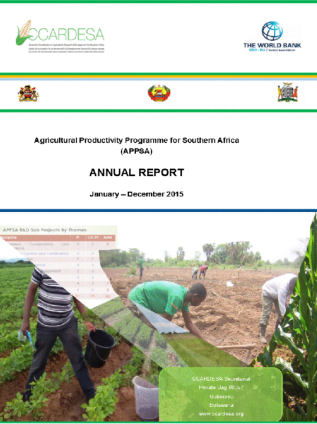
Agricultural Productivity Programme for Southern African (APPSA) 2015 Annual Report

Type
File
Date of Publication
Jan 01, 2016
Description/Abstract

The Agricultural Productivity Programme for Southern African (APPSA) is a six-year project (2013 – 2019) financed by the World Bank using a Specific Investment Loan (SIL) to the tune of US$ 90 Million. APPSA supports the objectives of the World Bank’s Africa Action Plan, which identifies regional integration as an important element to achieving higher economic growth and poverty reduction. The project’s objective is to increase the availability of improved agricultural technologies in participating countries in the SADC region through: (i) establishing Regional Centres of Leadership (RCoLs) on commodities of regional importance; (ii) supporting regional collaboration in agricultural research, technology dissemination, and training; and (iii) facilitating increased sharing of agricultural information, knowledge, and technology among participating countries. Implementation of APPSA is based on partnerships and collaborations among three participating countries (Malawi, Mozambique and Zambia). Malawi is focusing on maize- based farming systems, Mozambique on rice-based farming systems, and Zambia on food legumes-based farming systems (involving beans, cowpeas, groundnuts, pigeon peas, and soybeans). Additional countries within the SADC region are expected to join as APPSA evolves and expands

Author or Institution as Author
CCARDESA
Institution
CCARDESA
Language
Category
Resource Type
Citation

CCARDESA (2016). Agricultural Productivity Programme for Southern African (APPSA) 2015 Annual Report.

CCARDESA 1st General Assembly May 2014

Type
Date of Publication
Jan 01, 2014
Description/Abstract

In fulfillment of the Charter, CCARDESA held its first General Assembly in March 2014 in Boipuso hall, Gaborone, Botswana. The General Assembly was attended by several stakeholders which included, development partners, the Forum for Agricultural Research (FARA), other sub regional organisations namely ASARECA and CORAF and more impotently stakeholders who constitute the CCARDESA.

The General Assembly appointed Dr Mick Mwala as its first Chairman and deliberated on several issues which shape the operations of CCARDESA as a sub-regional organisation. This included the objectives of CCARDESA, its historical background, current initiatives of the organisation as well as suggestions of changes to the charter.
Main outcomes included:

  1. The election of the first chairman
  2. Approval of external auditors
  3. Approval of the CCARDESA Medium Term Operational Plan (MTOP)
  4. Nomination of new board members and
  5. The amendment of the Governance manual and the Charter estab-lishing CCARDESA
Author or Institution as Author
CCARDESA
Institution
CCARDESA
Language
Category
Resource Type
Citation

CCARDESA (2014). Centre for Coordination of Agricultural Research and Development for Southern Africa, 1st General Assembly, May 2014. Proceedings Report.

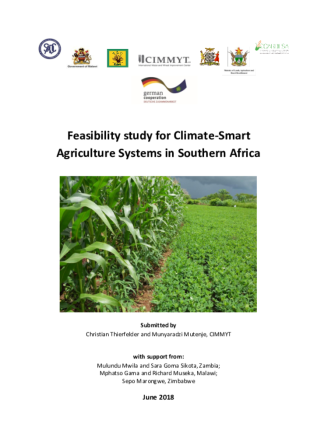
Feasibility study for Climate-Smart Agriculture Systems in Southern Africa

Type
File
Date of Publication
Jun 01, 2018
Description/Abstract

Climate variability and change is projected to increasingly affect smallholder farming systems in southern Africa and the maize value chain will particularly suffer from the late onset of and more  erratic rainfalls. Heat stress will further affect maize-based cropping systems as temperature is projected to increase by 2.1-2.7°C

Author or Institution as Author
Thierfelder, C., and Mutenje, M.
Co-authors

Mwila, M., Sikota, S.G., Gama, M., Museka, M.m and Marongwe, S.

Language
Category
Resource Type
Citation

Thierfelder,C. and Mutenje, M. (2018). Feasibility study for Climate-Smart Agriculture Systems in Southern Africa. CIMMYT.

Pilot Study - Results from on-farm trials conducted in cropping season 2017/2018

Type
File
Date of Publication
Oct 01, 2018
Description/Abstract

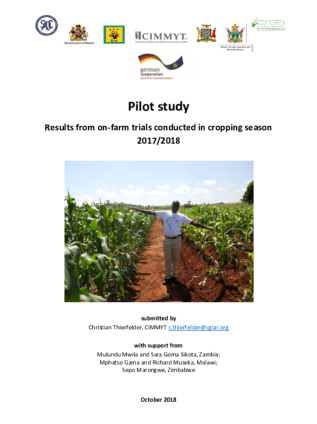
This Pilot Study is a summry to address increasing threats of climate change and declining soil fertility, a cross regional agronomic study was conducted in southern Africa, covering 19 on-farm communities in contrasting agro-ecologies ranging from around 500 mm to more than 1800mm of rainfall. The 19 on-farm communities have been under long-term research by CIMMYT and national partners in Malawi, Zambia and Zimbabwe. The aim of this study was to assess how different climate-smart agriculture technologies perform under a variable climate and to pilot new doubled-up legume systems of groundnuts with pigeonpea in 6 selected target communities.

Author or Institution as Author
Thierfelder, C
Co-authors

Mwila, M., Sikota, S.G., Gama, M., Mueska, R., and Marongw, S.

Language
Category
Resource Type
Citation

Thierfelder. C. (2018). Pilot Study - Results from on-farm trials conducted in cropping season 2017/2018. CIMMYT.

A Climate Risk Profile of Maize Value Chain Farming System in Malawi, Zambia and Zimbabwe - Vulnerability Assessment Report

Type
File
Date of Publication
Apr 01, 2018
Description/Abstract

This study examines the vulnerability to climate variability and change of the conventional maize value chain in the mid and low altitude agro-ecological zones of Malawi, agro-ecological zone II of Zambia and agro-ecological zone III of Zimbabwe. The aim is to develop feasible priorities and strategies for climate variability and change adaptation based on farmer preference. A literature review for the countries Malawi, Zambia and Zimbabwe was conducted to assess the current and future impact of climate change and variability on the smallholder farming system. A mix of methods, which included participatory vulnerability assessment tools, focus group discussions and key informant interviews among 108 farmers from five communities, complemented the literature review. Data were collected on the current and likely future impacts and sensitivity of the systems and adaptation capacities.

Author or Institution as Author
Mutenje, M.
Co-authors

Thierfelder, C., Mwila, M., Gama, M., and Marongwe, S.

Language
Category
Resource Type
Citation

Mutenje, M. (2018). A Climate Risk Profile of Maize Value Chain Farming System in Malawi, Zambia and Zimbabwe - Vulnerability Assessment Report. GIZ-ACCRA.

ACCRA Policy Baseline Report - Analysis of the Climate Change-related Elements in SADC Member States’ Agricultural and Food Security Policies

Type
File
Date of Publication
Jul 01, 2017
Description/Abstract

This  report  analyses  the  status  of  incorporation  of  climate  change  adaptation  and  climate-smart agriculture (CSA) measures in the SADC Member States’ agriculture and food security frameworks and policies. It  details the current situation in the SADC member states  with respect to  the existence of policies, strategies and programmes that were primarily designed to build resilience to climate change among famers.

Author or Institution as Author
Chikakula Miti and Wiebke Förch
Co-authors

Nathaniel Mtunji, Simon Mwale, Sarah Beerhalter

Language
Category
Resource Type
Citation

Miti, C. and Förch, W. and Mtunji, N. and Mwale, S. and Beerhalter, S. (2017). Analysis of the Climate Change-related Elements in SADC Member States’ Agricultural and Food Security Policies. ACCRA Policy Baseline Report.

Agricultural Productivity Programme for Southern Africa (APPSA) Annual Report 2017

Type
File
Date of Publication
Dec 01, 2017
Description/Abstract

This progress report describes key achievements during the project implementation period from 1 January to 31 December 2017. The project was in its 4th year of implementation.

Author or Institution as Author
CCARDESA
Institution
CCARDESA
Language
Category
Resource Type
Citation

CCARDESA, APPSA. Agricultural Productivity Programme for Southern Africa (APPSA) Annual Report 2017. (2017). p87. 

Agricultural Productivity Programme for Southern Africa (APPSA) Annual Report January-December 2016

Type
File
Date of Publication
Dec 01, 2016
Description/Abstract

In 2016, the Agricultural Productivity Programme for Southern Africa (APPSA) was in its third year of implementation in the three countries (Malawi, Mozambique and Zambia). CCARDESA provided the regional coordination role. The aim of APPSA is to strengthen and scale up regional cooperation in generation of technologies, capacity building, and knowledge sharing in food legumes, rice and maize. The project has three key components: (1) Technology Generation and Dissemination; (2) Strengthening Regional centres of Leadership; and (3) Coordination and Facilitation.

Author or Institution as Author
CCARDESA
Co-authors

The World Bank

Institution
CCARDESA
Language
Category
Resource Type
Citation

CCARDESA, APPSA. Agricultural Productivity Programme for Southern Africa (APPSA) Annual Report January-December 2016. p.46.

Subscribe to Report

Funding Partners