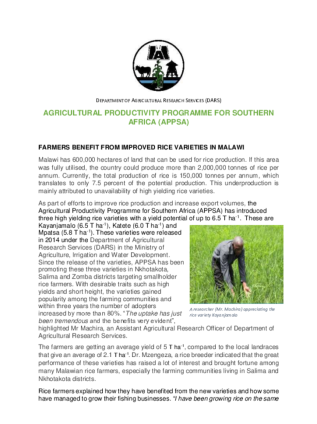
Farmers benefit from improved rice varieties in Malawi
Type
File
Date of Publication
Oct 01, 2016
Description/Abstract

This resource is an APPSA success story of introducing high yielding rice varieties in Malawi.  As part of efforts to improve rice production and increase export volumes, the Agricultural Productivity Programme for Southern Africa (APPSA) introduced
three high yielding rice varieties with a yield potential of up to 6.5 T ha-1. These are Kayanjamalo (6.5 T ha-1), Katete (6.0 T ha-1) and Mpatsa (5.8 T ha-1). These varieties were released in 2014 under the Department of Agricultural Research Services (DARS) in the Ministry of Agriculture, Irrigation and Water Development. Since the release of the varieties, APPSA has been promoting these three varieties in Nkhotakota, Salima and Zomba districts targeting smallholder rice farmers. With desirable traits such as high yields and short height, the varieties gained popularity among the farming communities and within three years the number of adopters increased by more than 80%.

Author or Institution as Author
Department of Agricultural Research Services (DARS)
Institution
CCARDESA
Language
Category
Resource Type
Citation

Mzengeza, T. 2016. Farmers benefit from improved rice varieties in Malawi, Chitedze Research Station, Malawi

Scaling up smallholder soybean productivity in Zambia

Type
File
Date of Publication
Oct 01, 2016
Description/Abstract

This is a success story produced by the Zambia Agricultural Research Institute (ZARI) under APPSA. Through partnerships with the Department of Agriculture and other players, the World Bank funded Agricultural Productivity Programme for Southern Africa (APPSA) supported smallholder farmers with necessary information and technologies to transform
the way they grow their soybean in order to increase farm yields and income. In collaboration with the Department of Agriculture under Extension Services the project mobilised lead farmers to host demonstration plots showcasing improved soybean production technologies.

Author or Institution as Author
Zambia Agriculture Research Institute (ZARI)
Institution
CCARDESA
Language
Category
Resource Type
Citation

Kapulu, N.P. 2016. Scaling up smallholder soybean productivity in Zambia, Zambia Agriculture Research Institute (ZARI)

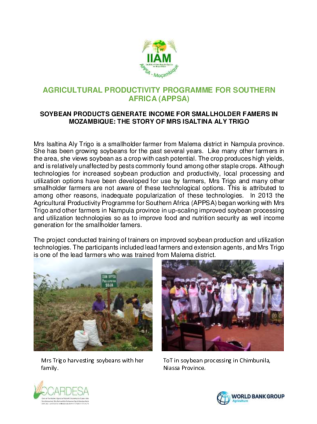
Soybean products generate income for smallholder farmers in Mozambique: the story of Mrs Isaltina Aly Trigo

Type
File
Date of Publication
Oct 01, 2016
Description/Abstract

This resource is one of the APPSA success stories for Mozambique. It narrates the story of Mrs Isaltina Aly Trigo. Mrs Trigo is a smallholder farmer from Malema district in Nampula province. She has been growing soybeans for the past several years. Like many other farmers in the area, she views soybean as a crop with cash potential. The crop produces high yields, and is relatively unaffected by pests commonly found among other staple crops. Although technologies for increased soybean production and productivity, local processing and utilization options have been developed for use by farmers, Mrs Trigo and many other smallholder farmers are not aware of these technological options. This is attributed to among other reasons, inadequate popularization of these technologies. In 2013 the Agricultural Productivity Programme for Southern Africa (APPSA) began working with Mrs Trigo and other farmers in Nampula province in up-scaling improved soybean processing and utilization technologies so as to improve food and nutrition security as well income generation for the smallholder famers. Since working with the project, Mrs Trigo has been processing her soybeans into milk and bagias. Initially, the soybean milk was just for home consumption while the bagias were for home consumption and for sale. With time, she increased the quantities of her processed products, and started selling both products.

Author or Institution as Author
IIAM
Institution
CCARDESA
Language
Category
Resource Type
Citation

Penicella, L. 2016. Soybean products generate income for smallholder farmers in Mozambique: the story of Mrs Isaltina Aly Trigo, IIAM

Use of ICT for Agriculture in GIZ projects - Status quo, opportunities and challenges

Date of Publication
Feb 01, 2016
Description/Abstract

The present study on the “Use of ICT for Agriculture in GIZ projects – Status quo, opportunities and challenges” is meant to be a practical guideline for projects and planning officers alike. It is based on an analysis of past, current and planned ICT4Ag experiences in GIZ, with special focus on extension, training and agricultural value chain development, and enriched with experiences and lessons learned by other developing organizations.

The objective of the study was to provide a general overview on the development, risks and potentials of ICT4Ag, to do a stock taking and compile a list of ongoing GIZ projects with ICT4Ag experience, to gain more insight in the current application and use of ICT solutions in GIZ agriculture programs and projects, to collect the available results and learnings ‘from the field’, and to match these with global lessons on ICT4D and ICT4Ag.

Author or Institution as Author
François Laureys
Institution
Deutsche Gesellschaft für internationale Zusammenarbeit (GIZ) GmbH
Language
Category
Resource Type
Citation

Laureys, F. 2016. Use of ICT for Agriculture in GIZ projects - Status quo, opportunities and challenges, Deutsche Gesellschaft für Internationale Zusammenarbeit (GIZ) GmbH, Bonn and Eschborn, Germany

Innovations and Emerging Trends in Agricultural Insurance

Date of Publication
Jul 01, 2016
Description/Abstract

How can we transfer natural risks out of rural livelihooods to empower and protect people?

Author or Institution as Author
Ulrich Hess
Co-authors

Peter Hazell

Institution
Deutsche Gesellschaft für interntaionale Zusammenarbeit (GIZ) GmbH
Language
Category
Resource Type
Citation

Hess, U. and Hazell, P. 2016. Innovations and Emerging Trends in Agricultural Insurance, Deutsche Gesellschaft für interntaionale Zusammenarbeit (GIZ) GmbH, Bonn and Eschborn, Germany

Bonnes pratiques de conservation des eaux et des sols

Date of Publication
Jun 01, 2012
Description/Abstract

Contribution à l’adaptation au changement climatique et à la résilience des producteurs au Sahel

Author or Institution as Author
Sabine Dorlöchter-Sulser
Co-authors

Dr. Dieter Nill

Institution
Deutsche Gesellschaft für internationale Zusammenarbeit (GIZ) GmbH
Language
Category
Resource Type
Citation

Dorlöchter-Sulser, S. and Nill, D. 2012. Bonnes pratiques de conservation des eaux et des sols, Deutsche Gesellschaft für internationale Zusammenarbeit (GIZ) GmbH, Bonn and Eschborn, Germany

34 indigenous crops promoting health and feeding the world

Date of Publication
Oct 01, 2018
Description/Abstract

Food Tank has compiled a list of indigenous fruits, vegetables, and grains from many regions that are nutritious, delicious, and contribute to sustainable livelihoods in rural communities across the globe.

Every day, plant species across the globe are disappearing. The U.N. Food and Agriculture Organization (FAO) reports that approximately 75 percent of the Earth’s plant genetic resources are now extinct, and another third of plant biodiversity is expected to disappear by 2050. Up to 100,000 plant varieties are currently endangered worldwide.

Unfortunately, most investments in agriculture are for crops such as wheat, rice, and maize, rather than for more nutritious foods or indigenous crops—and this focus has had devastating consequences. Global obesity rates have doubled over the last 30 years, increasing the risk of diet-related illnesses including diabetes, hypertension, and heart disease in industrialized and developing countries alike.

Many indigenous crops are environmentally sustainable, improve food security, help prevent malnutrition, and increase farmer incomes. Initiatives like the World Vegetable Center (AVRDC)’s Vegetable Genetic Resources System and Slow Food International’s Ark of Taste are working to catalog indigenous species of fruits and vegetables all over the world.

Food Tank has compiled a list of indigenous fruits, vegetables, and grains from many regions that are nutritious, delicious, and contribute to sustainable livelihoods in rural communities across the globe.

Author or Institution as Author
other
Co-authors

Food Tank

Language
Category
Resource Type

Good Practices in Soil and Water Conservation

Date of Publication
Jul 01, 2012
Description/Abstract

A contribution to adaptation and farmers´ resilience towards climate change in the Sahel

Author or Institution as Author
Sabine Dorlöchter-Sulser
Co-authors

Dr. Dieter Nill

Institution
Deutsche Gesellschaft für internationale Zusammenarbeit (GIZ) GmbH
Language
Category
Resource Type
Citation

Dorlöchter-Sulser, S. and Nill, D. 2012. Good Practices in Soil and Water Conservation, Deutsche Gesellschaft für internationale Zusammenarbeit (GIZ) GmbH, Bonn and Eschborn, Germany

Potentials for Greenhouse Gas Mitigation in Agriculture

Date of Publication
Mar 01, 2014
Description/Abstract

Review of research findings, options for mitigation and recommendations for development cooperation

Author or Institution as Author
Birgit Kundermann
Institution
Federal Ministry for Economic Cooperation and Development (BMZ), Division Rural development; agriculture; food security
Language
Category
Resource Type
Citation

Kundermann, B. 2014. Potentials for Greenhouse Gas Mitigation in Agriculture, Deutsche Gesellschaft für internationale Zusammenarbeit (GIZ) GmbH, Bonn and Eschborn, Germany

Edging Towards a Tipping Point? An Appraisal of the Evolution of Livelihoods under Climate Change in Semi-Arid Matobo, Zimbabwe

Date of Publication
Oct 01, 2014
Description/Abstract

his paper contributes to emerging research on the impacts of climate change on communities in the Global South by mapping and analyzing its impacts on rural livelihoods in semi-arid Matobo District in Zimbabwe. It investigates the possibilities and scope for climate change adaptation in this region as communal households adjust and diversify their livelihood portfolios. In so doing, it finds that climate change has had remarkable consequences on the livelihoods of people in this semi-arid area. It has altered the ecosystem leading to the disappearance of certain plant and insect species that were an essential part of the local natural habitat and livelihoods of local people. Rainfall patterns have also become unpredictable leading to erratic, mostly, poor farming seasons with direct implications on the local food system and rural economy. In response to these climate change induced impacts, a variety of new livelihood strategies are emerging as households seek to cushion themselves against this threat to their sustainability. However, a pertinent question is: how far can these adaptation strategies evolve under the increasing pressure of climate change impacts? In other words, are these communal households urging towards tipping points?

Author or Institution as Author
Philani Moyo
Co-authors

Thulani Dube

Institution
University of Zimbabwe
Language
Category
Resource Type
Citation

Moyo, P. and Dube, T. (2014), “Edging towards a tipping point? An appraisal of the evolution of livelihoods under climate change in semi-arid Matobo, Zimbabwe”, International Journal of Development and Sustainability, Vol. 3 No. 6, pp. 1340-1353.

Subscribe to Case Study

Funding Partners